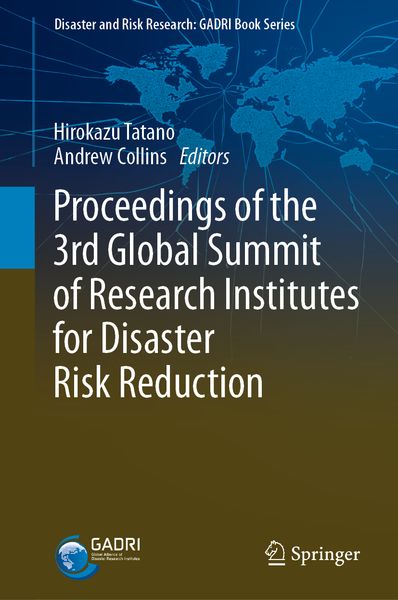
Produktbild: Proceedings of the 3rd Global Summit of Research Institutes for Disaster Risk Reduction

Proceedings of the 3rd Global Summit of Research Institutes for Disaster Risk Reduction

155,99 €

inkl. gesetzl. MwSt., Versandkostenfrei


Beschreibung

Produktdetails

Einband

Gebundene Ausgabe

Erscheinungsdatum

12.01.2021

Herausgeber

Hirokazu Tatano + weitere

Verlag

Springer Singapore

Seitenzahl

250

Maße (L/B/H)

24,1/16/2 cm

Auflage

1st ed. 2021

Sprache

Englisch

ISBN

978-981-15-8661-3

Beschreibung

Portrait

Prof. Hirokazu Tatano is the Research Division Head of Disaster Management for Safe and Secure Society, the Disaster Prevention Research Institute (DPRI), Kyoto University. In addition to his responsibilities as a Professor at the DPRI, he has served as Vice President of the International Society of Integrated Disaster Risk Management (IDRiM Society) since 2010, and as Secretary General of the Global Alliance of Disaster Research Institutes (GADRI) since 2015. He has pursued pioneering research on economic consequence analysis with a major focus on economic resilience to natural disasters at the levels of individual businesses, markets, and regional economies. Another research focus is on methodologies for integrated disaster risk management and governance. Through these academic activities, he hopes to help establish “implementation science” as a key area of science for disaster risk reduction.

Prof. Andrew Collins is a leader of the Disaster and Development Network and a Professor of Disaster and Development, Department of Geography, Northumbria University, UK. Beyond his research, local teaching and management responsibilities, he represents disaster, development and health-related initiatives internationally. He led the establishment of the world’s first disaster management and sustainable development postgraduate programme, launched in 2000, and the Disaster and Development Network (DDN), launched in 2004. Prior to his academic appointments, Andrew also worked internationally, including three years of voluntary support to communities in wartime Mozambique. He is currently engaged in high-level policy and advisory work, serves on the reviewing and commissioning boards for national and international organisations and multiple journals, and is involved with 13 research funding bodies.

Produktdetails

Einband

Gebundene Ausgabe

Erscheinungsdatum

12.01.2021

Herausgeber

Verlag

Springer Singapore

Seitenzahl

250

Maße (L/B/H)

24,1/16/2 cm

Auflage

1st ed. 2021

Sprache

Englisch

ISBN

978-981-15-8661-3

Herstelleradresse

Springer-Verlag KG
Sachsenplatz 4-6
1201 Wien
AT

Email: GPSR Kontakt

Noch keine Bewertungen vorhanden

Verfassen Sie die erste Bewertung zu diesem Artikel

Helfen Sie anderen Kundinnen und Kunden durch Ihre Meinung.

Kundinnen und Kunden meinen

Bewertungen (0)

  • Produktbild: Proceedings of the 3rd Global Summit of Research Institutes for Disaster Risk Reduction
  • Part 1: Overiview of the 3rd Global Summit of Research Institutes for Disaster Risk Reduction.- Chapter 1. Summary report  of the 3rd Global Summit of Research Institutes for Disaster Risk Reduction: Expanding the Platform for Bridging Science and Policy Making (GSRIDRR 2017) held at the Disaster Prevention Research Institute (DPRI), Kyoto University, Kyoto, Japan from 19th to 21st of March 2017.- Chapter 2. Evaluating Current Research Status and Identifying Most Important Future Research Themes.- Part 2: Selected Papers from Keynote Speeches.- Chapter 3. Regional Science Engineering Technology and Innovation (SETI) Support for Disaster Risk Reduction.- Chapter 4. Science and technology commitment to the implementation of the Sendai Framework for Disaster Risk Reduction 2015-2030.- Chapter 5. Practical Point of View from Donors: “What we expect from science and technology group” – Application to Developing Countries.- Chapter 6. Knowledge to Sustainable Practices: International Network for Transdisciplinary Education (INATE) Approach.- Chapter 7. Disaster Risk Management Knowledge Centre: a new European Initiative to Bridge Science and Policy.- Part 3: Selected Papers from Presentations (arranged in country alphabetical order).- Chapter 8. International Federation for Information Processing and its Domain Committee on Information Technology in Disaster Risk Reduction.- Chapter 9. Research Capacity in Disaster Risk Reduction – an Indian Perspective.- Chapter 10. Participatory Flood Risk Mapping - How Participatory is It?.- Chapter 11. Grant for Global Sustainability Project: Enhancing the Urban Disaster Resilience of Kathmandu and Yangon through Local Participatory Platform Activities.- Chapter 12. Seismic Vulnerability Assessment of Existing RC Buildings in Ranau, Sabah Malaysia.- Chapter 13. Large Landslides in México in the Past 10 Years.- Chapter 14. Disaster Risk Reduction (DRR) and Management under a Changing Climate: Bridging the Divide through IntegratedCoastal Management (ICM) towards Sustainable Development.- Chapter 15. Landslide Disaster Management in Sri Lanka.- Chapter 16. Framework to Promote Multi-disciplinary Culture of Landslide Studies and Management.- Chapter 17. Disaster Resilient Infrastructure.- Chapter 18. Drought Disaster in the Central Highlands of Vietnam: Relationship Between Land-use Change and Drought’s Impact.