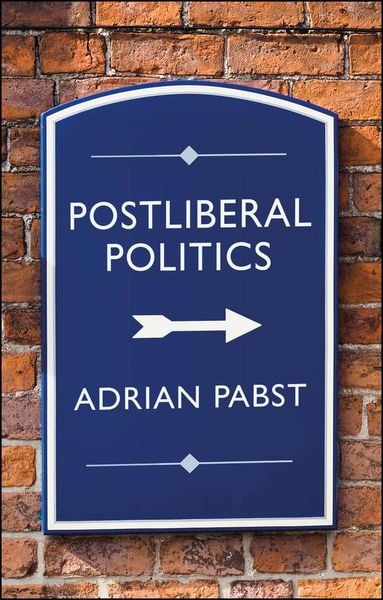
Rezension
"As the neoliberal consensus that provided the public philosophy of the post-Cold War West shatters, demagogic populism and authoritarianism threaten to take its place. Rejecting these dangerous alternatives, Adrian Pabst makes a persuasive case for rebuilding democracy on a foundation of strong communities."
Michael Lind, author of The New Class War: Saving Democracy from the Metropolitan Elite
"All thinking people realize that western liberal societies face dilemmas they have been unable to resolve, but until now there has been no constructive account of what a post-liberal social order would look like. Adran Pabst's brilliant short book fills that gap. Fully recognizing the irreplaceable achievements of liberalism, he argues compellingly that they are endangered by an excessively individualist understanding of human well being. By showing what this means in a wide variety of fields, he has given us a book that advances understanding of the most fundamental issues of our time."
John Gray, author and philosopher
"Adrian Pabst is one of our most interesting political thinkers - and this wise, compelling book provides not only a penetrating analysis of the crisis of liberalism but something much more valuable: a road map for a transformative politics. It should be essential reading for Keir Starmer - and indeed Boris Johnson."
Jason Cowley, Editor of the New Statesman
"A common critique of 'post-liberal' writing is that it's stronger on critique than on vision. In the erudite but highly readable Postliberal Politics, Adrian Pabst seeks to remedy that shortcoming. Pabst draws on classical and Christian thinking to synthesise a vision for healthy public life after liberalism, that's neither narrowly nationalistic nor inhumanly globalised but ordered by solidarity both at local and international levels, and with our natural world. Readers on both Left and Right will find much in this timely book to challenge political preconceptions, and also to enrich and re-humanise an urgent political debate."
Mary Harrington, UnHerd columnist
"By starting with the inescapability of limits and the common ground between liberal and authoritarian high-tech capitalism, Pabst succeeds with some flair in injecting political and intellectual substance into the idea of post-liberalism."
Helen Thompson, University of Cambridge
"Within an impressive body of work this is Adrian Pabst's most political contribution to date. His ambition is to rethink the terms of what is known as postliberalism and anchor contemporary debate within certain distinct ethical traditions. He succeeds and in so doing performs the essential - and long overdue - task of reclaiming postliberalism from the right. This is a vital contribution to any renewed public philosophy for the left. After four defeats in just over a decade, here are the foundations of a coherent domestic and foreign policy reset for Labour."
Jon Cruddas, Labour MP for Dagenham and Rainham and author of The Dignity of Labour
"Adrian Pabst is one of the most original and insightful thinkers writing about politics today. In this book he examines the challenges which technological change, environmental degradation and unaccountable power pose to human flourishing. You don't need to agree with his prescriptions to admire the power of his diagnosis - this work is essential reading for all concerned with our current discontents."
Michael Gove, Chancellor of the Duchy of Lancaster
"A compelling case for a new politics based on the things that matter: families, places, traditions, relationships. This is the proper ground of political dispute - right and left should be fighting to represent the communitarian idea. Dr Pabst has mapped the emerging post-liberal landscape with skill and passion. A vital book for the 2020s."
Danny Kruger, Conservative MP for Devizes
"Probably the word 'liberal' should never have been a noun but left as an adjective, describing an ethos of fairness and generosity. As a noun it has come to be attached to a messy, incoherent bundle of positions, as chaotic as the opportunist and value-free capitalism whose ally it so often is. This incisive and intelligent book exposes with brilliant clarity the failures of our current political culture, and outlines where we should look for a political future that - for a change - has something to do with the heart of human identity and human desire. It obliges us to ask seriously what we have learned about this in the collective trauma of the last year."
Rowan Williams, Former Archbishop of Canterbury
"A quite brilliant book"
New Statesman