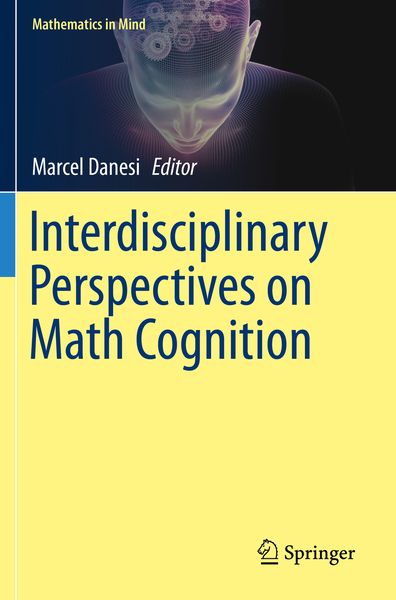
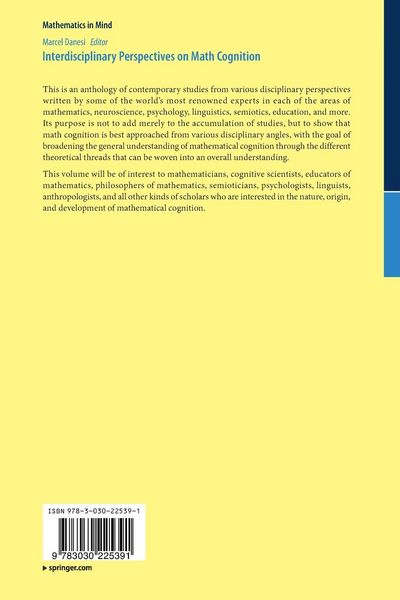
• Produktbild: Interdisciplinary Perspectives on Math Cognition
  • Produktbild: Interdisciplinary Perspectives on Math Cognition

Interdisciplinary Perspectives on Math Cognition

Aus der Reihe Mathematics in Mind

106,99 €

inkl. gesetzl. MwSt., Versandkostenfrei


Beschreibung

Produktdetails

Einband

Taschenbuch

Erscheinungsdatum

25.09.2020

Herausgeber

Marcel Danesi

Verlag

Springer

Seitenzahl

344

Maße (L/B/H)

23,5/15,5/2 cm

Gewicht

534 g

Auflage

1st ed. 2019

Sprache

Englisch

ISBN

978-3-030-22539-1

Beschreibung

Rezension

“The book is dense with very well rounded research that provides the reader with a deep understanding of each body of research. I highly recommend this book for those interested in how math cognition works and to have new, insightful takeaways for additional research of your own making.” (Peter Olszewski, MAA Reviews, January 4, 2020)

Produktdetails

Einband

Taschenbuch

Erscheinungsdatum

25.09.2020

Herausgeber

Marcel Danesi

Verlag

Springer

Seitenzahl

344

Maße (L/B/H)

23,5/15,5/2 cm

Gewicht

534 g

Auflage

1st ed. 2019

Sprache

Englisch

ISBN

978-3-030-22539-1

Herstelleradresse

Springer-Verlag KG
Sachsenplatz 4-6
1201 Wien
AT

Email: GPSR Kontakt

Noch keine Bewertungen vorhanden

Verfassen Sie die erste Bewertung zu diesem Artikel

Helfen Sie anderen Kundinnen und Kunden durch Ihre Meinung.

Kundinnen und Kunden meinen

Bewertungen (0)

  • Produktbild: Interdisciplinary Perspectives on Math Cognition
  • Produktbild: Interdisciplinary Perspectives on Math Cognition
  • 1. From Biological Brain to Mathematical Mind: The Long-Term Evolution of Mathematical Thinking (D. Tall).- 2. Compression and Decompression in Mathematics (M. Turner).- 3. How Technology Has Changed What It Means to Think Mathematically (K. Devlin).- 4. Machine vs. Structure of Language Via Statistical Universals (K. Tanaka-Ishii).- 5. Number Work: Recovering the Original Complexity of Learning Arithmetic (B. Davis).- 6. The Body of/in Proof: An Embodied Analysis of Mathematical Reasoning (L. Edwards).- 7. Math Puzzles and Learning Devices (M. Danesi).- 8. Diagrams in Mathematics: On Visual Experience in Peirce (V. Kiryushchenko).- 9. Laws of Form, Peirce and Cantor (L. Kauffman).- 10. The Topology of Mathematics in the Mind and its Interaction with Verbal and Written Language (R.K. Logan, I.P. Oldenhoff).- 11. Mathematical Fiction as an Interdisciplinary Source for Mathematics Courses: Resources and Recommendations (F. Nuessel).- 12. Science, Magic, and the In-Between: Whence Logic (I. Semetsky).- 13. Geometric Cognition (W. Whiteley).- 14. Using Evidence to Close the Achievement Gap in Math (J. Mighton).- 15. Knowledge Building, Mathematics and Creative Thinking: An Overview on Ontario Elementary Mathematical Teaching Beyond 21st Century Skills (S. Costa).- 16. Crypto-Mathematics in Ethnography: Estimation and Approximation via Ballparks adn Eyeballing (M. Anderson).- 17. A Mathematician, A Physicist and an Engineer: The Meaning of "M" in Stem (D. Martinovic).- 18. Why a Duck? A Three-Part Essay on the Mathematics of Cognition (Y. Neuman).- 19. On Mathematical Ways of Knowing: Ramblings of a Humanistic Mathematician (G. Karaali).- 20. Epilogue: So What is Math Cognition? (M. Danesi).