Gutscheinbedingungen

Gültig bis 19.08.2026 | Gültig für Spielzeug, Filme, Musik, Software, Games, Elektronik, Geschenke & Trends, Schreibwaren, Hörbücher und Hörbuch-Downloads (außer Abo & Shelfies), gebrauchte Bücher, nicht preisgebundene Bücher und Kalender | Einlösbar unter osiander.de und in der Osiander App | Click & Collect nur mit Online-Zahlung (Paypal/Kreditkarte) vorab | Einzelne Artikel können ausgeschlossen sein | Nicht kombinierbar mit anderen Gutscheinen oder Preisaktionen | Nur einmal pro Einkauf einlösbar | Gutschein wird auf max. 500€ Bestellwert angerechnet | Keine Barauszahlung | Digitale Hörbücher nur für Android  | Nicht gültig für preisgebundene Artikel (aufgrund der Buchpreisbindung sind Gutscheine nicht auf Bücher, eBooks, Presse einlösbar), tolino eReader & Zubehör, Abonnements & Flatrates, Geschenkkarten, Versandkosten und Services

  • Produktbild: Salt Stress, Microbes, and Plant Interactions: Mechanisms and Molecular Approaches
  • Produktbild: Salt Stress, Microbes, and Plant Interactions: Mechanisms and Molecular Approaches
- 10%

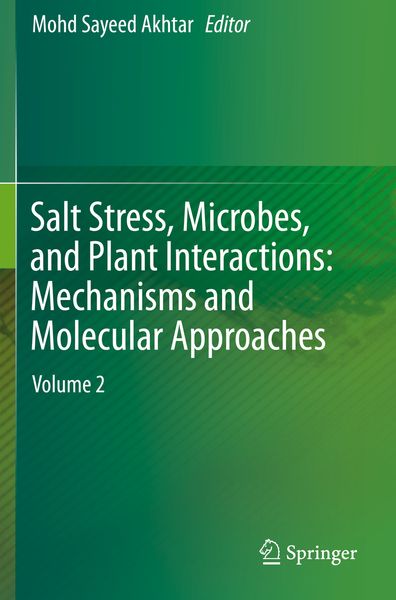
Salt Stress, Microbes, and Plant Interactions: Mechanisms and Molecular Approaches Volume 2

10% sparen

143,99 € UVP 160,49 €

inkl. gesetzl. MwSt., Versandkostenfrei


Beschreibung

Produktdetails

Einband

Taschenbuch

Erscheinungsdatum

04.11.2020

Herausgeber

Mohd Sayeed Akhtar

Verlag

Springer Singapore

Seitenzahl

300

Maße (L/B/H)

23,5/15,5/1,8 cm

Auflage

1st ed. 2019

Sprache

Englisch

ISBN

978-981-13-8807-1

Beschreibung

Portrait

Dr. Mohd Sayeed Akhtar (PhD) is working as an Assistant Professor in Gandhi Faiz-e-Aam College, Shahjahanpur, U.P., India. He has received his PhD degree from Aligarh Muslim University (AMU), India in 2008, prior to conducting post-doctoral research at the Botanical Institute, University of Basel (BIB), Switzerland (2008–2010), and Chonbuk National University (CBNU), Republic of Korea in 2011. He was an Assistant Professor, Jimma University, Ethiopia (2011-2014), and a fellow researcher at the Institute of Tropical Agriculture, Universiti Putra Malaysia (UPM), (2014-2015). Dr. Akhtar has more than 15 years of research, and 10 years of teaching experience in soil microbiology, applied microbiology, environmental microbiology, molecular biology, plant pathology and plant nanobiotechnology. He is author and co-author of more than hundred articles in peer-reviewed journals, conference proceedings, and book chapters, and has edited 12 books with international publishers. He is serving the scientific community as editorial board member and reviewer of several high-impact international journals. His current research is focused on the rhizospheric plant-microbe interactions and their molecular biotechnology, bioremediation, biomineralization, nano-fertilizers and nanobiotechnology.

Produktdetails

Einband

Taschenbuch

Erscheinungsdatum

04.11.2020

Herausgeber

Mohd Sayeed Akhtar

Verlag

Springer Singapore

Seitenzahl

300

Maße (L/B/H)

23,5/15,5/1,8 cm

Auflage

1st ed. 2019

Sprache

Englisch

ISBN

978-981-13-8807-1

Herstelleradresse

Springer-Verlag KG
Sachsenplatz 4-6
1201 Wien
AT

Email: GPSR Kontakt

Noch keine Bewertungen vorhanden

Verfassen Sie die erste Bewertung zu diesem Artikel

Helfen Sie anderen Kundinnen und Kunden durch Ihre Meinung.

Kundinnen und Kunden meinen

Bewertungen (0)

  • Produktbild: Salt Stress, Microbes, and Plant Interactions: Mechanisms and Molecular Approaches
  • Produktbild: Salt Stress, Microbes, and Plant Interactions: Mechanisms and Molecular Approaches
  • Chapter 1. Microbial management of crop salinity stress: mechanisms, applications and prospects.- Chapter  2. Adaptive Mechanisms of Plants Against Salt Stress and Salt Shock.- Chapter 3. Molecular approaches and salt tolerance mechanisms in leguminous plants.- Chapter 4. Crop improvement through microbial biotechnology: A Crosstalk.- Chapter 5. Role of Phytohormones in Recuperating Salt Stress.- Chapter 6. An enigma in the genetic responses of plants to salt stresses.- Chapter 7. Application of microbial biotechnology in improving Salt stress and crop productivity.- Chapter 8. Consequences of bioinoculants and intercropping approach to alleviate plant drought and salinity stress for sustainable agriculture.- Chapter 9. Role of Signaling Pathways in Improving Salt Stress in Plants.- Chapter 10. Mechanisms and Molecular Approaches for Salt Tolerance Enhancement.- Chapter 11. Crops and Methods to Control Soil Salinity.- Chapter 12. Ameliorating plants salt stress through bacterial inoculation: Prospects and Challenges.- Chapter 13. Proline accumulation and oxidative stress: Diverse roles and mechanism of tolerance and adaptation under salinity stress.