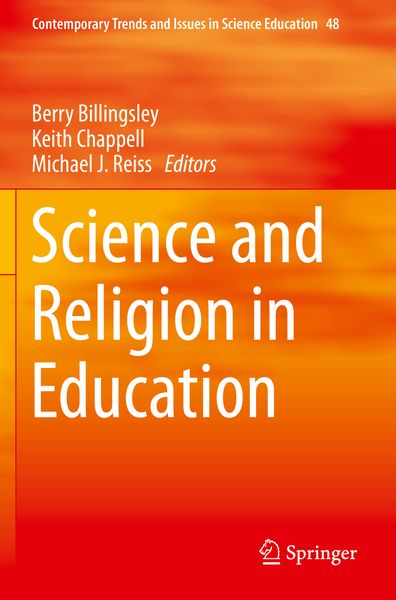
Science and Religion in Education
-
- Hardcover
- Taschenbuch ausgewählt
- eBook
-
Sprache:Englisch
97,99 €
inkl. gesetzl. MwSt.,
Beschreibung
Produktdetails
Einband
Taschenbuch
Erscheinungsdatum
14.11.2020
Herausgeber
Berry Billingsley + weitereVerlag
SpringerSeitenzahl
353
Maße (L/B/H)
23,5/15,5/2 cm
Gewicht
557 g
Auflage
1st ed. 2019
Sprache
Englisch
ISBN
978-3-030-17236-7
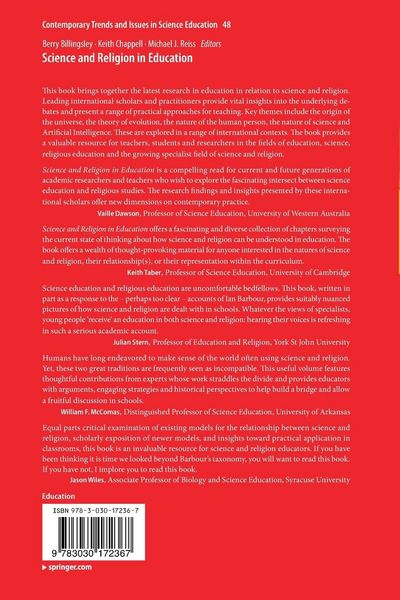
This book brings together the latest research in education in relation to science and religion. Leading international scholars and practitioners provide vital insights into the underlying debates and present a range of practical approaches for teaching. Key themes include the origin of the universe, the theory of evolution, the nature of the human person, the nature of science and Artificial Intelligence. These are explored in a range of international contexts. The book provides a valuable resource for teachers, students and researchers in the fields of education, science, religious education and the growing specialist field of science and religion.
Science and Religion in Education is a compelling read for current and future generations of academic researchers and teachers who wish to explore the fascinating intersect between science education and religious studies. The research findings and insights presented by these international scholars offer new dimensions on contemporary practice.
- Vaille Dawson, Professor of Science Education, University of Western Australia
Science and Religion in Education offers a fascinating and diverse collection of chapters surveying the current state of thinking about how science and religion can be understood in education. The book offers a wealth of thought-provoking material for anyone interested in the natures of science and religion, their relationship(s), or their representation within the curriculum.
- Professor Keith Taber, University of Cambridge
Science education and religious education are uncomfortable bedfellows. This book, written in part as a response to the – perhaps too clear – accounts of Ian Barbour, provides suitably nuanced pictures of how science and religion are dealt with in schools. Whatever the views of specialists, young people ‘receive’ an education in both science and religion: hearing their voices is refreshing in such a serious academic account.
-Julian Stern, Professor of Education and Religion, York St John University
Humans have long endeavored to make sense of the world often using science and religion. Yet, these two great traditions are frequently seen as incompatible. This useful volume features thoughtful contributions from experts whose work straddles the divide and provides educators with arguments, engaging strategies and historical perspectives to help build a bridge and allow a fruitful discussion in schools.- William F. McComas, Distinguished Professor of Science Education, University of Arkansas
Equal parts critical examination of existing models for the relationship between science and religion, scholarly exposition of newer models, and insights toward practical application in classrooms, this book is an invaluable resource for science and religion educators. If you have been thinking it is time we looked beyond Barbour’s taxonomy, you will want to read this book. If you havenot, I implore you to read this book.
- Jason Wiles, Associate Professor of Biology and Science Education, Syracuse University
Noch keine Bewertungen vorhanden
Verfassen Sie die erste Bewertung zu diesem Artikel
Helfen Sie anderen Kundinnen und Kunden durch Ihre Meinung.
Kurze Frage zu unserer Seite
Vielen Dank für Ihr Feedback
Wir nutzen Ihr Feedback, um unsere Produktseiten zu verbessern. Bitte haben Sie Verständnis, dass wir Ihnen keine Rückmeldung geben können. Falls Sie Kontakt mit uns aufnehmen möchten, können Sie sich aber gerne an unseren Kund*innenservice wenden.
zum Kundenservice