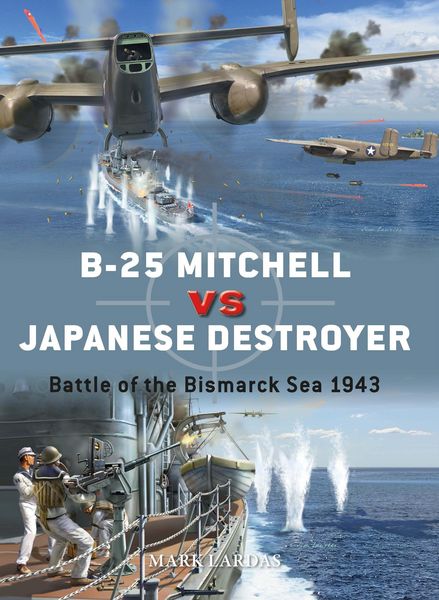
B-25 Mitchell vs Japanese Destroyer Battle of the Bismarck Sea 1943
-
- Taschenbuch ausgewählt
- eBook
-
Sprache:Englisch
17,99 €
inkl. gesetzl. MwSt.,
Beschreibung
Produktdetails
Einband
Taschenbuch
Erscheinungsdatum
23.12.2021
Abbildungen
Colour illustrations throughout, including profiles, technical drawings, battlescene artworks, maps and photographs.
Illustriert von
Jim Laurier
Verlag
Bloomsbury AcademicSeitenzahl
80
Maße (L/B/H)
24,5/18,2/0,4 cm
Gewicht
264 g
Sprache
Englisch
ISBN
978-1-4728-4517-7
The Battle of the Bismarck Sea was one of the most decisive naval battles of World War II and this highly illustrated study details the three-day fight which shaped the outcome of the war.
Throughout the first year of the war in the Pacific during World War II the USAAF was relatively ineffective against ships. Indeed, warships in particular proved to be too elusive for conventional medium-level bombing. High-level attacks wasted bombs, and torpedo attacks required extensive training. But as 1942 closed, the Fifth Air Force developed new weapons and new tactics that were not just effective, they were deadly. A maintenance officer assigned to a B-25 unit found a way to fill the bombardier's position with four 0.50-cal machine guns and strap an additional four 0.50s to the sides of the bomber, firing forward. Additionally, skip-bombing was developed. This called for mast-top height approaches flying the length of the target ship. If the bombs missed the target, they exploded in the water close enough to crush the sides. The technique worked perfectly when paired with "strafe" B-25s.
Over the first two months of 1943, squadrons perfected these tactics. Then, in early March, Japan tried to reinforce their garrison in Lae, New Guinea, with a 16-ship convoy - eight transports guarded by eight destroyers. The Fifth Air Force pounced on the convoy in the Bismarck Sea. By March 5 all eight transports and four destroyers had been sunk.
This volume examines the mechanics of skip-bombing combined with a strafing B-25, assessing the strengths and weaknesses of the combatants (B-25 versus destroyer), and revealing the results of the attacks and the reasons why these USAAF tactics were so successful.
Kundinnen und Kunden meinen
Verfassen Sie die erste Bewertung zu diesem Artikel
Helfen Sie anderen Kund*innen durch Ihre Meinung
Kurze Frage zu unserer Seite
Vielen Dank für Ihr Feedback
Wir nutzen Ihr Feedback, um unsere Produktseiten zu verbessern. Bitte haben Sie Verständnis, dass wir Ihnen keine Rückmeldung geben können. Falls Sie Kontakt mit uns aufnehmen möchten, können Sie sich aber gerne an unseren Kund*innenservice wenden.
zum Kundenservice