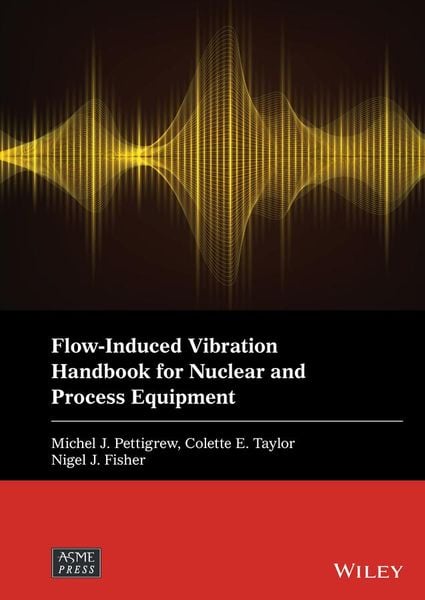
Flow-Induced Vibration Handbook for Nuclear and Process Equipment
168,99 €
inkl. gesetzl. MwSt.,
Beschreibung
Produktdetails
Einband
Gebundene Ausgabe
Erscheinungsdatum
09.12.2021
Herausgeber
Michel J. Pettigrew + weitereVerlag
John Wiley & Sons IncSeitenzahl
496
Maße (L/B/H)
26,2/18,8/3,3 cm
Gewicht
1157 g
Auflage
1. Auflage
Sprache
Englisch
ISBN
978-1-119-81096-4
Fatigue or fretting-wear damage in process and plant equipment caused by flow-induced vibration can lead to operational disruptions, lost production, and expensive repairs. Mechanical engineers can help prevent or mitigate these problems during the design phase of high capital cost plants such as nuclear power stations and petroleum refineries by performing thorough flow-induced vibration analysis. Accordingly, it is critical for mechanical engineers to have a firm understanding of the dynamic parameters and the vibration excitation mechanisms that govern flow-induced vibration.
Flow-Induced Vibration Handbook for Nuclear and Process Equipment provides the knowledge required to prevent failures due to flow-induced vibration at the design stage. The product of more than 40 years of research and development at the Canadian Nuclear Laboratories, this authoritative reference covers all relevant aspects of flow-induced vibration technology, including vibration failures, flow velocity analysis, vibration excitation mechanisms, fluidelastic instability, periodic wake shedding, acoustic resonance, random turbulence, damping mechanisms, and fretting-wear predictions. Each in-depth chapter contains the latest available lab data, a parametric analysis, design guidelines, sample calculations, and a brief review of modelling and theoretical considerations. Written by a group of leading experts in the field, this comprehensive single-volume resource:
* Helps readers understand and apply techniques for preventing fatigue and fretting-wear damage due to flow-induced vibration at the design stage
* Covers components including nuclear reactor internals, nuclear fuels, piping systems, and various types of heat exchangers
* Features examples of vibration-related failures caused by fatigue or fretting-wear in nuclear and process equipment
* Includes a detailed overview of state-of-the-art flow-induced vibration technology with an emphasis on two-phase flow-induced vibration
Covering all relevant aspects of flow-induced vibration technology, Flow-Induced Vibration Handbook for Nuclear and Process Equipment is required reading for professional mechanical engineers and researchers working in the nuclear, petrochemical, aerospace, and process industries, as well as graduate students in mechanical engineering courses on flow-induced vibration.
Noch keine Bewertungen vorhanden
Verfassen Sie die erste Bewertung zu diesem Artikel
Helfen Sie anderen Kundinnen und Kunden durch Ihre Meinung.
Kurze Frage zu unserer Seite
Vielen Dank für Ihr Feedback
Wir nutzen Ihr Feedback, um unsere Produktseiten zu verbessern. Bitte haben Sie Verständnis, dass wir Ihnen keine Rückmeldung geben können. Falls Sie Kontakt mit uns aufnehmen möchten, können Sie sich aber gerne an unseren Kund*innenservice wenden.
zum Kundenservice