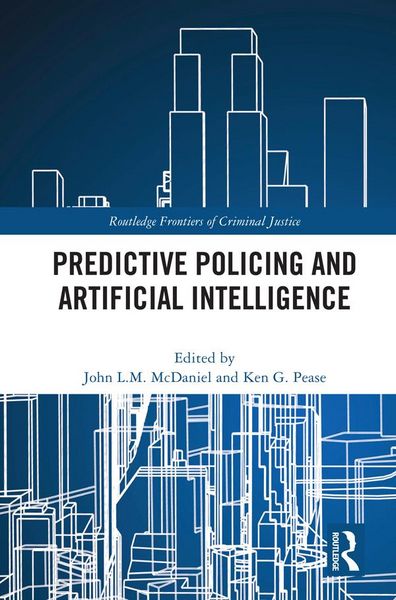
Predictive Policing and Artificial Intelligence
-
- Hardcover
- Taschenbuch
- eBook ausgewählt
-
Form:Einzelkauf Download
-
Sprache:Englisch
-
eBook Format:PDF
- ePUB 3 59,99 €
- PDF 59,99 € ausgewählt
59,99 €
inkl. gesetzl. MwSt.Beschreibung
Produktdetails
Format
Kopierschutz
Ja
Family Sharing
Nein
Text-to-Speech
Nein
Erscheinungsdatum
25.02.2021
Herausgeber
John McDaniel + weitereVerlag
Taylor & Francis eBooksSeitenzahl
330 (Printausgabe)
Auflage
1. Auflage
Sprache
Englisch
EAN
9780429555916
This edited text draws together the insights of numerous worldwide eminent academics to evaluate the condition of predictive policing and artificial intelligence (AI) as interlocked policy areas. Predictive and AI technologies are growing in prominence and at an unprecedented rate. Powerful digital crime mapping tools are being used to identify crime hotspots in real-time, as pattern-matching and search algorithms are sorting through huge police databases populated by growing volumes of data in an eff ort to identify people liable to experience (or commit) crime, places likely to host it, and variables associated with its solvability. Facial and vehicle recognition cameras are locating criminals as they move, while police services develop strategies informed by machine learning and other kinds of predictive analytics. Many of these innovations are features of modern policing in the UK, the US and Australia, among other jurisdictions.
AI promises to reduce unnecessary labour, speed up various forms of police work, encourage police forces to more efficiently apportion their resources, and enable police officers to prevent crime and protect people from a variety of future harms. However, the promises of predictive and AI technologies and innovations do not always match reality. They often have significant weaknesses, come at a considerable cost and require challenging trade- off s to be made. Focusing on the UK, the US and Australia, this book explores themes of choice architecture, decision- making, human rights, accountability and the rule of law, as well as future uses of AI and predictive technologies in various policing contexts. The text contributes to ongoing debates on the benefits and biases of predictive algorithms, big data sets, machine learning systems, and broader policing strategies and challenges.
Written in a clear and direct style, this book will appeal to students and scholars of policing, criminology, crime science, sociology, computer science, cognitive psychology and all those interested in the emergence of AI as a feature of contemporary policing.
Noch keine Bewertungen vorhanden
Verfassen Sie die erste Bewertung zu diesem Artikel
Helfen Sie anderen Kundinnen und Kunden durch Ihre Meinung.
Kurze Frage zu unserer Seite
Vielen Dank für Ihr Feedback
Wir nutzen Ihr Feedback, um unsere Produktseiten zu verbessern. Bitte haben Sie Verständnis, dass wir Ihnen keine Rückmeldung geben können. Falls Sie Kontakt mit uns aufnehmen möchten, können Sie sich aber gerne an unseren Kund*innenservice wenden.
zum Kundenservice