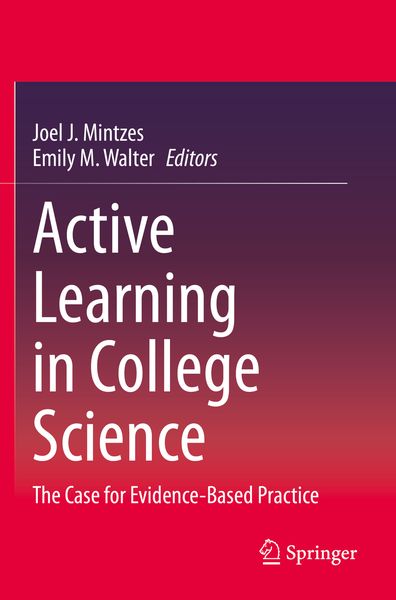
Active Learning in College Science The Case for Evidence-Based Practice
-
- Hardcover
- Taschenbuch ausgewählt
- eBook
-
Sprache:Englisch
273,99 €
inkl. gesetzl. MwSt.,
Beschreibung
Produktdetails
Einband
Taschenbuch
Erscheinungsdatum
24.02.2021
Herausgeber
Joel J. Mintzes + weitereVerlag
SpringerSeitenzahl
1001
Maße (L/B/H)
23,5/15,5/5,5 cm
Gewicht
1527 g
Auflage
1st ed. 2020
Sprache
Englisch
ISBN
978-3-030-33602-8
This book explores evidence-based practice in college science teaching. It is grounded in disciplinary education research by practicing scientists who have chosen to take Wieman’s (2014) challenge seriously, and to investigate claims about the efficacy of alternative strategies in college science teaching. In editing this book, we have chosen to showcase outstanding cases of exemplary practice supported by solid evidence, and to include practitioners who offer models of teaching and learning that meet the high standards of the scientific disciplines. Our intention is to let these distinguished scientists speak for themselves and to offer authentic guidance to those who seek models of excellence. Our primary audience consists of the thousands of dedicated faculty and graduate students who teach undergraduate science at community and technical colleges, 4-year liberal arts institutions, comprehensive regional campuses, and flagship research universities.
In keeping with Wieman’s challenge, our primary focus has been on identifying classroom practices that encourage and support meaningful learning and conceptual understanding in the natural sciences. The content is structured as follows: after an Introduction based on Constructivist Learning Theory (Section I), the practices we explore are Eliciting Ideas and Encouraging Reflection (Section II); Using Clickers to Engage Students (Section III); Supporting Peer Interaction through Small Group Activities (Section IV); Restructuring Curriculum and Instruction (Section V); Rethinking the Physical Environment (Section VI); Enhancing Understanding with Technology (Section VII), and Assessing Understanding (Section VIII). The book’s final section (IX) is devoted to Professional Issues facing college and university faculty who choose to adopt active learning in their courses.
The common feature underlying all of the strategies described in this book is their emphasis on actively engaging students who seek to make sense of natural objects and events. Many of the strategies we highlight emerge from a constructivist view of learning that has gained widespread acceptance in recent years. In this view, learners make sense of the world by forging connections between new ideas and those that are part of their existing knowledge base. For most students, that knowledge base is riddled with a host of naïve notions, misconceptions and alternative conceptions they have acquired throughout their lives. To a considerable extent, the job of the teacher is to coax out these ideas; to help students understand how their ideas differ from the scientifically accepted view; to assist as students restructure and reconcile their newly acquired knowledge; and to provide opportunities for students to evaluate what they have learned and apply it in novel circumstances. Clearly, this prescription demands far more than most college and university scientists havebeen prepared for.
Kundinnen und Kunden meinen
Verfassen Sie die erste Bewertung zu diesem Artikel
Helfen Sie anderen Kund*innen durch Ihre Meinung
Kurze Frage zu unserer Seite
Vielen Dank für Ihr Feedback
Wir nutzen Ihr Feedback, um unsere Produktseiten zu verbessern. Bitte haben Sie Verständnis, dass wir Ihnen keine Rückmeldung geben können. Falls Sie Kontakt mit uns aufnehmen möchten, können Sie sich aber gerne an unseren Kund*innenservice wenden.
zum Kundenservice