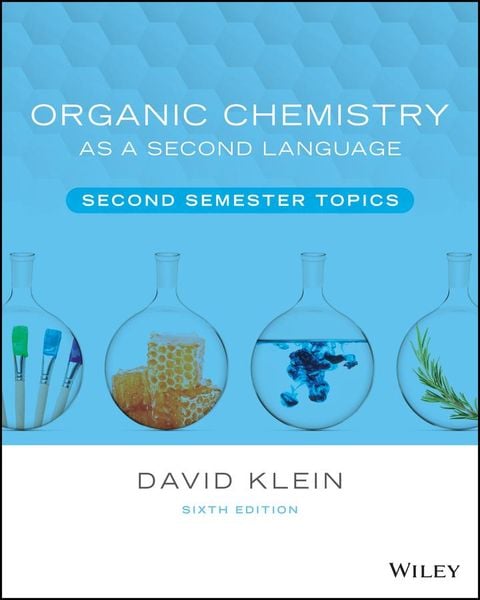
Organic Chemistry as a Second Language Second Semester Topics
-
- Englisch ausgewählt
59,99 €
inkl. gesetzl. MwSt.,
Beschreibung
Produktdetails
Einband
Taschenbuch
Erscheinungsdatum
12.03.2024
Verlag
John Wiley & SonsSeitenzahl
576
Maße (L/B/H)
25,4/20,2/1,8 cm
Gewicht
925 g
Auflage
6th edition
Sprache
Englisch
ISBN
978-1-119-83705-3
Organic chemistry is a challenging subject, with many students expecting it to require many hours of memorization. Author David Klein's Second Language books prove this is not true-organic chemistry is one continuous story that actually makes sense if you pay close attention. Klein's books use a conversational tone making them more accessible and easier to read for students.
Organic Chemistry as a Second Language: Second Semester Topics, 6e builds on the principles explored in the first half of the course, delving deeper into molecular mechanisms, reactions, and analytical techniques. Using Klein's one-of-a-kind SkillBuilder approach, the book includes hands-on exercises and thoroughly explained solutions designed to further reinforce student comprehension of chemical concepts and organic principles. An indispensable supplement to the primary text, this resource covers aromatic compounds, infrared (IR) and nuclear magnetic resonance (NMR) spectroscopy, nucleophilic and electrophilic aromatic substitution, ketones and aldehydes, carboxylic acid derivatives, and much more.
Organic Chemistry as a Second Language: Second Semester Topics, 6e teaches students how to ask the right questions to solve problems, study more efficiently, and learn to speak the language of organic chemistry. Like its first-semester companion title, it is an essential 'guide on the side' for any organic chemistry student no matter what textbook or instructor-provided lecture material is used. The inclusion of new end of chapter problems, providing both practice and challenge, will prepare students and build confidence come exam time, as well as outside the classroom.
Noch keine Bewertungen vorhanden
Verfassen Sie die erste Bewertung zu diesem Artikel
Helfen Sie anderen Kundinnen und Kunden durch Ihre Meinung.
Kurze Frage zu unserer Seite
Vielen Dank für Ihr Feedback
Wir nutzen Ihr Feedback, um unsere Produktseiten zu verbessern. Bitte haben Sie Verständnis, dass wir Ihnen keine Rückmeldung geben können. Falls Sie Kontakt mit uns aufnehmen möchten, können Sie sich aber gerne an unseren Kund*innenservice wenden.
zum Kundenservice