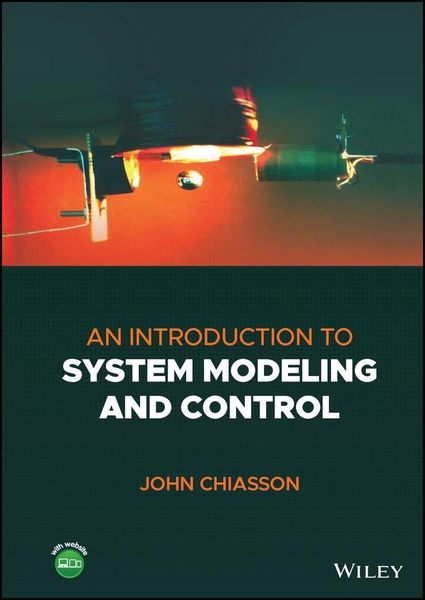
An Introduction to System Modeling and Control
172,99 €
inkl. gesetzl. MwSt.,
Beschreibung
Produktdetails
Einband
Gebundene Ausgabe
Erscheinungsdatum
22.03.2022
Verlag
John Wiley & SonsSeitenzahl
752
Maße (L/B/H)
25,7/18,5/3,8 cm
Gewicht
1633 g
Auflage
1. Auflage
Sprache
Englisch
ISBN
978-1-119-84289-7
In An Introduction to System Modeling and Control, Dr. Chiasson delivers an accessible and intuitive guide to understanding modeling and control for students in electrical, mechanical, and aerospace/aeronautical engineering. The book begins with an introduction to the need for control by describing how an aircraft flies complete with figures illustrating roll, pitch, and yaw control using its ailerons, elevators, and rudder, respectively. The book moves on to rigid body dynamics about a single axis (gears, cart rolling down an incline) and then to modeling DC motors, DC tachometers, and optical encoders. Using the transfer function representation of these dynamic models, PID controllers are introduced as an effective way to track step inputs and reject constant disturbances.
It is further shown how any transfer function model can be stabilized using output pole placement and on how two-degree of freedom controllers can be used to eliminate overshoot in step responses. Bode and Nyquist theory are then presented with an emphasis on how they give a quantitative insight into a control system's robustness and sensitivity. An Introduction to System Modeling and Control closes with chapters on modeling an inverted pendulum and a magnetic levitation system, trajectory tracking control using state feedback, and state estimation. In addition the book offers:
* A complete set of MATLAB/SIMULINK files for examples and problems included in the book.
* A set of lecture slides for each chapter.
* A solutions manual with recommended problems to assign.
* An analysis of the robustness and sensitivity of four different controller designs for an inverted pendulum (cart-pole).
Perfect for electrical, mechanical, and aerospace/aeronautical engineering students, An Introduction to System Modeling and Control will also be an invaluable addition to the libraries of practicing engineers.
Noch keine Bewertungen vorhanden
Verfassen Sie die erste Bewertung zu diesem Artikel
Helfen Sie anderen Kundinnen und Kunden durch Ihre Meinung.
Kurze Frage zu unserer Seite
Vielen Dank für Ihr Feedback
Wir nutzen Ihr Feedback, um unsere Produktseiten zu verbessern. Bitte haben Sie Verständnis, dass wir Ihnen keine Rückmeldung geben können. Falls Sie Kontakt mit uns aufnehmen möchten, können Sie sich aber gerne an unseren Kund*innenservice wenden.
zum Kundenservice