• Produktbild: Advances in Electromagnetics Empowered by Artificial Intelligence and Deep Learning
  • Produktbild: Advances in Electromagnetics Empowered by Artificial Intelligence and Deep Learning

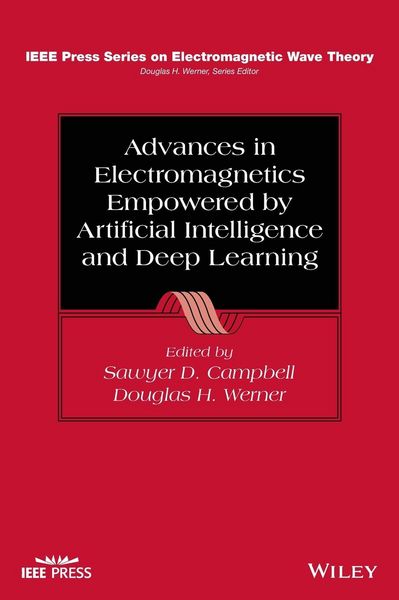
Advances in Electromagnetics Empowered by Artificial Intelligence and Deep Learning and Deep Learnin

183,99 €

inkl. gesetzl. MwSt., Versandkostenfrei


Beschreibung

Produktdetails

Einband

Gebundene Ausgabe

Erscheinungsdatum

22.08.2023

Herausgeber

Sawyer D. Campbell + weitere

Verlag

John Wiley & Sons Inc

Seitenzahl

592

Maße (L/B/H)

26/18,3/3,6 cm

Gewicht

1299 g

Auflage

1. Auflage

Sprache

Englisch

ISBN

978-1-119-85389-3

Beschreibung

Produktdetails

Einband

Gebundene Ausgabe

Erscheinungsdatum

22.08.2023

Herausgeber

Verlag

John Wiley & Sons Inc

Seitenzahl

592

Maße (L/B/H)

26/18,3/3,6 cm

Gewicht

1299 g

Auflage

1. Auflage

Sprache

Englisch

ISBN

978-1-119-85389-3

Herstelleradresse

Libri GmbH
Europaallee 1
36244 Bad Hersfeld
DE

Email: gpsr@libri.de

Noch keine Bewertungen vorhanden

Verfassen Sie die erste Bewertung zu diesem Artikel

Helfen Sie anderen Kundinnen und Kunden durch Ihre Meinung.

Kundinnen und Kunden meinen

Bewertungen (0)

Die Leseprobe wird geladen.
  • Produktbild: Advances in Electromagnetics Empowered by Artificial Intelligence and Deep Learning
  • Produktbild: Advances in Electromagnetics Empowered by Artificial Intelligence and Deep Learning
  • About the Editors xix

    List of Contributors xx

    Preface xxvi

    Section I Introduction to AI-Based Regression and Classification 1

    1 Introduction to Neural Networks 3
    Isha Garg and Kaushik Roy

    1.1 Taxonomy 3

    1.1.1 Supervised Versus Unsupervised Learning 3

    1.1.2 Regression Versus Classification 4

    1.1.3 Training, Validation, and Test Sets 4

    1.2 Linear Regression 5

    1.2.1 Objective Functions 6

    1.2.2 Stochastic Gradient Descent 7

    1.3 Logistic Classification 9

    1.4 Regularization 11

    1.5 Neural Networks 13

    1.6 Convolutional Neural Networks 16

    1.6.1 Convolutional Layers 17

    1.6.2 Pooling Layers 18

    1.6.3 Highway Connections 19

    1.6.4 Recurrent Layers 19

    1.7 Conclusion 20

    References 20

    2 Overview of Recent Advancements in Deep Learning and Artificial Intelligence 23
    Vijaykrishnan Narayanan, Yu Cao, Priyadarshini Panda, Nagadastagiri Reddy Challapalle, Xiaocong Du, Youngeun Kim, Gokul Krishnan, Chonghan Lee, Yuhang Li, Jingbo Sun, Yeshwanth Venkatesha, Zhenyu Wang, and Yi Zheng

    2.1 Deep Learning 24

    2.1.1 Supervised Learning 26

    2.1.1.1 Conventional Approaches 26

    2.1.1.2 Deep Learning Approaches 29

    2.1.2 Unsupervised Learning 35

    2.1.2.1 Algorithm 35

    2.1.3 Toolbox 37

    2.2 Continual Learning 38

    2.2.1 Background and Motivation 38

    2.2.2 Definitions 38

    2.2.3 Algorithm 38

    2.2.3.1 Regularization 39

    2.2.3.2 Dynamic Network 40

    2.2.3.3 Parameter Isolation 40

    2.2.4 Performance Evaluation Metric 41

    2.2.5 Toolbox 41

    2.3 Knowledge Graph Reasoning 42

    2.3.1 Background 42

    2.3.2 Definitions 42

    2.3.3 Database 43

    2.3.4 Applications 43

    2.3.5 Toolbox 44

    2.4 Transfer Learning 44

    2.4.1 Background and Motivation 44

    2.4.2 Definitions 44

    2.4.3 Algorithm 45

    2.4.4 Toolbox 46

    2.5 Physics-Inspired Machine Learning Models 46

    2.5.1 Background and Motivation 46

    2.5.2 Algorithm 46

    2.5.3 Applications 49

    2.5.4 Toolbox 50

    2.6 Distributed Learning 50

    2.6.1 Introduction 50

    2.6.2 Definitions 51

    2.6.3 Methods 51

    2.6.4 Toolbox 54

    2.7 Robustness 54

    2.7.1 Background and Motivation 54

    2.7.2 Definitions 55

    2.7.3 Methods 55

    2.7.3.1 Training with Noisy Data/Labels 55

    2.7.3.2 Adversarial Attacks 55

    2.7.3.3 Defense Mechanisms 56

    2.7.4 Toolbox 56

    2.8 Interpretability 56

    2.8.1 Background and Motivation 56

    2.8.2 Definitions 57

    2.8.3 Algorithm 57

    2.8.4 ToolBox 58

    2.9 Transformers and Attention Mechanisms for Text and Vision Models 58

    2.9.1 Background and Motivation 58

    2.9.2 Algorithm 59

    2.9.3 Application 60

    2.9.4 Toolbox 61

    2.10 Hardware for Machine Learning Applications 62

    2.10.1 Cpu 62

    2.10.2 Gpu 63

    2.10.3 ASICs 63

    2.10.4 Fpga 64

    Acknowledgment 64

    References 64

    Section II Advancing Electromagnetic Inverse Design with Machine Learning 81

    3 Breaking the Curse of Dimensionality in Electromagnetics Design Through Optimization Empowered by Machine Learning 83
    N. Anselmi, G. Oliveri, L. Poli, A. Polo, P. Rocca, M. Salucci, and A. Massa

    3.1 Introduction 83

    3.2 The SbD Pillars and Fundamental Concepts 85

    3.3 SbD at Work in EMs Design 88

    3.3.1 Design of Elementary Radiators 88

    3.3.2 Design of Reflectarrays 92

    3.3.3 Design of Metamaterial Lenses 93

    3.3.4 Other SbD Customizations 96

    3.4 Final Remarks and Envisaged Trends 101

    Acknowledgments 101

    References 102

    4 Artificial Neural Networks for Parametric Electromagnetic Modeling and Optimization 105
    Feng Feng, Weicong Na, Jing Jin, and Qi-Jun Zhang

    4.1 Introduction 105

    4.2 ANN Structure and Training for Parametric EM Modeling 106

    4.3 Deep Neural Network for Microwave Modeling 107

    4.3.1 Structure of the Hybrid DNN 107

    4.3.2 Training of the Hybrid DNN 108

    4.3.3 Parameter-Extraction Modeling of a Filter Using the Hybrid DNN 108

    4.4 Knowledge-Based Parametric Modeling for Microwave Components 111

    4.4.1 Unified Knowledge-Based Parametric Model Structure 112

    4.4.2 Training with l 1 Optimization of the Unified Knowledge-Based Parametric Model 115

    4.4.3 Automated Knowledge-Based Model Generation 117

    4.4.4 Knowledge-Based Parametric Modeling of a Two-Section Low-Pass Elliptic Microstrip Filter 117

    4.5 Parametric Modeling Using Combined ANN and Transfer Function 121

    4.5.1 Neuro-TF Modeling in Rational Form 121

    4.5.2 Neuro-TF Modeling in Zero/Pole Form 122

    4.5.3 Neuro-TF Modeling in Pole/Residue Form 123

    4.5.4 Vector Fitting Technique for Parameter Extraction 123

    4.5.5 Two-Phase Training for Neuro-TF Models 123

    4.5.6 Neuro-TF Model Based on Sensitivity Analysis 125

    4.5.7 A Diplexer Example Using Neuro-TF Model Based on Sensitivity Analysis 126

    4.6 Surrogate Optimization of EM Design Based on ANN 129

    4.6.1 Surrogate Optimization and Trust Region Update 129

    4.6.2 Neural TF Optimization Method Based on Adjoint Sensitivity Analysis 130

    4.6.3 Surrogate Model Optimization Based on Feature-Assisted of Neuro-TF 130

    4.6.4 EM Optimization of a Microwave Filter Utilizing Feature-Assisted Neuro-TF 131

    4.7 Conclusion 133

    References 133

    5 Advanced Neural Networks for Electromagnetic Modeling and Design 141
    Bing-Zhong Wang, Li-Ye Xiao, and Wei Shao

    5.1 Introduction 141

    5.2 Semi-Supervised Neural Networks for Microwave Passive Component Modeling 141

    5.2.1 Semi-Supervised Learning Based on Dynamic Adjustment Kernel Extreme Learning Machine 141

    5.2.1.1 Dynamic Adjustment Kernel Extreme Learning Machine 142

    5.2.1.2 Semi-Supervised Learning Based on DA-KELM 147

    5.2.1.3 Numerical Examples 150

    5.2.2 Semi-Supervised Radial Basis Function Neural Network 157

    5.2.2.1 Semi-Supervised Radial Basis Function Neural Network 157

    5.2.2.2 Sampling Strategy 161

    5.2.2.3 SS-RBFNN With Sampling Strategy 162

    5.3 Neural Networks for Antenna and Array Modeling 166

    5.3.1 Modeling of Multiple Performance Parameters for Antennas 166

    5.3.2 Inverse Artificial Neural Network for Multi-objective Antenna Design 175

    5.3.2.1 Knowledge-Based Neural Network for Periodic Array Modeling 183

    5.4 Autoencoder Neural Network for Wave Propagation in Uncertain Media 188

    5.4.1 Two-Dimensional GPR System with the Dispersive and Lossy Soil 188

    5.4.2 Surrogate Model for GPR Modeling 190

    5.4.3 Modeling Results 191

    References 193

    Section III Deep Learning for Metasurface Design 197

    6 Generative Machine Learning for Photonic Design 199
    Dayu Zhu, Zhaocheng Liu, and Wenshan Cai

    6.1 Brief Introduction to Generative Models 199

    6.1.1 Probabilistic Generative Model 199

    6.1.2 Parametrization and Optimization with Generative Models 199

    6.1.2.1 Probabilistic Model for Gradient-Based Optimization 200

    6.1.2.2 Sampling-Based Optimization 200

    6.1.2.3 Generative Design Strategy 201

    6.1.2.4 Generative Adversarial Networks in Photonic Design 202

    6.1.2.5 Discussion 203

    6.2 Generative Model for Inverse Design of Metasurfaces 203

    6.2.1 Generative Design Strategy for Metasurfaces 203

    6.2.2 Model Validation 204

    6.2.3 On-demand Design Results 206

    6.3 Gradient-Free Optimization with Generative Model 207

    6.3.1 Gradient-Free Optimization Algorithms 207

    6.3.2 Evolution Strategy with Generative Parametrization 207

    6.3.2.1 Generator from VAE 207

    6.3.2.2 Evolution Strategy 208

    6.3.2.3 Model Validation 209

    6.3.2.4 On-demand Design Results 209

    6.3.3 Cooperative Coevolution and Generative Parametrization 210

    6.3.3.1 Cooperative Coevolution 210

    6.3.3.2 Diatomic Polarizer 211

    6.3.3.3 Gradient Metasurface 211

    6.4 Design Large-Scale, Weakly Coupled System 213

    6.4.1 Weak Coupling Approximation 214

    6.4.2 Analog Differentiator 214

    6.4.3 Multiplexed Hologram 215

    6.5 Auxiliary Methods for Generative Photonic Parametrization 217

    6.5.1 Level Set Method 217

    6.5.2 Fourier Level Set 218

    6.5.3 Implicit Neural Representation 218

    6.5.4 Periodic Boundary Conditions 220

    6.6 Summary 221

    References 221

    7 Machine Learning Advances in Computational Electromagnetics 225
    Robert Lupoiu and Jonathan A. Fan

    7.1 Introduction 225

    7.2 Conventional Electromagnetic Simulation Techniques 226

    7.2.1 Finite Difference Frequency (FDFD) and Time (FDTD) Domain Solvers 226

    7.2.2 The Finite Element Method (FEM) 229

    7.2.2.1 Meshing 229

    7.2.2.2 Basis Function Expansion 229

    7.2.2.3 Residual Formulation 230

    7.2.3 Method of Moments (MoM) 230

    7.3 Deep Learning Methods for Augmenting Electromagnetic Solvers 231

    7.3.1 Time Domain Simulators 231

    7.3.1.1 Hardware Acceleration 231

    7.3.1.2 Learning Finite Difference Kernels 232

    7.3.1.3 Learning Absorbing Boundary Conditions 234

    7.3.2 Augmenting Variational CEM Techniques Via Deep Learning 234

    7.4 Deep Electromagnetic Surrogate Solvers Trained Purely with Data 235

    7.5 Deep Surrogate Solvers Trained with Physical Regularization 240

    7.5.1 Physics-Informed Neural Networks (PINNs) 240

    7.5.2 Physics-Informed Neural Networks with Hard Constraints (hPINNs) 241

    7.5.3 WaveY-Net 243

    7.6 Conclusions and Perspectives 249

    Acknowledgments 250

    References 250

    8 Design of Nanofabrication-Robust Metasurfaces Through Deep Learning-Augmented Multiobjective Optimization 253
    Ronald P. Jenkins, Sawyer D. Campbell, and Douglas H. Werner

    8.1 Introduction 253

    8.1.1 Metasurfaces 253

    8.1.2 Fabrication State-of-the-Art 253

    8.1.3 Fabrication Challenges 254

    8.1.3.1 Fabrication Defects 254

    8.1.4 Overcoming Fabrication Limitations 255

    8.2 Related Work 255

    8.2.1 Robustness Topology Optimization 255

    8.2.2 Deep Learning in Nanophotonics 256

    8.3 DL-Augmented Multiobjective Robustness Optimization 257

    8.3.1 Supercells 257

    8.3.1.1 Parameterization of Freeform Meta-Atoms 257

    8.3.2 Robustness Estimation Method 259

    8.3.2.1 Simulating Defects 259

    8.3.2.2 Existing Estimation Methods 259

    8.3.2.3 Limitations of Existing Methods 259

    8.3.2.4 Solver Choice 260

    8.3.3 Deep Learning Augmentation 260

    8.3.3.1 Challenges 261

    8.3.3.2 Method 261

    8.3.4 Multiobjective Global Optimization 267

    8.3.4.1 Single Objective Cost Functions 267

    8.3.4.2 Dominance Relationships 267

    8.3.4.3 A Robustness Objective 269

    8.3.4.4 Problems with Optimization and DL Models 269

    8.3.4.5 Error-Tolerant Cost Functions 269

    8.3.5 Robust Supercell Optimization 270

    8.3.5.1 Pareto Front Results 270

    8.3.5.2 Examples from the Pareto Front 271

    8.3.5.3 The Value of Exhaustive Sampling 272

    8.3.5.4 Speedup Analysis 273

    8.4 Conclusion 275

    8.4.1 Future Directions 275

    Acknowledgments 276

    References 276

    9 Machine Learning for Metasurfaces Design and Their Applications 281
    Kumar Vijay Mishra, Ahmet M. Elbir, and Amir I. Zaghloul

    9.1 Introduction 281

    9.1.1 ML/DL for RIS Design 283

    9.1.2 ML/DL for RIS Applications 283

    9.1.3 Organization 285

    9.2 Inverse RIS Design 285

    9.2.1 Genetic Algorithm (GA) 286

    9.2.2 Particle Swarm Optimization (PSO) 286

    9.2.3 Ant Colony Optimization (ACO) 289

    9.3 DL-Based Inverse Design and Optimization 289

    9.3.1 Artificial Neural Network (ANN) 289

    9.3.1.1 Deep Neural Networks (DNN) 290

    9.3.2 Convolutional Neural Networks (CNNs) 290

    9.3.3 Deep Generative Models (DGMs) 291

    9.3.3.1 Generative Adversarial Networks (GANs) 291

    9.3.3.2 Conditional Variational Autoencoder (cVAE) 293

    9.3.3.3 Global Topology Optimization Networks (GLOnets) 293

    9.4 Case Studies 294

    9.4.1 MTS Characterization Model 294

    9.4.2 Training and Design 296

    9.5 Applications 298

    9.5.1 DL-Based Signal Detection in RIS 302

    9.5.2 DL-Based RIS Channel Estimation 303

    9.6 DL-Aided Beamforming for RIS Applications 306

    9.6.1 Beamforming at the RIS 306

    9.6.2 Secure-Beamforming 308

    9.6.3 Energy-Efficient Beamforming 309

    9.6.4 Beamforming for Indoor RIS 309

    9.7 Challenges and Future Outlook 309

    9.7.1 Design 310

    9.7.1.1 Hybrid Physics-Based Models 310

    9.7.1.2 Other Learning Techniques 310

    9.7.1.3 Improved Data Representation 310

    9.7.2 Applications 311

    9.7.3 Channel Modeling 311

    9.7.3.1 Data Collection 311

    9.7.3.2 Model Training 311

    9.7.3.3 Environment Adaptation and Robustness 312

    9.8 Summary 312

    Acknowledgments 313

    References 313

    Section IV Rf, Antenna, Inverse-scattering, and other Em Applications of Deep Learning 319

    10 Deep Learning for Metasurfaces and Metasurfaces for Deep Learning 321
    Clayton Fowler, Sensong An, Bowen Zheng, and Hualiang Zhang

    10.1 Introduction 321

    10.2 Forward-Predicting Networks 322

    10.2.1 FCNN (Fully Connected Neural Networks) 323

    10.2.2 CNN (Convolutional Neural Networks) 324

    10.2.2.1 Nearly Free-Form Meta-Atoms 324

    10.2.2.2 Mutual Coupling Prediction 327

    10.2.3 Sequential Neural Networks and Universal Forward Prediction 330

    10.2.3.1 Sequencing Input Data 331

    10.2.3.2 Recurrent Neural Networks 332

    10.2.3.3 1D Convolutional Neural Networks 332

    10.3 Inverse-Design Networks 333

    10.3.1 Tandem Network for Inverse Designs 333

    10.3.2 Generative Adversarial Nets (GANs) 335

    10.4 Neuromorphic Photonics 339

    10.5 Summary and Outlook 340

    References 341

    11 Forward and Inverse Design of Artificial Electromagnetic Materials 345
    Jordan M. Malof, Simiao Ren, and Willie J. Padilla

    11.1 Introduction 345

    11.1.1 Problem Setting 346

    11.1.2 Artificial Electromagnetic Materials 347

    11.1.2.1 Regime 1: Floquet-Bloch 348

    11.1.2.2 Regime 2: Resonant Effective Media 349

    11.1.2.3 All-Dielectric Metamaterials 350

    11.2 The Design Problem Formulation 351

    11.3 Forward Design 352

    11.3.1 Search Efficiency 353

    11.3.2 Evaluation Time 354

    11.3.3 Challenges with the Forward Design of Advanced AEMs 354

    11.3.4 Deep Learning the Forward Model 355

    11.3.4.1 When Does Deep Learning Make Sense? 355

    11.3.4.2 Common Deep Learning Architectures 356

    11.3.5 The Forward Design Bottleneck 356

    11.4 Inverse Design with Deep Learning 357

    11.4.1 Why Inverse Problems Are Often Difficult 359

    11.4.2 Deep Inverse Models 360

    11.4.2.1 Does the Inverse Model Address Non-uniqueness? 360

    11.4.2.2 Multi-solution Versus Single-Solution Models 360

    11.4.2.3 Iterative Methods versus Direct Mappings 361

    11.4.3 Which Inverse Models Perform Best? 361

    11.5 Conclusions and Perspectives 362

    11.5.1 Reducing the Need for Training Data 362

    11.5.1.1 Transfer Learning 362

    11.5.1.2 Active Learning 363

    11.5.1.3 Physics-Informed Learning 363

    11.5.2 Inverse Modeling for Non-existent Solutions 363

    11.5.3 Benchmarking, Replication, and Sharing Resources 364

    Acknowledgments 364

    References 364

    12 Machine Learning-Assisted Optimization and Its Application to Antenna and Array Designs 371
    Qi Wu, Haiming Wang, and Wei Hong

    12.1 Introduction 371

    12.2 Machine Learning-Assisted Optimization Framework 372

    12.3 Machine Learning-Assisted Optimization for Antenna and Array Designs 375

    12.3.1 Design Space Reduction 375

    12.3.2 Variable-Fidelity Evaluation 375

    12.3.3 Hybrid Optimization Algorithm 378

    12.3.4 Robust Design 379

    12.3.5 Antenna Array Synthesis 380

    12.4 Conclusion 381

    References 381

    13 Analysis of Uniform and Non-uniform Antenna Arrays Using Kernel Methods 385
    Manel Martínez-Ramón, José Luis Rojo Álvarez, Arjun Gupta, and Christos Christodoulou

    13.1 Introduction 385

    13.2 Antenna Array Processing 386

    13.2.1 Detection of Angle of Arrival 387

    13.2.2 Optimum Linear Beamformers 388

    13.2.3 Direction of Arrival Detection with Random Arrays 389

    13.3 Support Vector Machines in the Complex Plane 390

    13.3.1 The Support Vector Criterion for Robust Regression in the Complex Plane 390

    13.3.2 The Mercer Theorem and the Nonlinear SVM 393

    13.4 Support Vector Antenna Array Processing with Uniform Arrays 394

    13.4.1 Kernel Array Processors with Temporal Reference 394

    13.4.1.1 Relationship with the Wiener Filter 394

    13.4.2 Kernel Array Processor with Spatial Reference 395

    13.4.2.1 Eigenanalysis in a Hilbert Space 395

    13.4.2.2 Formulation of the Processor 396

    13.4.2.3 Relationship with Nonlinear MVDM 397

    13.4.3 Examples of Temporal and Spatial Kernel Beamforming 398

    13.5 DOA in Random Arrays with Complex Gaussian Processes 400

    13.5.1 Snapshot Interpolation from Complex Gaussian Process 400

    13.5.2 Examples 402

    13.6 Conclusion 403

    Acknowledgments 404

    References 404

    14 Knowledge-Based Globalized Optimization of High-Frequency Structures Using Inverse Surrogates 409
    Anna Pietrenko-Dabrowska and Slawomir Koziel

    14.1 Introduction 409

    14.2 Globalized Optimization by Feature-Based Inverse Surrogates 411

    14.2.1 Design Task Formulation 411

    14.2.2 Evaluating Design Quality with Response Features 412

    14.2.3 Globalized Search by Means of Inverse Regression Surrogates 414

    14.2.4 Local Tuning Procedure 418

    14.2.5 Global Optimization Algorithm 420

    14.3 Results 421

    14.3.1 Verification Structures 422

    14.3.2 Results 423

    14.3.3 Discussion 423

    14.4 Conclusion 428

    Acknowledgment 428

    References 428

    15 Deep Learning for High Contrast Inverse Scattering of Electrically Large Structures 435
    Qing Liu, Li-Ye Xiao, Rong-Han Hong, and Hao-Jie Hu

    15.1 Introduction 435

    15.2 General Strategy and Approach 436

    15.2.1 Related Works by Others and Corresponding Analyses 436

    15.2.2 Motivation 437

    15.3 Our Approach for High Contrast Inverse Scattering of Electrically Large Structures 438

    15.3.1 The 2-D Inverse Scattering Problem with Electrically Large Structures 438

    15.3.1.1 Dual-Module NMM-IEM Machine Learning Model 438

    15.3.1.2 Receiver Approximation Machine Learning Method 440

    15.3.2 Application for 3-D Inverse Scattering Problem with Electrically Large Structures 441

    15.3.2.1 Semi-Join Extreme Learning Machine 441

    15.3.2.2 Hybrid Neural Network Electromagnetic Inversion Scheme 445

    15.4 Applications of Our Approach 450

    15.4.1 Applications for 2-D Inverse Scattering Problem with Electrically Large Structures 450

    15.4.1.1 Dual-Module NMM-IEM Machine Learning for Fast Electromagnetic Inversion of Inhomogeneous Scatterers with High Contrasts and Large Electrical Dimensions 450

    15.4.1.2 Nonlinear Electromagnetic Inversion of Damaged Experimental Data by a Receiver Approximation Machine Learning Method 454

    15.4.2 Applications for 3-D Inverse Scattering Problem with Electrically Large Structures 459

    15.4.2.1 Super-Resolution 3-D Microwave Imaging of Objects with High Contrasts by a Semi-Join Extreme Learning Machine 459

    15.4.2.2 A Hybrid Neural Network Electromagnetic Inversion Scheme (HNNEMIS) for Super-Resolution 3-Dimensional Microwave Human Brain Imaging 473

    15.5 Conclusion and Future work 480

    15.5.1 Summary of Our Work 480

    15.5.1.1 Limitations and Potential Future Works 481

    References 482

    16 Radar Target Classification Using Deep Learning 487
    Youngwook Kim

    16.1 Introduction 487

    16.2 Micro-Doppler Signature Classification 488

    16.2.1 Human Motion Classification 490

    16.2.2 Human Hand Gesture Classification 494

    16.2.3 Drone Detection 495

    16.3 SAR Image Classification 497

    16.3.1 Vehicle Detection 497

    16.3.2 Ship Detection 499

    16.4 Target Classification in Automotive Radar 500

    16.5 Advanced Deep Learning Algorithms for Radar Target Classification 503

    16.5.1 Transfer Learning 504

    16.5.2 Generative Adversarial Networks 506

    16.5.3 Continual Learning 508

    16.6 Conclusion 511

    References 511

    17 Koopman Autoencoders for Reduced-Order Modeling of Kinetic Plasmas 515
    Indranil Nayak, Mrinal Kumar, and Fernando L. Teixeira

    17.1 Introduction 515

    17.2 Kinetic Plasma Models: Overview 516

    17.3 EMPIC Algorithm 517

    17.3.1 Overview 517

    17.3.2 Field Update Stage 519

    17.3.3 Field Gather Stage 521

    17.3.4 Particle Pusher Stage 521

    17.3.5 Current and Charge Scatter Stage 522

    17.3.6 Computational Challenges 522

    17.4 Koopman Autoencoders Applied to EMPIC Simulations 523

    17.4.1 Overview and Motivation 523

    17.4.2 Koopman Operator Theory 524

    17.4.3 Koopman Autoencoder (KAE) 527

    17.4.3.1 Case Study I: Oscillating Electron Beam 529

    17.4.3.2 Case Study II: Virtual Cathode Formation 532

    17.4.4 Computational Gain 534

    17.5 Towards A Physics-Informed Approach 535

    17.6 Outlook 536

    Acknowledgments 537

    References 537

    Index 543