
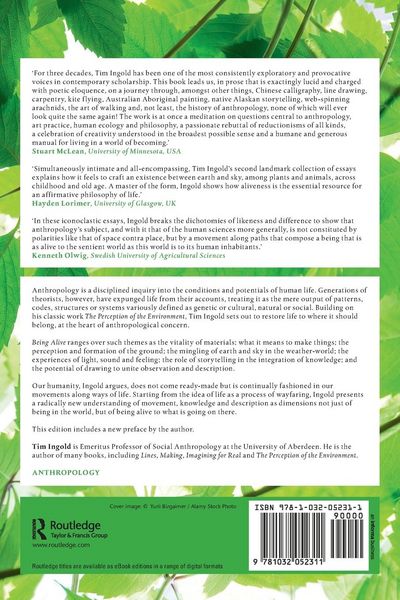
Being Alive Essays on Movement, Knowledge and Description
-
- Hardcover
- Taschenbuch ausgewählt
- eBook
-
Sprache:Englisch
53,99 €
UVP
62,10 €
inkl. gesetzl. MwSt.,
Beschreibung
Produktdetails
Einband
Taschenbuch
Erscheinungsdatum
30.11.2021
Abbildungen
schwarz-weiss Illustrationen, Raster, schwarz-weiss
Verlag
Taylor & FrancisSeitenzahl
358
Maße (L/B/H)
23,4/15,6/2 cm
Gewicht
542 g
Sprache
Englisch
ISBN
978-1-03-205231-1
Anthropology is a disciplined inquiry into the conditions and potentials of human life. Generations of theorists, however, have expunged life from their accounts, treating it as the mere output of patterns, codes, structures or systems variously defined as genetic or cultural, natural or social. Building on his classic work The Perception of the Environment, Tim Ingold sets out to restore life to where it should belong, at the heart of anthropological concern.
Being Alive ranges over such themes as the vitality of materials; what it means to make things; the perception and formation of the ground; the mingling of earth and sky in the weather-world; the experiences of light, sound and feeling; the role of storytelling in the integration of knowledge; and the potential of drawing to unite observation and description.
Our humanity, Ingold argues, does not come ready-made but is continually fashioned in our movements along ways of life. Starting from the idea of life as a process of wayfaring, Ingold presents a radically new understanding of movement, knowledge and description as dimensions not just of being in the world, but of being alive to what is going on there.
This edition includes a new preface by the author.
Noch keine Bewertungen vorhanden
Verfassen Sie die erste Bewertung zu diesem Artikel
Helfen Sie anderen Kundinnen und Kunden durch Ihre Meinung.
Kurze Frage zu unserer Seite
Vielen Dank für Ihr Feedback
Wir nutzen Ihr Feedback, um unsere Produktseiten zu verbessern. Bitte haben Sie Verständnis, dass wir Ihnen keine Rückmeldung geben können. Falls Sie Kontakt mit uns aufnehmen möchten, können Sie sich aber gerne an unseren Kund*innenservice wenden.
zum Kundenservice