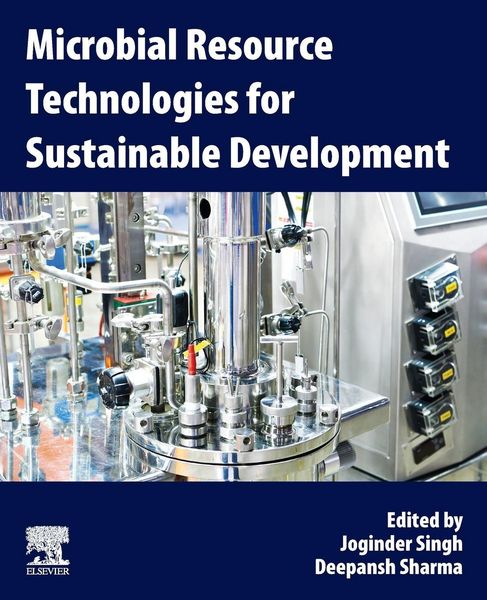
• Produktbild: Microbial Resource Technologies for Sustainable Development
  • Produktbild: Microbial Resource Technologies for Sustainable Development
- 26%

Microbial Resource Technologies for Sustainable Development

26% sparen

173,99 € UVP 237,50 €

inkl. gesetzl. MwSt., Versandkostenfrei


Beschreibung

Produktdetails

Einband

Taschenbuch

Erscheinungsdatum

24.06.2022

Herausgeber

Joginder Singh Panwar + weitere

Verlag

Elsevier Science & Technology

Seitenzahl

492

Maße (L/B/H)

23,5/19,1/2,5 cm

Gewicht

839 g

Sprache

Englisch

ISBN

978-0-323-90590-9

Beschreibung

Portrait

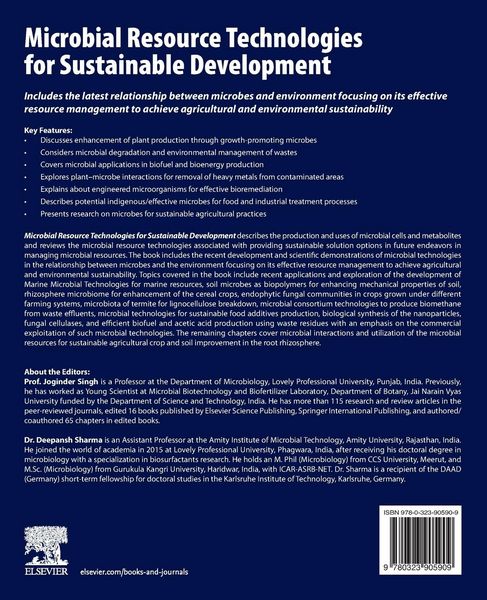
Dr. Joginder Singh is a Professor in the Department of Botany at Nagaland University, Lumami, India. His previous positions include a professorship at Lovely Professional University's School of Bioengineering and Biosciences and a Young Scientist role at Jai Narain Vyas University's Microbial Biotechnology and Biofertilizer Laboratory (funded by the Department of Science and Technology, Government of India). He is a member of several scientific societies, including the Association of Microbiologists of India and the European Federation of Biotechnology. Dr. Singh has an extensive publication record, with over 250 research and review articles, 35 edited books (with publishers like Elsevier and Springer), and 125 book chapters. He is a reviewer for numerous prestigious journals. He has actively participated in and presented at numerous national and international scientific events.

Dr. Deepansh Sharma is presently working as assistant professor at the Amity Institute of Microbial Technology, Amity University, Rajasthan, India. He joined the world of academia in 2015 at Lovely Professional University, Phagwara, India, after receiving his doctoral degree in microbiology with a specialization in biosurfactants research. He is M. Phil (Microbiology) from CCS University, Meerut, and M.Sc. (Microbiology) from Gurukula Kangri University, Haridwar, India, with ICAR-ASRB-NET. He has over eight years of research and teaching experience. He has successfully completed several recent food fermentation industrial consultancy projects. Dr. Sharma is a recipient of the DAAD (Germany) short-term fellowship for doctoral studies in Karlsruhe Institute of Technology, Karlsruhe, Germany. Dr. Sharma has published over 25 research papers and reviews in national and international journals and consortium proceedings along with 5 book chapters on various aspects of the microbial world. He is author of Biosurfactants of Lactic Acid Bacteria and Biosurfactants in Food (2016) published by Springer International Publishing. His research interests include biosurfactants, bacteriocins, and microbial food additives.

Produktdetails

Einband

Taschenbuch

Erscheinungsdatum

24.06.2022

Herausgeber

Verlag

Elsevier Science & Technology

Seitenzahl

492

Maße (L/B/H)

23,5/19,1/2,5 cm

Gewicht

839 g

Sprache

Englisch

ISBN

978-0-323-90590-9

Herstelleradresse

Libri GmbH
Europaallee 1
36244 Bad Hersfeld
DE

Email: gpsr@libri.de

Noch keine Bewertungen vorhanden

Verfassen Sie die erste Bewertung zu diesem Artikel

Helfen Sie anderen Kundinnen und Kunden durch Ihre Meinung.

Kundinnen und Kunden meinen

Bewertungen (0)

Die Leseprobe wird geladen.
  • Produktbild: Microbial Resource Technologies for Sustainable Development
  • Produktbild: Microbial Resource Technologies for Sustainable Development
  • 1. Survival and thriving behaviour of bacteria in microbial jungle
    2. Microbial Consortium: A New Approach in Sustainable Development
    3. Soil microbes as biopolymers for enhancing mechanical properties of soil: A sustainable approach
    4. The structure, function and utility of rhizosphere microbiome of cereal crops
    5. Importance of diverse soil microbial community in crop rotation for sustainable agriculture
    6. Impact of pertinent endophytic fungal communities and their secondary metabolites on crops
    7. Microbial technologies for acetic acid production from fruit waste
    8. Metabolic interaction network of gut microbiota in Termite for lignocellulose breakdown
    9. Biomethane: A sustainable bio-energy source from potential waste effluents
    10. Microbial symbiotic implications in exploring novel antibiotics
    11. Advancement in the use of microbes as primers for monitoring water quality
    12. Microbial resources for efficient lignocellulosic conversion to ethanol production
    13. Biological synthesis of metal nanoparticles by microorganism: A sustainable approach
    14. Microbial technologies for sustainable food additives production
    15. Bioactive peptides production using microbial resources
    16. Soil Health Sustenance through Varied Fertility Management Approaches for Increasing Microbial Load under Temperate Climatic Conditions: A Practical Approach
    17. Microbial biodesulfurization: A sustainable technology for biorefining of fossil fuels
    18. Fungal cellulases: An overview and applications
    19. Hybrid nano and microbial consortium technologies to harvest biofuel (biomethane) from organic and agri waste
    20. Electrochemically active bacteria as platform technology in microbial electrochemical system (MES)
    21. Microbes Enhancing Assimilation and Utilization of Minerals Promoting Plant Health
    22. Chromium removal by microorganisms as sustainable a water treatment strategy
    23. Improvement of ecological sustainability of in situ bioremediation through coordinated approaches