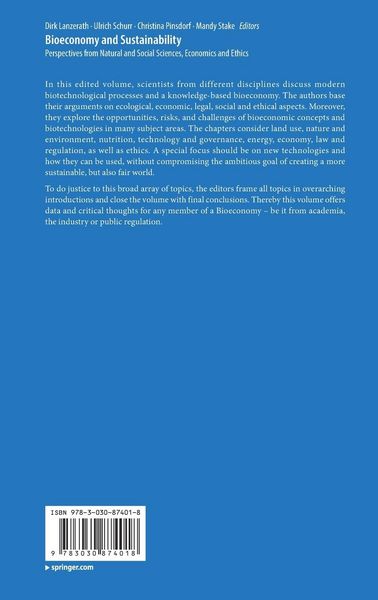
• Produktbild: Bioeconomy and Sustainability
  • Produktbild: Bioeconomy and Sustainability
- 10%

Bioeconomy and Sustainability Perspectives from Natural and Social Sciences, Economics and Ethics

10% sparen

152,99 € UVP 171,19 €

inkl. gesetzl. MwSt., Versandkostenfrei


Beschreibung

Produktdetails

Einband

Gebundene Ausgabe

Erscheinungsdatum

29.03.2022

Herausgeber

Dirk Lanzerath + weitere

Verlag

Springer

Seitenzahl

380

Maße (L/B/H)

24,1/16/2,7 cm

Gewicht

746 g

Auflage

1st ed. 2022

Sprache

Englisch

ISBN

978-3-030-87401-8

Beschreibung

Portrait

Dirk Lanzerath graduated in philosophy and biology. He is executive officer of the German Reference Centre for Ethics in the Life Sciences (DRZE), a research centre of the Northrhine Westfalian Academy of Sciences, Humanities and the Arts at the University of Bonn. He is professor of ethics at the University of Applied Sciences Bonn-Rhein-Sieg and secretary general of the European Network of Research Ethics Committees (EUREC). Prof. Lanzerath is also a member of the Central Ethics Committee at the German Physician Association (ZEKO), the Ethics Committee of the University of Maastricht, and the Editorial Board of the Journal "Research Ethics Review.

Ulrich Schurr is a plant physiologist and heads the Institute of Plant Sciences at Forschungszentrum Jülich (Research Center Jülich - IBG:2 Plant Sciences). The institute is a world leader in plant phenotyping, developing quantitative methods for analyzing plant architecture and function in controlled environmental conditions and in the field, and translating these methods with partners into practical applications in horticulture, agriculture and breeding. He initiated and coordinates the German Plant Phenotyping Network DPPN. He is the chairman of the ESFRI project EMPHASIS and president of the global International Plant Phenotyping Network (IPPN). Uli Schurr has been leading the Bioeconomy Science Center, the largest European research network on sustainable bioeconomy based on the cooperation of the Universities of Bonn, Aachen, Düsseldorf and the Research Center Jülich, for 10 years. He initiated the Bioeconomy REVIER initiative to establish a model region for sustainable bioeconomy in the context of structural change in the coal-phase out in one of the coal-phase out regions in Germany. Ulrich Schurr is a member of the International Advisory Council for Global Bioeconomy (IACGB).

Christina Pinsdorf is a philosopher with a specialization in ethics. She holds a permanent post-doc positionas research associate at the Institute of Science and Ethics at the University of Bonn. Her research focuses on applied ethics, especially nature and environmental ethics, animal ethics, ethics of bioeconomy, as well as medical ethics. Furthermore, she has an expertise in philosophy of nature and German Romanticism. Besides diverse scholarships and academic distinctions she has won the Kant-Award of the Institute for Philosophy of the University of Bonn for her monograph „Lebensformen und Anerkennungsverhältnisse – Zur Ethik der belebten Natur“ (“Life Forms and Relations of Recognition – On the Ethics of Live Nature”). Currently she works on her habilitation project “Philosophie der Wildnis” (“Philosophy of Wilderness”).

Mandy Stake is a post-doc at the Institute of Ethics in the Neurosciences (INM-8) at the Research Centre Jülich in Germany. She studied philosophy and communication sciences at the University of Salzburg and recently completed her PhD-studies in philosophy at the University of Bonn. She was a research assistant at the Institute of Science and Ethics (IWE) and the German Reference Centre of Ethics in the Life Sciences (DRZE). Some of her main interests include philosophy of mind, metaethics and applied ethics, especially neuroethics, ethics of Artificial Intelligence as well as environmental ethics.

Produktdetails

Einband

Gebundene Ausgabe

Erscheinungsdatum

29.03.2022

Herausgeber

Verlag

Springer

Seitenzahl

380

Maße (L/B/H)

24,1/16/2,7 cm

Gewicht

746 g

Auflage

1st ed. 2022

Sprache

Englisch

ISBN

978-3-030-87401-8

Herstelleradresse

Springer-Verlag GmbH
Tiergartenstr. 17
69121 Heidelberg
DE

Email: ProductSafety@springernature.com

Kundinnen und Kunden meinen

0 Bewertungen

Informationen zu Bewertungen

Zur Abgabe einer Bewertung ist eine Anmeldung im Konto notwendig. Die Authentizität der Bewertungen wird von uns nicht überprüft. Wir behalten uns vor, Bewertungstexte, die unseren Richtlinien widersprechen, entsprechend zu kürzen oder zu löschen.

Die Bewertungen sind nach Format, Anzahl Sterne und Datum sortiert.

Verfassen Sie die erste Bewertung zu diesem Artikel

Helfen Sie anderen Kund*innen durch Ihre Meinung

Kundinnen und Kunden meinen

0 Bewertungen filtern

  • Produktbild: Bioeconomy and Sustainability
  • Produktbild: Bioeconomy and Sustainability
  • PART I. Introduction and Overview .- Introduction: Bioeconomy and Sustainability.- PART II. Energy and Land Use .- “Global Shifting Agriculture” and Bioeconomy: Challenges for the Sustainable Use of Global Land Resources.- Sustainable Resources: From Plants to Products.- PART III. Nutrition and Food Ethics.- Food as a Moral Problem.- Bioeconomy and Food Security.- Acceptance of Insects and In Vitro Meat as a Sustainable Meat Substitute in Germany: In Search of the Decisive Nutritional-Psychological Factors.- PART IV. Technology and Governance.- Characteristics of Innovation in Bioeconomy.- Spatial Implications of the Leitmotif Shift from Biotechnology to Bioeconomy.- Problem Structures of Bioenergy Policy in the Power and Heat Sector in Germany.- The Bioeconomy Transformation in the German Rheinische Revier: Stakeholders and Discourses in Media Coverage.- PART V. Regulation and Economics .- Bioeconomy and Genome Editing: A Comparison Between Germany and the Netherlands.- Monitoring and Measuring Bioeconomy.- Resource Sufficiency in a Sustainable Bioeconomy: A Predator-Prey Perspective.- Agriculture in the Bioeconomy: Economics and Policies.- PART VI. Normativity and Ethics .- Bioeconomy and Ethics.- Bioeconomy from the Perspective of Environmental Ethics.- Conditions for an Ethically Responsible and Sustainable Bioeconomy Based on Hans Jonas’ Ethics of Responsibility.- Bioeconomy as a Normative Concept of Resilience: Challenges and Opportunities.- PART VII. Conclusions and Outlook .- Bioeconomy: Challenges and Conflicts from an Interdisciplinary Perspective.- Bioeconomy Beneath and Beyond: Persisting Challenges from a Philosophical and Ethical Perspective.