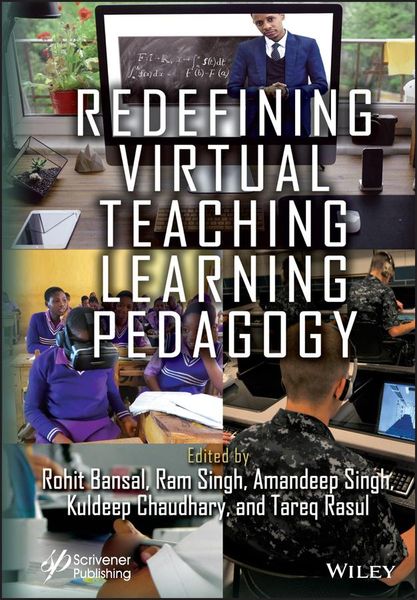
Redefining Virtual Teaching Learning Pedagogy
249,99 €
inkl. gesetzl. MwSt.,
Beschreibung
Produktdetails
Einband
Gebundene Ausgabe
Erscheinungsdatum
08.03.2023
Herausgeber
Rohit Bansal + weitereVerlag
John Wiley & Sons IncSeitenzahl
464
Maße (L/B/H)
25,4/17,8/2,6 cm
Gewicht
1061 g
Auflage
1. Auflage
Sprache
Englisch
ISBN
978-1-119-86758-6
Online education is now a growing and critical piece of modern-day infrastructure and this book details how virtual teaching and learning can continue to be transformed through leveraging digital platforms.
In the current technology-driven era, education systems are undergoing major changes by adopting advanced digital education strategies. Schools, colleges, and universities around the world have swiftly switched to online delivery modes. Students are learning via new platforms and the use of narrated lectures, podcasts, online quizzes, and other e-learning materials has increased. Virtual learning improves the educational experience, transforms teaching and learning, and provides rich, diverse, and flexible learning opportunities for the digital generation. It also makes students able to gain, share and verify knowledge through different sources such as social media communities, blogging, web-based content writing, video-based learning, etc.
The main focus of "Redefining Virtual Teaching Learning Pedagogy" is to bring together leading academic scientists, researchers, and research scholars to exchange and share their experiences and results on all aspects of virtual learning and teaching. The chapters mainly focus on 6 critical areas of virtual teaching and learning:
* Curriculum and learning objectives
* Learning materials
* Pedagogic processes
* Classroom assessment frameworks
* Teacher support in the classrooms
* School leadership and management development.
Audience
Educators, researchers, academicians, entrepreneurs, and corporate professionals will gain knowledge and be updated about the role & future of virtual teaching and learning and the latest digital tools used for that purpose.
Noch keine Bewertungen vorhanden
Verfassen Sie die erste Bewertung zu diesem Artikel
Helfen Sie anderen Kundinnen und Kunden durch Ihre Meinung.
Kurze Frage zu unserer Seite
Vielen Dank für Ihr Feedback
Wir nutzen Ihr Feedback, um unsere Produktseiten zu verbessern. Bitte haben Sie Verständnis, dass wir Ihnen keine Rückmeldung geben können. Falls Sie Kontakt mit uns aufnehmen möchten, können Sie sich aber gerne an unseren Kund*innenservice wenden.
zum Kundenservice