• Produktbild: Nano-biosorbents for Decontamination of Water, Air, and Soil Pollution
  • Produktbild: Nano-biosorbents for Decontamination of Water, Air, and Soil Pollution
- 27%

Nano-biosorbents for Decontamination of Water, Air, and Soil Pollution

27% sparen

173,99 € UVP 238,50 €

inkl. gesetzl. MwSt., Versandkostenfrei


Beschreibung

Produktdetails

Einband

Taschenbuch

Erscheinungsdatum

04.02.2022

Abbildungen

50 illustrations (50 in full color), Illustrationen, nicht spezifiziert

Herausgeber

Adil Denizli + weitere

Verlag

Elsevier Science & Technology

Seitenzahl

644

Maße (L/B/H)

23,5/19,1/3,3 cm

Gewicht

1310 g

Sprache

Englisch

ISBN

978-0-323-90912-9

Beschreibung

Portrait

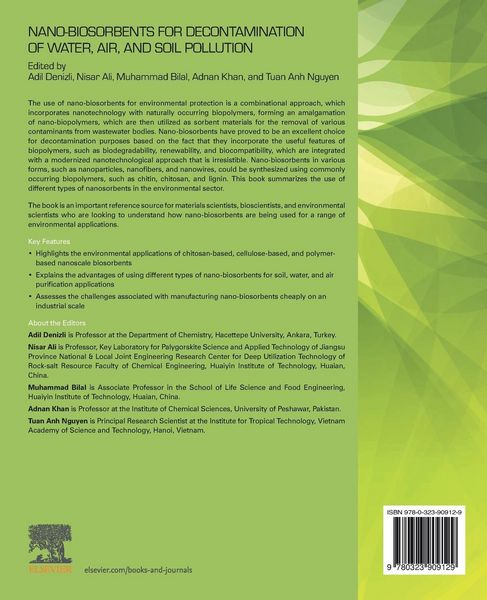
Adil Denizli is Professor at Hacettepe University, Department of Chemistry, Ankara, Turkey. His main research fields are molecular imprinting technologies, purification of biomolecules by chromatographic methods, detection of molecules by sensors, production of polymers with different surface and bulk properties, shape and geometries, and application of these polymers in different applications.

Nisar Ali is an Associate Professor in the Department of Basic and Applied Sciences, College of Applied and Health Sciences, A’Sharqiyah University, Oman. His research interest includes polymer/biopolymer hybrids and assembly materials, magnetic composite nanostructures, surface functionalization, wettability, and wastewater remediation.

Muhammad Bilal is working as an Associate Professor at the Faculty of Civil and Environmental Engineering, Gdansk University of Technology, Poland. Previously, he served as an assistant/associate Professor at Poznan University of Technology, Poland, and the School of Life Science and Food Engineering, Huaiyin Institute of Technology, Huaian, China. He earned his Ph.D. from Shanghai Jiao Tong University, specializing in bioengineering and applied biotechnology. His main research activities are oriented to Environmental biotechnology, nanotechnology, enzyme engineering, immobilization, chemical modifications, and industrial applications of microbial enzymes, liquid, and solid waste management. He has authored over 700 peer-reviewed articles, 150 book chapters, 25 edited books. Dr. Bilal is the associate editor of Frontiers in Chemical Engineering and Frontiers in Environmental Science (Frontiers), and an editorial board member for several journals. He was listed as a highly cited researcher (Clarivate) in 2021 and holds several "highly cited papers" in WOS.

Adnan Khan earned his Ph.D. in Inorganic Chemistry from the Institute of Chemistry University of Campinas, Sao Paulo-Brazil (UNICAMP) in 2011. His main areas of interest includes adsorption, catalysis, biopolymers, and molecularly imprinted polymers. He is currently wroks as an Associate Professor at the Institute of Chemical Sciences, University of Peshawar. Dr. Adnan has more than 75 publications to his name in international peer-reviewed journals, including co-editor of books, author book chapters, review papers, and conference papers that are either published or in progress.

Tuan Anh Nguyen is a Senior Principal Research Scientist at the Institute for Tropical Technology, Vietnam Academy of Science and Technology, Hanoi, Vietnam. He received a BS in physics from Hanoi University in 1992, a BS in economics from Hanoi National Economics University in 1997, and a PhD in chemistry from the Paris Diderot University, France, in 2003. He was a Visiting Scientist at Seoul National University, South Korea, in 2004, and the University of Wollongong, Australia, in 2005. He then worked as a Postdoctoral Research Associate and Research Scientist at Montana State University, United States in 2006-09. In 2012 he was appointed as the Head of the Microanalysis Department at the Institute for Tropical Technology. His research areas of interest include smart sensors, smart networks, smart hospitals, smart cities, complexiverse, and digital twins. He has edited more than 74 books for Elsevier, 12 books for CRC Press, 1 book for Springer, 1 book for RSC, and 2 books for IGI Global. He is the Editor-in-Chief of Kenkyu Journal of Nanotechnology & Nanoscience.
Produktdetails

Einband

Taschenbuch

Erscheinungsdatum

04.02.2022

Abbildungen

50 illustrations (50 in full color), Illustrationen, nicht spezifiziert

Herausgeber

Verlag

Elsevier Science & Technology

Seitenzahl

644

Maße (L/B/H)

23,5/19,1/3,3 cm

Gewicht

1310 g

Sprache

Englisch

ISBN

978-0-323-90912-9

Herstelleradresse

Libri GmbH
Europaallee 1
36244 Bad Hersfeld
DE

Email: gpsr@libri.de

Noch keine Bewertungen vorhanden

Verfassen Sie die erste Bewertung zu diesem Artikel

Helfen Sie anderen Kundinnen und Kunden durch Ihre Meinung.

Kundinnen und Kunden meinen

Bewertungen (0)

Die Leseprobe wird geladen.
  • Produktbild: Nano-biosorbents for Decontamination of Water, Air, and Soil Pollution
  • Produktbild: Nano-biosorbents for Decontamination of Water, Air, and Soil Pollution
  • Section I: Basics principles
    1. Nano-biosorbents for contaminant removal: An introduction
    2. Introduction to nano-biosorbents
    3. Nanobiosorbents: Basic principles, synthesis, and application for contaminants removal
    4. Methods for the synthesis of nanobiosorbents for the contaminant removal
    5. An insight into the potential contaminants, their effects, and removal means
    6. Advantages of nanoadsorbents, biosorbents, and nanobiosorbents for contaminant removal
    7. Nanomaterials for removal of heavy metals from wastewater
    8. Nanosorbents for heavy metals removal
    9. Non-toxic nature of nano-biosorbents as a positive approach toward green environment
    10. Nanoadsorbents for environmental remediation of polluting agents

    Section II: Cellulose-based nanobiosorbents for decontamination of environmental matrices
    11. Risk assessment of nanocellulose exposure
    12. Cellulose-based nanobiosorbents: An insight
    13. Synthesis and properties of cellulosebased nanobiosorbents
    14. Introduction to cellulose-based nanobiosorbents
    15. Cellulose composites as nanobiosorbents for ecological remediation
    16. Modification and derivatization of cellulose-based nanobiosorbents and their utilization in environmental remediation
    17. Cellulose-based nano-biosorbents in water purification

    Section III: Chitosan-based nanobiosorbents for deterioration of environmental matrices
    18. Toxic metals adsorption from water using chitosan nanoderivatives
    19. Toxicological impact and adsorptive removal of triclosan from water bodies using chitosan and carbon-based nano-architectures

    Section IV: Multifarious biopolymers as nanobiosorbents for decontamination of environmental matrices
    20. Citrus waste-based sorbent for wastewater treatment
    21. Alginate-based nanobiosorbents for bioremediation of environmental pollutants
    22. Synthesis of novel nanobioadsorbent for the effective removal of Pb2+ and Zn2+ ions-Adsorption, equilibrium, modeling, and optimization studies
    23. Nanocrystalline NiO powder: Synthesis, characterization and emerging applications
    24. Attraction to adsorption: Preparation methods and performance of novel magnetic biochars for water and wastewater treatment
    25. Biomass-derived nanocomposites: A critical evaluation of their performance toward the capture of inorganic pollutants
    26. Magnetic nanomaterials-based biosorbents