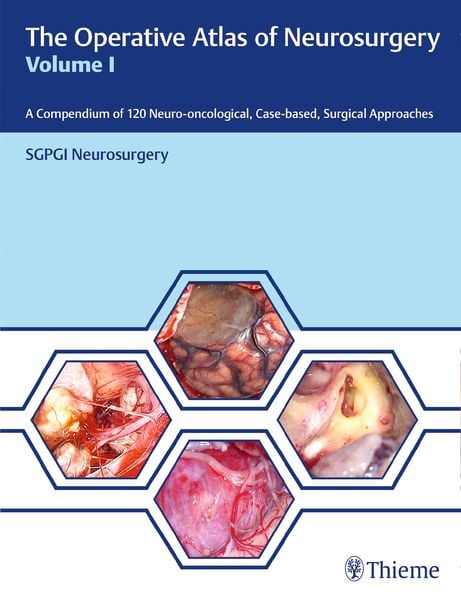
Produktbild: The Operative Atlas of Neurosurgery, Vol I

The Operative Atlas of Neurosurgery, Vol I A Compendium of 120 Neuro-oncological, Case-based, Surgical Approaches

89,99 €

inkl. gesetzl. MwSt., Versandkostenfrei


Beschreibung

Produktdetails

Einband

Gebundene Ausgabe

Erscheinungsdatum

12.01.2022

Abbildungen

Illustrationen, nicht spezifiziert

Herausgeber

SGPGI Neurosurgery

Verlag

Thieme Medical Publishers

Seitenzahl

708

Maße (L/B/H)

28,5/22/3,9 cm

Gewicht

2267 g

Farbe

Hellblau / Marine

Auflage

1. Auflage

Sprache

Englisch

ISBN

978-93-88257-91-6

Beschreibung

Produktdetails

Einband

Gebundene Ausgabe

Erscheinungsdatum

12.01.2022

Abbildungen

Illustrationen, nicht spezifiziert

Herausgeber

SGPGI Neurosurgery

Verlag

Thieme Medical Publishers

Seitenzahl

708

Maße (L/B/H)

28,5/22/3,9 cm

Gewicht

2267 g

Farbe

Hellblau / Marine

Auflage

1. Auflage

Sprache

Englisch

ISBN

978-93-88257-91-6

EU-Ansprechpartner

Georg Thieme Verlag KG
Oswald-Hesse-Straße 50
70469 Stuttgart
DE
info@thieme.de

Herstelleradresse

Thieme Medical & Scientific Publishers Pvt Ltd.
A-12, Second Floor, Sector -2
201301 Noida
IN
customerservice@thieme.in

Kundinnen und Kunden meinen

0 Bewertungen

Informationen zu Bewertungen

Zur Abgabe einer Bewertung ist eine Anmeldung im Konto notwendig. Die Authentizität der Bewertungen wird von uns nicht überprüft. Wir behalten uns vor, Bewertungstexte, die unseren Richtlinien widersprechen, entsprechend zu kürzen oder zu löschen.

Die Bewertungen sind nach Format, Anzahl Sterne und Datum sortiert.

Verfassen Sie die erste Bewertung zu diesem Artikel

Helfen Sie anderen Kund*innen durch Ihre Meinung

Kundinnen und Kunden meinen

0 Bewertungen filtern

  • Produktbild: The Operative Atlas of Neurosurgery, Vol I
  • Volume I
    Section 1: Microsurgery for Supratentorial Tumors
    Chapter 1: Left Medial Temporal Ganglioglioma with Refractory Temporal Lobe Epilepsy—Lesionectomy with Selective Amygdalo-hippocampectomy
    Chapter 2: Optico-chiasmatic Glioma—The Trans-Sylvian Corridor
    Chapter 3: Resection of an Insular Glioma using a Transcortical Approach under Intraoperative Motor Mapping
    Chapter 4: Awake Focused Craniotomy for Supratentorial Brain Tumors
    Chapter 5: Temporoparietal Craniotomy for a Solitary Posterior Temporal Metastasis from an Unknown Primary
    Chapter 6: Microsurgical En Bloc Resection of Hemispheric Gliomas
    Chapter 7: Frontal Craniotomy and the Middle Frontal Gyrus Approach for the Simultaneous Excision of the Concurrently Existing Intraventricular Glioblastoma and Frontal
    Chapter 8: Left Parietal Craniotomy for a Parietal High Grade Neuroepithelial Tumor with an Anaplastic Astroblastoma Phenotype
    Chapter 9: Frontal Parasagittal Craniotomy and Excision of a Cortical Surfacing Metastatic Melanoma
    Chapter 10: Wax-Pile Method for Insular Gliomas: Counteracting Brain-Shift in Intraoperative Magnetic Resonance Imaging
    Chapter 11: Contralateral Posterior Interhemispheric Approach to a Medial Parietal Glioma
    Chapter 12: Posterior Interhemispheric, Transcallosal, Interforniceal, Trans-Velum Interpositum, Trans-Ventricular Approach for the Excision of a Rostrally Located Midbrain Pilocytic Astrocytoma
    Chapter 13: Pterional Approach for an Olfactory Groove Meningioma
    Chapter 14: Lateral Supra-Orbital Craniotomy and a Subfrontal-Trans-Sylvian Approach for an Olfactory Groove Meningioma
    Chapter 15: Parietal Parasagittal Craniotomy in Prone Position for Excision of a Parasagittal Meningioma
    Chapter 16: Trans-Cavernous Sinus Resection of a Gamma Knife–treated Petrous Apex Meningioma with Cavernous Sinus
    Chapter 17: Surgical Approach to a Medial Sphenoid Wing Meningioma
    Chapter 18: Keyhole Supraorbital Hybrid Microscopic-Endoscopic Approach with Extradural Clinoidectomy for Excision of a Medial Sphenoid Wing Meningioma
    Chapter 19: Anterior Interhemispheric Approach to a Sellar-Suprasellar Craniopharyngioma
    Chapter 20: Anterior Third Ventricular Craniopharyngioma: The Pterional Trans-Lamina Terminalis Approach
    Chapter 21: Fronto-Temporal Craniotomy, Trans-Sylvian Approach and Optic Nerve Mobilisation for a Calcified and Firm Suprasellar Craniopharyngioma
    Chapter 22: Primary Central Nervous System Plasmablastic Lymphoma in the Left Eloquent Cortex: Intraoperative Ultrasound and Electrophysiological Monitoring-Guided Excision
    Chapter 23: Interhemispheric Epidermoid: Excision Using a Supraorbital Key-hole Approach
    Chapter 24: Anterior Interhemispheric Approach to an Interhemispheric Epidermoid
    Chapter 25: Contralateral Pterional Trans-Lamina Terminalis Approach for the Disconnection of a Third Ventricular Hypothalamic Hamartoma
    Chapter 26: Enucleation of the Globe for an Aggressive Retinal Hemangioblastoma in a Patient with Von Hippel-Lindau (VHL) Disease
    Chapter 27: Temporal Craniotomy and Middle Temporal Gyrus Approach for the Excision of an Intraventricular Choroid Plexus Papilloma located in the Trigone in a Pediatric Patient 2
    Chapter 28: Frontotemporal Craniotomy for a Temporal Para-Sylvian Arachnoid Cyst
    Chapter 29: Micro-Neurosurgery of the Posterior Incisural Space
    Chapter 30: Gravity Assisted Retraction-less Occipital Trans-tentorial Approach (GAROT) for Posterior Third Ventricular Tumors
    Chapter 31: Infratentorial Supracerebellar (ITSC) Approach to the Posterior Third Ventricular Tumors
    Chapter 32: Supracerebellar Transtentorial (SCTT) Approach for a Posteromedial Tentorial Meningioma Located in the Mediobasal Temporal Lobe Region
    Chapter 33: Surgery for a Giant Calvarial Hemangioma
    Chapter 34: Cerebral Revascularization for Brain Tumors
    Chapter 35: Anterior Temporal Lobectomy with Tumor Resection for a Patient with a Temporal lobe Glioma Presenting with Epilepsy
    Chapter 36: Surgery for Frontal Lobe Intrinsic Brain Tumors: Nuances and Vulnerabilities
    Chapter 37: Frontal Craniotomy and Subfrontal Approach to an Orbital Hemangioma
    Chapter 38: Frontal Craniotomy for Excision of a Secondary Aneurysmal Bone Cyst Associated with Calvarial Fibrous Dysplasia
    Chapter 39: Keyhole Approach to Brain Tumors
    Chapter 40: Neurosurgery for Craniofacial Fibrous Dysplasia
    Chapter 41: Fronto-temporal Craniotomy with Zygomatic Osteotomy for a Clinoidal Meningioma: The Role of Extradural Clinoidal Drilling
    Section 2: Microsurgery for Infratentorial Tumors
    Chapter 1: Midline Suboccipital Craniectomy for a Pediatric Brain Stem Glioma under Intraoperative Magnetic Resonance Imaging Guidance
    Chapter 2: Midline Suboccipital Craniotomy for Excision of a Posterior Fossa Medulloblastoma: Surgery in Sitting Position
    Chapter 3: Telo-Velo-Tonsillar Approach to Fourth Ventricular Tumors
    Chapter 4: Resection of a Vestibular Schwannoma Using a Microscopic Mini Retromastoid Suboccipital Approach in Supine Lateral Position
    Chapter 5: Retrosigmoid Approach for the Management of Vestibular Schwannoma
    Chapter 6: Retro-Sigmoid Approach to a Petroclival Meningioma
    Chapter 7: Middle Cranial Fossa Approach
    Chapter 8: Suboccipital Craniectomy and Cervical Laminectomy for Excision of Multiple Cervicomedullary Hemangioblastomas
    Section 3: Microsurgery for Tumors of the Neck, Brachial Plexus and Peripheral Nerves
    Chapter 1:Surgical Technique for the Excision of Peripheral Nerve Sheath Tumors
    Chapter 2: Surgery for a Cervical Sympathetic Chain Schwannoma
    Chapter 3: Surgery for Excision of a Vagal Paraganglioma
    Section 4: Adjunctive Techniques Used in Facilitating Neuro-Oncological Surgery
    Chapter 1: The Role of 4K-Three-Dimensional Exoscope System in Brain Tumor Surgery
    Chapter 2: Microsurgical DREZotomy for Intractable Pain and Spasticity Following Tumor Surgery
    Chapter 3: Vascularized Temporoparietal Fascial Flap (TPFF) Technique to Facilitate Entry of Adjuvant Chemotherapeutic Agents in a Glioblastoma
    Chapter 4: Principles and Applications of Microscope Integrated Sodium Fluorescein-Fluorescence Module in Neuro-Oncology: A Low Cost and a High Utility Armamentarium
    Chapter 5: Stereotactic Biopsy of a Right Thalamopeduncular Lesion
    Chapter 6: Gamma Knife Radiosurgery
    Chapter 7: Embolization of Skull Base Tumors