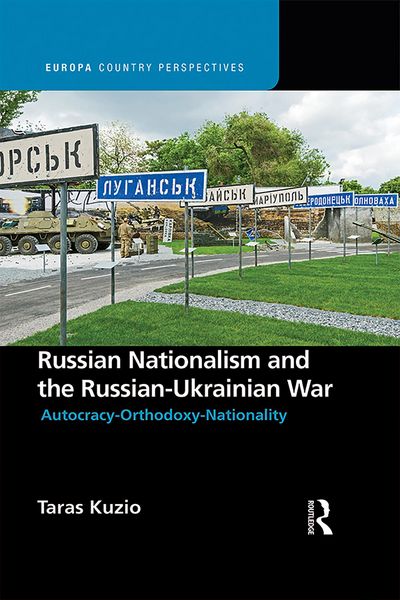
Russian Nationalism and the Russian-Ukrainian War
-
- Hardcover
- Taschenbuch
- eBook ausgewählt
-
Form:Einzelkauf Download
-
Sprache:Englisch
-
eBook Format:PDF
- ePUB 3 60,99 €
- PDF 60,99 € ausgewählt
60,99 €
inkl. gesetzl. MwSt.Beschreibung
Produktdetails
Format
Kopierschutz
Ja
Family Sharing
Nein
Text-to-Speech
Nein
Erscheinungsdatum
26.01.2022
Verlag
Taylor & Francis eBooksSeitenzahl
288 (Printausgabe)
Auflage
1. Auflage
Sprache
Englisch
EAN
9781000534030
This book is the first to provide an in-depth understanding of the 2014 crisis, Russia's annexation of Crimea and Europe's de facto war between Russia and Ukraine. The book provides a historical and contemporary understanding behind President Vladimir Putin Russia's obsession with Ukraine and why Western opprobrium and sanctions have not deterred Russian military aggression.
The volume provides a wealth of detail about the inability of Russia, from the time of the Tsarist Empire, throughout the era of the Union of Soviet Socialist Republics (USSR), and since the dissolution of the latter in 1991, to accept Ukraine as an independent country and Ukrainians as a people distinct and separate from Russians. The book highlights the sources of this lack of acceptance in aspects of Russian national identity. In the Soviet period, Russians principally identified themselves not with the Russian Soviet Federative Republic, but rather with the USSR as a whole. Attempts in the 1990s to forge a post-imperial Russian civic identity grounded in the newly independent Russian Federation were unpopular, and notions of a far larger Russian 'imagined community' came to the fore. A post-Soviet integration of Tsarist Russian great power nationalism and White Russian émigré chauvinism had already transformed and hardened Russian denial of the existence of Ukraine and Ukrainians as a people, even prior to the 2014 crises in Crimea and the Donbas. Bringing an end to both the Russian occupation of Crimea and to the broader Russian-Ukrainian conflict can be expected to meet obstacles not only from the Russian de facto President-for-life, Vladimir Putin, but also from how Russia perceives its national identity.
Noch keine Bewertungen vorhanden
Verfassen Sie die erste Bewertung zu diesem Artikel
Helfen Sie anderen Kundinnen und Kunden durch Ihre Meinung.
Kurze Frage zu unserer Seite
Vielen Dank für Ihr Feedback
Wir nutzen Ihr Feedback, um unsere Produktseiten zu verbessern. Bitte haben Sie Verständnis, dass wir Ihnen keine Rückmeldung geben können. Falls Sie Kontakt mit uns aufnehmen möchten, können Sie sich aber gerne an unseren Kund*innenservice wenden.
zum Kundenservice