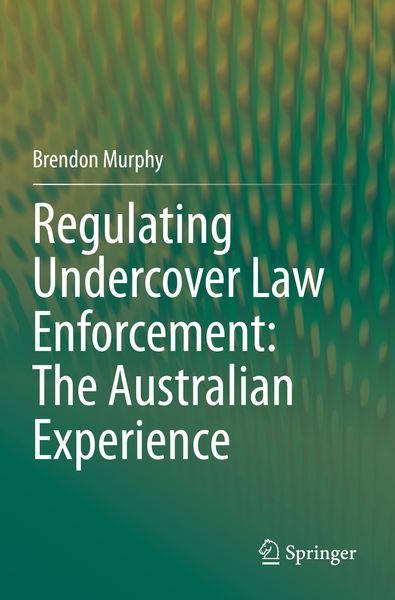
Regulating Undercover Law Enforcement: The Australian Experience
-
- Hardcover
- Taschenbuch ausgewählt
- eBook
-
Sprache:Englisch
84,99 €
UVP
96,29 €
inkl. gesetzl. MwSt.,
Beschreibung
Produktdetails
Einband
Taschenbuch
Erscheinungsdatum
07.03.2022
Abbildungen
XXIII, 370 p. 12 illus.
Verlag
Springer SingaporeSeitenzahl
370
Maße (L/B/H)
23,5/15,5/2,2 cm
Gewicht
598 g
Auflage
1st ed. 2021
Sprache
Englisch
ISBN
978-981-3363-83-0
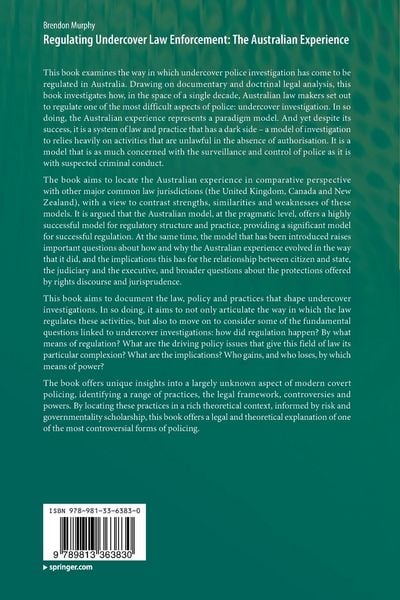
This book examines the way in which undercover police investigation has come to be regulated in Australia. Drawing on documentary and doctrinal legal analysis, this book investigates how, in the space of a single decade, Australian law makers set out to regulate one of the most difficult aspects of police: undercover investigation. In so doing, the Australian experience represents a paradigm model. And yet despite its success, it is a system of law and practice that has a dark side – a model of investigation to relies heavily on activities that are unlawful in the absence of authorisation. It is a model that is as much concerned with the surveillance and control of police as it is with suspected criminal conduct.
The book aims to locate the Australian experience in comparative perspective with other major common law jurisdictions (the United Kingdom, Canada and New Zealand), with a view to contrast strengths, similarities and weaknesses of these models. It is arguedthat the Australian model, at the pragmatic level, offers a highly successful model for regulatory structure and practice, providing a significant model for successful regulation. At the same time, the model that has been introduced raises important questions about how and why the Australian experience evolved in the way that it did, and the implications this has for the relationship between citizen and state, the judiciary and the executive, and broader questions about the protections offered by rights discourse and jurisprudence.
This book aims to document the law, policy and practices that shape undercover investigations. In so doing, it aims to not only articulate the way in which the law regulates these activities, but also to move on to consider some of the fundamental questions linked to undercover investigations: how did regulation happen? By what means of regulation? What are the driving policy issues that give this field of law its particular complexion? What are the implications? Who gains, and who loses, by which means of power?
The book offers unique insights into a largely unknown aspect of modern covert policing, identifying a range of practices, the legal framework, controversies and powers. By locating these practices in a rich theoretical context, informed by risk and governmentality scholarship, this book offers a legal and theoretical explanation of one of the most controversial forms of policing.
Noch keine Bewertungen vorhanden
Verfassen Sie die erste Bewertung zu diesem Artikel
Helfen Sie anderen Kundinnen und Kunden durch Ihre Meinung.
Kurze Frage zu unserer Seite
Vielen Dank für Ihr Feedback
Wir nutzen Ihr Feedback, um unsere Produktseiten zu verbessern. Bitte haben Sie Verständnis, dass wir Ihnen keine Rückmeldung geben können. Falls Sie Kontakt mit uns aufnehmen möchten, können Sie sich aber gerne an unseren Kund*innenservice wenden.
zum Kundenservice