Gutscheinbedingungen

Gültig bis 13.07.2026 | Gültig für Spielzeug (außer Tonieboxen & ausgewählte Tonies), Filme, Musik, Software, Games, Schreibwaren, Hörbücher und Hörbuch-Downloads (außer Abo & Shelfies), gebrauchte Bücher, nicht preisgebundene Bücher und Kalender | Einlösbar unter osiander.de und in der Osiander App | Click & Collect nur mit Online-Zahlung (Paypal/Kreditkarte) vorab | Einzelne Artikel können ausgeschlossen sein | Nicht kombinierbar mit anderen Gutscheinen oder Preisaktionen | Nur einmal pro Einkauf einlösbar | Gutschein wird auf max. 500€ Bestellwert angerechnet | Keine Barauszahlung | Digitale Hörbücher nur für Android | Nicht gültig für preisgebundene Artikel (aufgrund der Buchpreisbindung sind Gutscheine nicht auf Bücher, eBooks, Presse einlösbar), tolino eReader & Zubehör, Elektronik, Geschenke & Trends, Abonnements & Flatrates, Geschenkkarten, Versandkosten und Services

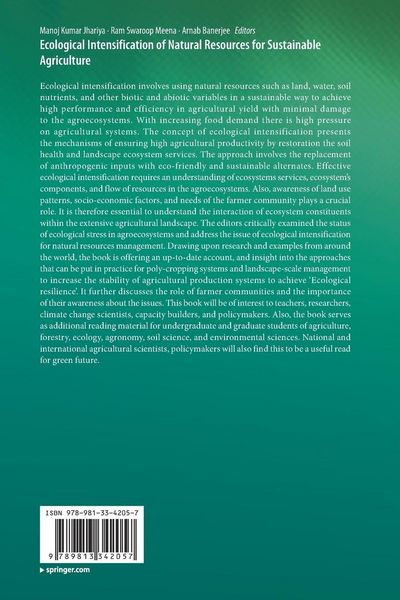
  • Produktbild: Ecological Intensification of Natural Resources for Sustainable Agriculture
  • Produktbild: Ecological Intensification of Natural Resources for Sustainable Agriculture
- 13%

Ecological Intensification of Natural Resources for Sustainable Agriculture

13% sparen

231,99 € UVP 267,49 €

inkl. gesetzl. MwSt., Versandkostenfrei


Beschreibung

Produktdetails

Einband

Taschenbuch

Erscheinungsdatum

09.03.2022

Herausgeber

Manoj Kumar Jhariya + weitere

Verlag

Springer Singapore

Seitenzahl

655

Maße (L/B/H)

23,5/15,5/3,6 cm

Auflage

1st ed. 2021

Sprache

Englisch

ISBN

978-981-3342-05-7

Beschreibung

Portrait

Dr. Manoj Kumar Jhariya is Assistant Professor at the Department of Farm Forestry, Sant Gahira Guru Vishwavidyalaya (Formerly Sarguja University) Ambikapur (Chhattisgarh), India, and the author or co-author of more than 68 scientific papers, 09 books, 33 book chapters and several extension articles. Dr.Jhariya acquired B.Sc. (Agriculture), M.Sc. and Ph.D. (both in Forestry) degrees from Indira Gandhi Krishi Vishwavidyalaya, Raipur, Chhattisgarh, India. Dr.Jhariya was awarded a UGC-RGNF Fellowship, New Delhi, India, and received a Chhattisgarh Young Scientist Award from Chhattisgarh Council of Science and Technology in 2013. He is an editorial board member for several journals and a life member of numerous societies

Dr. Ram Swaroop Meena  is working as an Assistant Professor in the Department of Agronomy, I.Ag. Scs., BHU, Varanasi (UP). Dr. Meena has been awarded Raman Research Fellowship by the MHRD, GOI. He has completed his postdoctoral research on soil carbon sequestration under Prof. Rattan Lal World Food Prize 2020 Laureate 2020, Director, CMASC, Columbus, USA. Dr. Meena has supervised 20 PG and 6 PhD students, and have10 years of research and teaching experience. He is working on the three externally funded projects (DST, MHRD, ICAR) with one patent. Dr. Meena has published more than 110 research and review papers and have H-index ~ 40, as well 4 published books at the national and 14 books at the international levels, and contributedin the books with 15 chapters at national and 50 at the international levels. He has worked as an expert for the NCERT, MHRD, GOI. Dr. Meena is contributed in several agricultural extension activities, trainings, meetings, workshops, etc.   

Dr. Arnab Banerjee  is an assistant professor, Department of Environmental Science, Sant Gahira Guru Vishwavidyalaya, Ambikapur, Chhattisgarh, India. He has completed M.Sc. and Ph.D. (Environmental Science) from Burdwan University and M.Phil. in Environmental Science from Kalyani University, West Bengal. He won the University Gold Medal for securing first class first position in M.Sc. examination. He has been awarded Young Scientist Award for best oral presentation at the international conference held at the University of Burdwan. He was a project fellow under UGC-sponsored major research project. To his credit, he has published 67 research papers in reputed national and international journals, 8 books, and 27 book chapters. He is life member of the Academy of Environmental Biology. He has supervised 23 postgraduate students and engaged in Postgraduate Teaching and Research.

,

Produktdetails

Einband

Taschenbuch

Erscheinungsdatum

09.03.2022

Herausgeber

Verlag

Springer Singapore

Seitenzahl

655

Maße (L/B/H)

23,5/15,5/3,6 cm

Auflage

1st ed. 2021

Sprache

Englisch

ISBN

978-981-3342-05-7

Herstelleradresse

Springer-Verlag KG
Sachsenplatz 4-6
1201 Wien
AT

Email: GPSR Kontakt

Noch keine Bewertungen vorhanden

Verfassen Sie die erste Bewertung zu diesem Artikel

Helfen Sie anderen Kundinnen und Kunden durch Ihre Meinung.

Kundinnen und Kunden meinen

Bewertungen (0)

  • Produktbild: Ecological Intensification of Natural Resources for Sustainable Agriculture
  • Produktbild: Ecological Intensification of Natural Resources for Sustainable Agriculture
  • Chapter 1. Ecological Intensification of Natural Resources towards Sustainable Productive System.- Chapter 2. Ecologically Harmonized Agricultural Management for Global Food Security.- Chapter 3. Ecological Intensification: A Step towards Biodiversity Conservation and Management of Terrestrial Landscape.- Chapter 4. Climate Change and Agricultural Sustainable Intensification in the Arid Lands.- Chapter 5. Ecological Intensification for Sustainable Development.- Chapter 6. Ecological Intensification for Sustainable Agriculture in South Asia.- Chapter 7. Ecological Intensification for Sustainble Agriculture and Environment in India.- Chapter 8. Mulching and Weed Management towards Sustainability.- Chapter 9. Vertical Greenhouses Agro-technology- Solution toward Environmental Problems.- chapter 10. Bioremediation of Lead Contaminated Soils for Sustainable Agriculture.- Chapter 11. Pollination and Ecological Intensification: A Way towards GreenRevolution.- Chapter 12. Ecosystem Services of Himalayan Alder.- Chapter 13. Soil Carbon Stock and Sequestration: Implications for Climate Change Adaptation and Mitigation.- Chpater 14. Ecomodelling towards Natural Resource Management and Sustainability.- Chapter 15. Ecological Intensification for Sustainable Agriculture: The Nigerian Perspective.- Chapter 16. Eco-designing for Sustainability.- Chpater 17. Ecological Intensification: Towards Food and Environmental Security in Sub-Saharan Africa.- Chapter 18. Eco-intensified Breeding Strategies for Improving Climate Resilience in Goats.