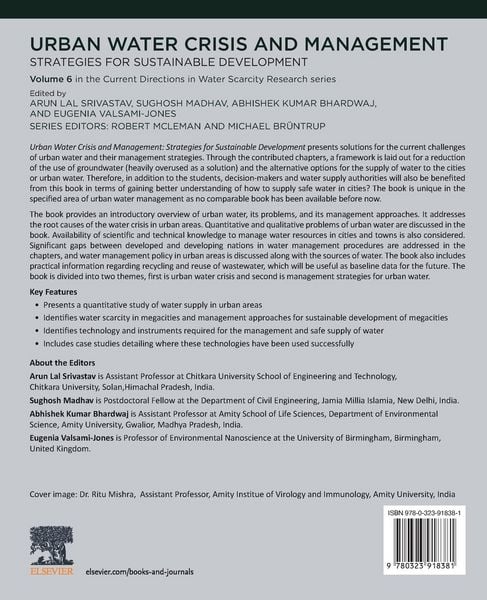
Dr. Sughosh Madhav works as a Postdoctoral Fellow at the Department of Civil Engineering, Jamia Millia Islamia, New Delhi, India. He has obtained his master's degree from the Department of Environmental Science Banaras Hindu University, Varanasi, India. He earned his doctorate from Jawaharlal Nehru University, New Delhi, India. The area of his doctoral research is the environmental impact of textile effluents on groundwater and soil quality. He has published various research papers and book chapters in environmental geochemistry, water pollution, and wastewater remediation. He also edited 4 books related to water resource management in Elsevier, Springer, and Wiley publications.
Dr. Abhishek Kumar Bhardwaj is working as an Assistant Professor at Amity School of Life Sciences, Department of Environmental Science, Amity University, India. He obtained his PhD from the Central University of Allahabad, Prayagraj, India, in the field of environmental nanotechnology. He has also done Post-doctoral research at the Department of Environmental Science, VBS Purvanchal University, Jaunpur (India). Currently, He is actively involved in the teaching and guidance of undergraduate, MSc, and PhD students. Dr. Bhardwaj's research interests encompass a wide array of topics, including green synthesis of nanomaterials for water purification, bio-sensing, nano-based device fabrication, water treatment, diatom cultivation, mushroom cultivation, phytoremediation, and waste management. His contributions to the field are well-recognized, as he has published over 30 research papers in prestigious journals, including Elsevier, Springer, American Chemical Society, American Institute of Physics, MDPI, and Frontier, among others. Furthermore, Dr. Bhardwaj serves as a respected reviewer for esteemed journals such as Journals of Cleaner Production, Journals of Environmental Pollution, Bioresource Technology, Journals of Nanoparticle Research, Scientific Reports, and more. He has also edited two books in collaboration with Elsevier and Springer. His dedication to academia and research has made him a valuable asset to the scientific community and a significant influence in the field of environmental science and nanotechnology.
Eugenia (Éva) Valsami-Jones is a Professor of Environmental Nanoscience at the University of Birmingham. She holds a degree in Earth Sciences from the University of Athens and a PhD in Geochemistry from the University of Newcastle-upon-Tyne. Her research focuses on nanoscale processes in the environment and within biota. She has pioneered the development of traceable stable-isotope labelled nanomaterials and has been working on the development of analytical solutions for the improvement in speed and quality of nanoscale characterisation. Her current research priorities revolve around the application of nanotechnologies in solving environmental problems, particularly related to clean water and sustainable agriculture. She was the Mineralogical Society's Distinguished Lecturer for 2015 and the Distinguished Guest Lecturer and Medalist of the Royal Society of Chemistry for 2015. She is currently a Royal Society Wolfson Fellow. She is a member of the coordination team of the European Commission's Nanosafety Cluster.
Dr. Arun Lal Srivastav is working as Professor and Associate Dean (Research), Tulas University, Dehradun, Uttarakhand, India. He received PhD from the Indian Institute of Technology (BHU), Varanasi. He has also done post-doctoral research at National Chung Hsing University, Taiwan. He is currently involved in the teaching of Environmental Science and Engineering, Disaster Management to the undergraduate engineering students. His research interests include water quality surveillance, climate change, water treatment, river ecosystem, soil health maintenance, engineering education, phytoremediation and waste management. Under his supervision, 3 PhD degrees have been awarded. He has published >150 research papers in various prestigious journals (Elsevier, Springer, IWA, Taylor & Francis etc.) including books, book chapters and conference publications. He has edited many books with Elsevier, Springer, NOVA, IGI global and Wiley. He worked on 04 Government sponsored projects (worth ~16 million INR) on phytoremediation, adsorption, capacity building, organic farming, leachate treatment, agro-waste management etc. He received the prestigious "Teachers Associateship for Research Excellence (TARE) Fellowship" followed by a research grant from the Science and Engineering Research Board (SERB), Govt. of India in 2022. He has also filed 31 patents on multidisciplinary topics and 14 out of which have been granted by the Government of India. He has also been recognized among the top 2% worldwide scientists of Earth and Environmental Sciences jointly by Stanford University and Elsevier in the year 2023, 2024 and 2025. Recently, his name has been included in top 0.05% scholars of the year 2025 by ScholarGPS in Environmental Sciences.