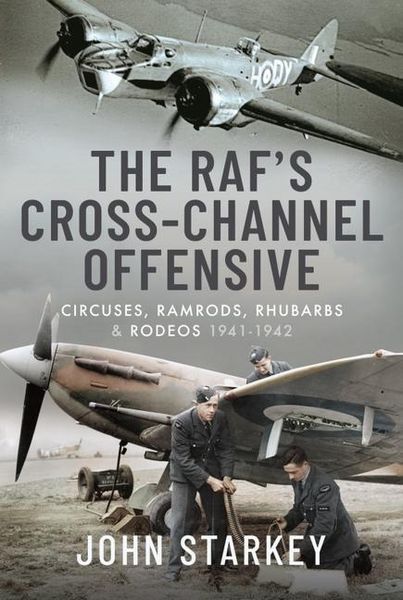
The RAF's Cross-Channel Offensive Circuses, Ramrods, Rhubarbs and Rodeos 1941-1942
31,99 €
inkl. gesetzl. MwSt.,
Beschreibung
Produktdetails
Einband
Gebundene Ausgabe
Erscheinungsdatum
12.12.2022
Verlag
Pen & Sword Books LtdSeitenzahl
256
Maße (L/B/H)
24,1/16,4/3,1 cm
Gewicht
630 g
Sprache
Englisch
ISBN
978-1-399-08892-3
Marshal of the Royal Air Force Hugh Montague Trenchard commanded the Royal Flying Corps in the First World War. His policy then had been for his aircraft and men to be continually on the offensive, always over the German lines taking the fight to the enemy. After being promoted to command the RAF, Trenchard retired in 1930.
In November 1940, Trenchard showed up again at the Air Ministry and proposed that the RAF should 'Lean Towards France' - that it should go on the offensive. The RAF would, claimed Trenchard, win the resulting battle of attrition.
One of the main outcomes of the RAF's new offensive stance was the introduction of the Circus sorties. These were attacks undertaken by a small force of bombers with a powerful fighter escort. They were intended to lure enemy fighters into the air so that they could be engaged by RAF fighters, the primary objective being the destruction of Luftwaffe fighters, followed by the protection of the bombers from attack.
A further development of the Circus missions were Ramrods, Rhubarbs and Rodeos, all of which were variations on the same theme. A Ramrod was similar to a Circus, though in this instance the primary objective was the destruction of the target, the main role of the accompanying fighters being to protect the bombers from attack. A Rhubarb was a small-scale attack by fighters using cloud cover and/or surprise, the object of which was to destroy German aircraft in the air and/or striking at ground targets, while a Rodeo consisted of a fighter sweep over enemy territory with no bombers.
Drawing on official documents and archive material, as well as accounts by many of those involved, James Starkey reveals just how Trenchard's views won through and the RAF went on the offensive from late 1940 into 1941. Was it a failed strategy? If so, why was it not halted once the results began to be seen?
Noch keine Bewertungen vorhanden
Verfassen Sie die erste Bewertung zu diesem Artikel
Helfen Sie anderen Kundinnen und Kunden durch Ihre Meinung.
Kurze Frage zu unserer Seite
Vielen Dank für Ihr Feedback
Wir nutzen Ihr Feedback, um unsere Produktseiten zu verbessern. Bitte haben Sie Verständnis, dass wir Ihnen keine Rückmeldung geben können. Falls Sie Kontakt mit uns aufnehmen möchten, können Sie sich aber gerne an unseren Kund*innenservice wenden.
zum Kundenservice