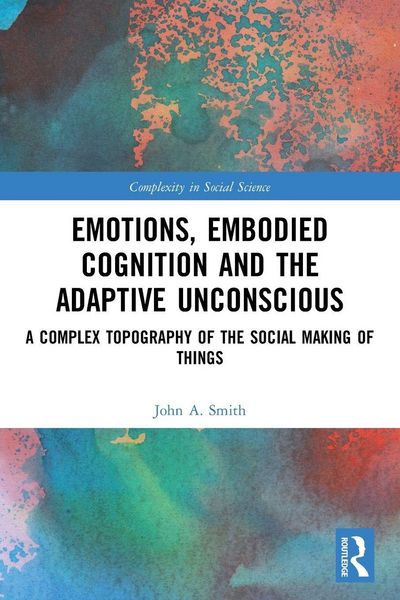
Emotions, Embodied Cognition and the Adaptive Unconscious A Complex Topography of the Social Making of Things
-
- Hardcover
- Taschenbuch ausgewählt
- eBook
-
Sprache:Englisch
69,99 €
inkl. gesetzl. MwSt.,
Beschreibung
Produktdetails
Einband
Taschenbuch
Erscheinungsdatum
29.04.2022
Verlag
Taylor & FrancisSeitenzahl
262
Maße (L/B/H)
23,4/15,6/1,4 cm
Gewicht
404 g
Sprache
Englisch
ISBN
978-0-367-56838-2
Emotions, Embodied Cognition and the Adaptive Unconscious argues for the need to consider many other factors, drawn from disciplines such as socio-biology, evolutionary psychology, the study of the emotions, the adaptive unconscious, the senses and conscious deliberation in analysing the complex topography of social action and the making of things.
These factors are taken as ecological conditions that shape the contemporary expression of complex societies, not as constraints on human plasticity. Without 'foundations', complex society cannot exist nor less evolve. This is the familiar pairing from complexity theory: path dependency and dynamic emergence. Inter-disciplinary and complexity perspectives need to be incorporated into the social sciences. Routinely, sociologists think of social phenomena as a distinct field, expressed in the term: the 'social construction of' without apparent need to refer to other material, biological, psychological, material or ecological conditions or agents.
This book shows how the familiar sociological dynamics of identity, solidarity, differentiation and communication are shaped through the persistent interaction of unconscious and affective processing with conscious deliberation in newly emergent contexts. It is this re-expression, not the surpassing, of human characteristics in contemporary social action that needs to re-inform a complex, ecological approach to the theory and methodologies of the social sciences. The book is intended for a postgraduate/research audience and doctoral students to introduce and synthesise inter-disciplinary contributions to research into complexity theory in the social sciences.
Noch keine Bewertungen vorhanden
Verfassen Sie die erste Bewertung zu diesem Artikel
Helfen Sie anderen Kundinnen und Kunden durch Ihre Meinung.
Kurze Frage zu unserer Seite
Vielen Dank für Ihr Feedback
Wir nutzen Ihr Feedback, um unsere Produktseiten zu verbessern. Bitte haben Sie Verständnis, dass wir Ihnen keine Rückmeldung geben können. Falls Sie Kontakt mit uns aufnehmen möchten, können Sie sich aber gerne an unseren Kund*innenservice wenden.
zum Kundenservice