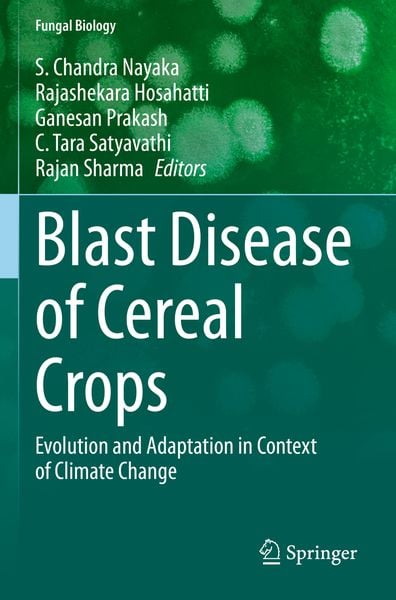
Blast Disease of Cereal Crops Evolution and Adaptation in Context of Climate Change
-
- Hardcover
- Taschenbuch ausgewählt
- eBook
-
Sprache:Englisch
138,99 €
UVP
160,49 €
inkl. gesetzl. MwSt.,
Beschreibung
Produktdetails
Einband
Taschenbuch
Erscheinungsdatum
23.04.2022
Abbildungen
XV, 219 p. 18 illus., 16 illus. in color.
Herausgeber
S. Chandra Nayaka + weitereVerlag
SpringerSeitenzahl
219
Maße (L/B/H)
23,5/15,5/1,4 cm
Gewicht
371 g
Auflage
22001 Auflage 1st ed. 2021
Sprache
Englisch
ISBN
978-3-030-60587-2
Blast is an important foliar disease that infects the majority of cereal crops like rice, finger millet, pearl millet, foxtail millet and wheat, and thus resulting in a huge economic impact. The pathogen is responsible for causing epidemics in many crops and commonly shifts to new hosts. Magnaporthe spp. is the most prominent cause of blast disease on a broad host range of grasses including rice as well as other species of poaceae family. To date, 137 members of Poaceae hosting this fungus have been described in Fungal Databases. This book provides information on all blast diseases of different cereal crops. The pathogen evolves quickly due to its high variability, and thus can quickly adapt to new cultivars and cause an epidemic in a given crop. Some of the topics covered here include historical perspectives, pathogen evolution, host range shift, cross-infectivity, and pathogen isolation, use of chemicals fungicides, genetics and genomics, and management of blast disease in different cereal crops with adoption of suitable methodologies.In the past two decades there have been significant developments in genomics and proteomics approaches and there has been substantial and rapid progress in the cloning and mapping of R genes for blast resistance, as well as in comparative genomics analysis for resolving delineation of Magnaporthe species that infect both cereals and grass species. Blast disease resistance follows a typical gene-for-gene hypothesis. Identification of new Avr genes and effector molecules from Magnaporthe spp. can be useful to understand the molecular mechanisms involved in the fast evolution of different strains of this fungal genus. Advances in these areas may help to reduce the occurrence of blast disease by the identification of potential R genes for effective deployment. Additionally, this book highlights the importance of blast disease that infects different cereal hosts in the context of climate change, and genomics approaches that may potentially help in understanding and applying new concepts and technologies that can make real impact in sustainable management of blast disease in different cereal crops.
Noch keine Bewertungen vorhanden
Verfassen Sie die erste Bewertung zu diesem Artikel
Helfen Sie anderen Kundinnen und Kunden durch Ihre Meinung.
Kurze Frage zu unserer Seite
Vielen Dank für Ihr Feedback
Wir nutzen Ihr Feedback, um unsere Produktseiten zu verbessern. Bitte haben Sie Verständnis, dass wir Ihnen keine Rückmeldung geben können. Falls Sie Kontakt mit uns aufnehmen möchten, können Sie sich aber gerne an unseren Kund*innenservice wenden.
zum Kundenservice