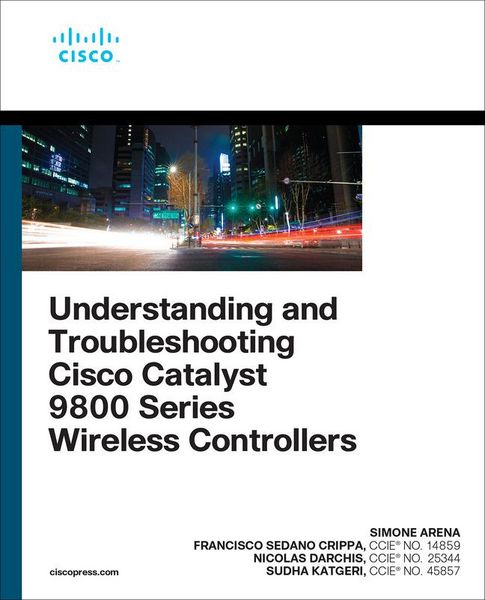
Understanding and Troubleshooting Cisco Catalyst 9800 Series Wireless Controllers
-
- Taschenbuch ausgewählt
- eBook
-
Sprache:Englisch
68,99 €
inkl. gesetzl. MwSt.,
Beschreibung
Produktdetails
Einband
Taschenbuch
Erscheinungsdatum
09.08.2022
Verlag
Pearson AcademicSeitenzahl
656
Maße (L/B/H)
18,9/23,2/3,4 cm
Gewicht
1084 g
Auflage
1. Auflage
Sprache
Englisch
ISBN
978-0-13-749232-9
The definitive professional’s guide to the Cisco next-gen 9800 wireless controllers
As wireless networks, applications, and services rapidly evolve, they grow increasingly business critical, with steeper requirements for performance, latency, deployment density, and device support. The advanced Catalyst 9800 wireless controllers from Cisco meet these challenges, delivering exceptional adaptability, security, performance, scalability, and programmability. Based on the modern and secure Cisco IOS XE operating system, their support for Cisco intent-based networking will help you continually leverage new innovation. Now, four Cisco experts offer end-to-end guidance, practical tips, and proven recommendations for designing, deploying, and managing wireless networks with the Catalyst 9800.
For technical decision makers, this guide delivers a deep understanding of Catalyst 9800 hardware and software, tightly linked to business value. Architects will find essential details for both upfront network design and feature implementation. Network operators and other IT professionals will discover tested tools and methods for reliable and efficient setup, configuration, monitoring, and troubleshooting. Whatever your role, this guide will help you maximize the value of any Catalyst 9800 network, and serve as your indispensable reference for years to come.
- Understand Catalyst 9800 benefits, capabilities, roles, and architecture
- Learn the new C9800 Configuration Model, with key design considerations and best practices
- Deploy and configure the C9800 in private and public clouds
- Systematically secure the C9800: from AAA and ACLs to rogue detection and wireless intrusion prevention (WIPS)
- Establish and optimize seamless client roaming in enterprise environments
- Learn how the C9800 implements key RF concepts
- Plan and implement an end-to-end architecture for QoS, and design/ deploy for high availability and network services like multicast
- Discover value-added wireless services available through Cisco DNA Spaces
- Drive agility and value via network programmability with YANG, Python, RESTCONF, and NETCONF
- Make the most out of the rich data models of Model-Driven Telemetry and Programmability using open-source tools
- Walk through wireless network troubleshooting, backup/restore, and upgrades
Noch keine Bewertungen vorhanden
Verfassen Sie die erste Bewertung zu diesem Artikel
Helfen Sie anderen Kundinnen und Kunden durch Ihre Meinung.
Kurze Frage zu unserer Seite
Vielen Dank für Ihr Feedback
Wir nutzen Ihr Feedback, um unsere Produktseiten zu verbessern. Bitte haben Sie Verständnis, dass wir Ihnen keine Rückmeldung geben können. Falls Sie Kontakt mit uns aufnehmen möchten, können Sie sich aber gerne an unseren Kund*innenservice wenden.
zum Kundenservice