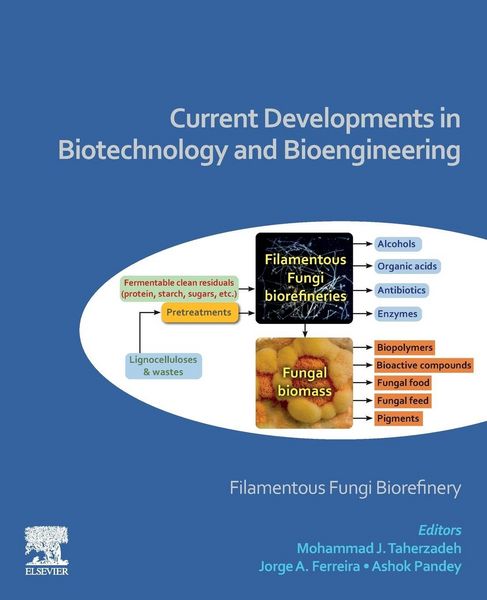
Current Developments in Biotechnology and Bioengineering Filamentous Fungi Biorefinery
-
- Hardcover
- Taschenbuch ausgewählt
- eBook
-
Sprache:Englisch
-
Verlag:Elsevier Science & Technology
- Elsevier Science & Technology 159,99 €
- Elsevier Science & Technology 159,99 €
- Elsevier Science & Technology 168,99 €
- Elsevier Science & Technology 168,99 €
- Elsevier Science & Technology 168,99 €
- Elsevier Science & Technology 168,99 €
- Elsevier Science & Technology 168,99 €
- Elsevier Science & Technology 168,99 €
- Elsevier Science & Technology 168,99 €
- Elsevier Science & Technology 168,99 €
- Elsevier Science & Technology 173,99 €
- Elsevier Science & Technology 173,99 €
- Elsevier Science & Technology 173,99 €
- Elsevier Science & Technology 173,99 €
- Elsevier Science & Technology 173,99 €
- Elsevier Science & Technology 173,99 €
- Elsevier Science & Technology 173,99 €
- Elsevier Science & Technology 173,99 €
- Elsevier Science & Technology 173,99 €
- Elsevier Science & Technology 173,99 € ausgewählt
173,99 €
UVP
237,50 €
inkl. gesetzl. MwSt.,
Beschreibung
Produktdetails
Einband
Taschenbuch
Erscheinungsdatum
25.11.2022
Abbildungen
Approx. 100 illustrations
Herausgeber
Mohammad Taherzadeh + weitereVerlag
Elsevier Science & TechnologySeitenzahl
614
Maße (L/B/H)
23,5/19,1/3,1 cm
Gewicht
1041 g
Sprache
Englisch
ISBN
978-0-323-91872-5
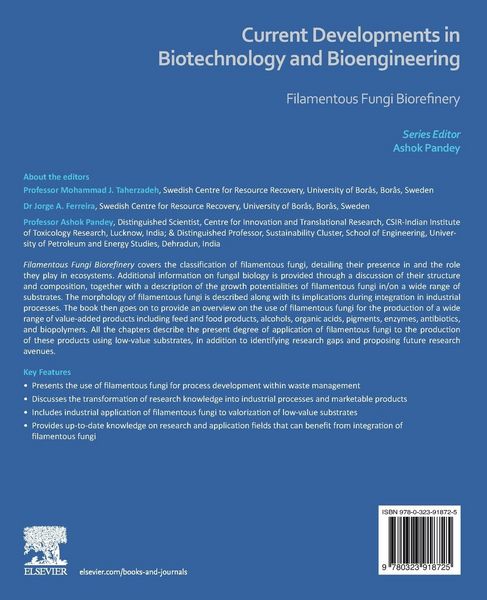
Filamentous Fungi Biorefinery, the latest release in the Current Developments in Biotechnology and Bioengineering series, builds on knowledge on the classification of filamentous fungi and presence and roles played in ecosystems. The importance of filamentous fungi is then further corroborated through a description of their present applications in biotechnological processes. Knowledge on fungal biology is extended through discussion on structure and composition together with a description of growth potentialities of filamentous fungi in/on a wide range of substrates. In addition, the morphology of filamentous fungi is then described and its implications during integration in industrial processes is discussed.
The book then provides an overview on the use of filamentous fungi for the production of a wide range of value-added products, including feed and food products, alcohols, organic acids, pigments, enzymes, antibiotics and biopolymers. All provided state-of-arts are extended to a description of the present degree of application of filamentous fungi towards the production of those products using low-value substrates, identification of research gaps, and proposes future research avenues.
Noch keine Bewertungen vorhanden
Verfassen Sie die erste Bewertung zu diesem Artikel
Helfen Sie anderen Kundinnen und Kunden durch Ihre Meinung.
Kurze Frage zu unserer Seite
Vielen Dank für Ihr Feedback
Wir nutzen Ihr Feedback, um unsere Produktseiten zu verbessern. Bitte haben Sie Verständnis, dass wir Ihnen keine Rückmeldung geben können. Falls Sie Kontakt mit uns aufnehmen möchten, können Sie sich aber gerne an unseren Kund*innenservice wenden.
zum Kundenservice