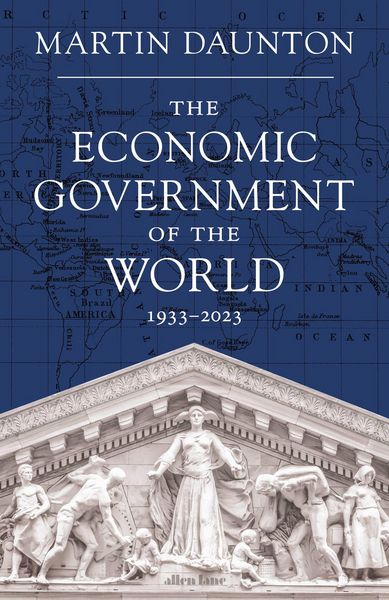
The Economic Government of the World 1933-2023
-
- Hardcover ausgewählt
- Taschenbuch
- eBook
-
Sprache:Englisch
55,99 €
inkl. gesetzl. MwSt.,
Beschreibung
Produktdetails
Einband
Gebundene Ausgabe
Erscheinungsdatum
11.05.2023
Verlag
Penguin Books UKSeitenzahl
1024
Maße (L/B/H)
23,8/15,5/5,1 cm
Gewicht
1324 g
Sprache
Englisch
ISBN
978-1-84614-171-3
An epic history of money, trade and development since 1933
In 1933, Keynes reflected on the crisis of the Great Depression that arose from individualistic capitalism: 'It is not intelligent, it is not beautiful, it is not just, it is not virtuous - and it doesn't deliver the goods ... But when we wonder what to put in its place, we are extremely perplexed.' We are now in a similar state of perplexity, wondering how to respond to the economic problems of the world.
Martin Daunton examines the changing balance over ninety years between economic nationalism and globalization, explaining why one economic order breaks down and how another one is built, in a wide-ranging history of the institutions and individuals who have managed the global economy. In 1933, the World Monetary and Economic Conference brought together the nations of the world: it failed. Trade and currency warfare led to economic nationalism and a turn from globalization that culminated in war. During the Second World War, a new economic order emerged - the embedded liberalism of Bretton Woods, the International Monetary Fund and the International Bank for Reconstruction and Development - and the post-war General Agreement on Tariffs and Trade. These institutions and their rules created a balance between domestic welfare and globalization, complemented by a social contract between labour, capital and the state to share the benefits of economic growth.
Yet this embedded liberalism reflected the interests of the 'west' in the Cold War: in the 1970s, it faced collapse, caused by its internal weaknesses and the breakdown of the social contract, and was challenged by the Third World as a form of neo-colonialism. It was succeeded by neoliberalism, financialisation and hyper-globalization. In 2008, the global financial crash exposed the flaws of neoliberalism without leading to a fundamental change. Now, as leading nations are tackling the fall-out from Covid-19 and the threats of inflation, food security and the existential risk of climate change, Martin Daunton calls for a return to a globalization that benefits many of the world's poor and a fairer capitalism that delivers domestic welfare and equality.
The Economic Government of the World is the first history to show how trade, international monetary relations, capital mobility and development impacted on and influenced each other. Martin Daunton places these economic relations in the geo-political context of the twentieth century, and considers the importance of economic ideas and of political ideology, of electoral calculations and institutional design. The book rests on extensive archival research to provide a powerful analysis of the origins of our current global crisis, and suggests how we might build a fairer international order.
Noch keine Bewertungen vorhanden
Verfassen Sie die erste Bewertung zu diesem Artikel
Helfen Sie anderen Kundinnen und Kunden durch Ihre Meinung.
Kurze Frage zu unserer Seite
Vielen Dank für Ihr Feedback
Wir nutzen Ihr Feedback, um unsere Produktseiten zu verbessern. Bitte haben Sie Verständnis, dass wir Ihnen keine Rückmeldung geben können. Falls Sie Kontakt mit uns aufnehmen möchten, können Sie sich aber gerne an unseren Kund*innenservice wenden.
zum Kundenservice