
Social Simulation for a Crisis Results and Lessons from Simulating the COVID-19 Crisis
-
- Hardcover
- Taschenbuch ausgewählt
- eBook
-
Sprache:Englisch
159,99 €
UVP
181,89 €
inkl. gesetzl. MwSt.,
Beschreibung
Produktdetails
Einband
Taschenbuch
Erscheinungsdatum
10.06.2022
Abbildungen
XIV, 453 p. 170 illus., 155 illus. in color.
Herausgeber
Frank DignumVerlag
SpringerSeitenzahl
453
Maße (L/B/H)
23,5/15,5/2,6 cm
Gewicht
703 g
Auflage
22001 Auflage 1st ed. 2021
Sprache
Englisch
ISBN
978-3-030-76399-2
Simulating
for
a crisis is far more than creating a simulation
of
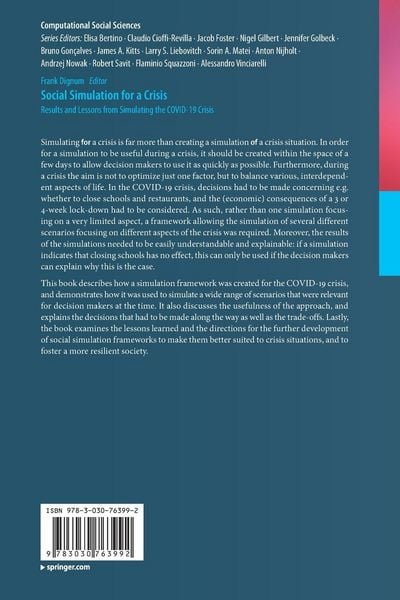
a crisis situation. In order for a simulation to be useful during a crisis, it should be created within the space of a few days to allow decision makers to use it as quickly as possible. Furthermore, during a crisis the aim is not to optimize just one factor, but to balance various, interdependent aspects of life. In the COVID-19 crisis, decisions had to be made concerning e.g. whether to close schools and restaurants, and the (economic) consequences of a 3 or 4-week lock-down had to be considered. As such, rather than one simulation focusing on a very limited aspect, a framework allowing the simulation of several different scenarios focusing on different aspects of the crisis was required. Moreover, the results of the simulations needed to be easily understandable and explainable: if a simulation indicates that closing schools has no effect, this can only be used if the decision makers can explain why this is the case. This book describes how a simulation framework was created for the COVID-19 crisis, and demonstrates how it was used to simulate a wide range of scenarios that were relevant for decision makers at the time. It also discusses the usefulness of the approach, and explains the decisions that had to be made along the way as well as the trade-offs. Lastly, the book examines the lessons learned and the directions for the further development of social simulation frameworks to make them better suited to crisis situations, and to foster a more resilient society.
Noch keine Bewertungen vorhanden
Verfassen Sie die erste Bewertung zu diesem Artikel
Helfen Sie anderen Kundinnen und Kunden durch Ihre Meinung.
Kurze Frage zu unserer Seite
Vielen Dank für Ihr Feedback
Wir nutzen Ihr Feedback, um unsere Produktseiten zu verbessern. Bitte haben Sie Verständnis, dass wir Ihnen keine Rückmeldung geben können. Falls Sie Kontakt mit uns aufnehmen möchten, können Sie sich aber gerne an unseren Kund*innenservice wenden.
zum Kundenservice