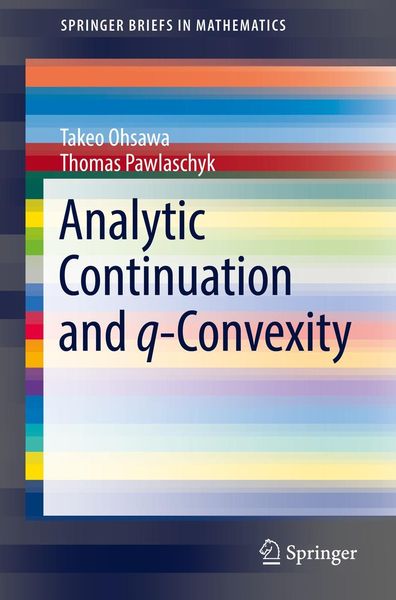
Analytic Continuation and q-Convexity
-
- Taschenbuch
- eBook ausgewählt
-
Form:Einzelkauf Download
-
Sprache:Englisch
58,84 €
inkl. gesetzl. MwSt.Beschreibung
Produktdetails
Format
Kopierschutz
Nein
Family Sharing
Nein
Text-to-Speech
Nein
Erscheinungsdatum
02.06.2022
Verlag
Springer Nature SingaporeSeitenzahl
58 (Printausgabe)
Dateigröße
1234 KB
Sprache
Englisch
EAN
9789811912399
The focus of this book is on the further development of the classical achievements in analysis of several complex variables, the analytic continuation and the analytic structure of sets, to settings in which the q-pseudoconvexity in the sense of Rothstein and the q-convexity in the sense of Grauert play a crucial role. After giving a brief survey of notions of generalized convexity and their most important results, the authors present recent statements on analytic continuation related to them.
Rothstein (1955) first introduced q-pseudoconvexity using generalized Hartogs figures. Slodkowski (1986) defined q-pseudoconvex sets by means of the existence of exhaustion functions which are q-plurisubharmonic in the sense of Hunt and Murray (1978). Examples of q-pseudoconvex sets appear as complements of analytic sets. Here, the relation of the analytic structure of graphs of continuous surfaces whose complements are q-pseudoconvex is investigated. As an outcome, the authors generalize results by Hartogs (1909), Shcherbina (1993), and Chirka (2001) on the existence of foliations of pseudoconcave continuous real hypersurfaces by smooth complex ones.A similar generalization is obtained by a completely different approach using L²-methods in the setting of q-convex spaces. The notion of q-convexity was developed by Rothstein (1955) and Grauert (1959) and extended to q-convex spaces by Andreotti and Grauert (1962). Andreotti-Grauert's finiteness theorem was applied by Andreotti and Norguet (1966-1971) to extend Grauert's solution of the Levi problem to q-convex spaces. A consequence is that the sets of (q-1)-cycles of q-convex domains with smooth boundaries in projective algebraic manifolds, which are equipped with complex structures as open subsets of Chow varieties, are in fact holomorphically convex. Complements of analytic curves are studied,and the relation of q-convexity and cycle spaces is explained. Finally, results for q-convex domains in projective spaces are shown and the q-convexity in analytic families is investigated.
Noch keine Bewertungen vorhanden
Verfassen Sie die erste Bewertung zu diesem Artikel
Helfen Sie anderen Kundinnen und Kunden durch Ihre Meinung.
Kurze Frage zu unserer Seite
Vielen Dank für Ihr Feedback
Wir nutzen Ihr Feedback, um unsere Produktseiten zu verbessern. Bitte haben Sie Verständnis, dass wir Ihnen keine Rückmeldung geben können. Falls Sie Kontakt mit uns aufnehmen möchten, können Sie sich aber gerne an unseren Kund*innenservice wenden.
zum Kundenservice