
Beschreibung
Produktdetails
Einband
Taschenbuch
Erscheinungsdatum
10.06.2022
Herausgeber
Kevala GoupVerlag
Aurea VidyaSeitenzahl
314
Maße (L/B/H)
22,9/15,2/1,9 cm
Gewicht
512 g
Sprache
Englisch
ISBN
978-1-931406-71-0
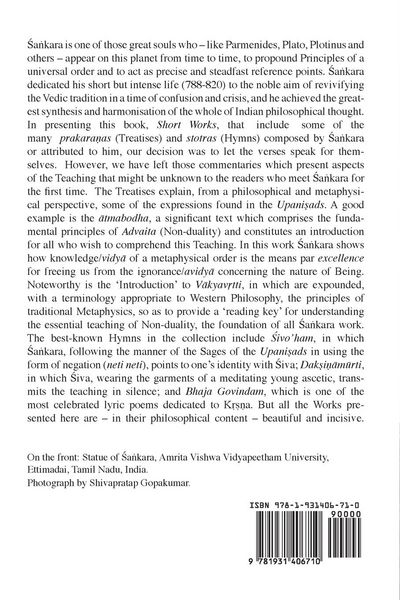
¿äkara is one of those great souls who - like Parmenides, Plato, Plotinus and others - appear on this planet from time to time, to propound Principles of a universal order and to act as precise and steadfast reference points. ¿äkara dedicated his short but intense life (788-820) to the noble aim of revivifying the Vedic tradition in a time of confusion and crisis, and he achieved the greatest synthesis and harmonisation of the whole of Indian philosophical thought. In presenting this book, Short Works, that include some of the many prakaräas (Treatises) and stotras (Hymns) composed by ¿äkara or attributed to him, our decision was to let the verses speak for themselves. However, we have left those commentaries which present aspects of the Teaching that might be unknown to the readers who meet ¿äkara for the first time. The Treatises explain, from a philosophical and metaphysical perspective, some of the expressions found in the Upani¿ads. A good example is the ¿tmabodha, a significant text which comprises the fundamental principles of Advaita (Non-duality) and constitutes an introduction for all who wish to comprehend this Teaching. In this work ¿äkara shows how knowledge/vidy¿ of a metaphysical order is the means par excellence for freeing us from the ignorance/avidy¿ concerning the nature of Being. Noteworthy is the 'Introduction' to V¿kyav¿tti, in which are expounded, with a terminology appropriate to Western Philosophy, the principles of traditional Metaphysics, so as to provide a 'reading key' for understanding the essential teaching of Non-duality, the foundation of all ¿äkara work. The best-known Hymns in the collection include ¿ivo'ham, in which ¿äkara, following the manner of the Sages of the Upani¿ads in using the form of negation (neti neti), points to one's identity with ¿iva; Dak¿i¿¿m¿rti, in which ¿iva, wearing the garments of a meditating young ascetic, transmits the teaching in silence; and Bhaja Govindam, which is one of the most celebrated lyric poems dedicated to K¿¿¿a. But all the Works presented here are - in their philosophical content - beautiful and incisive.
Noch keine Bewertungen vorhanden
Verfassen Sie die erste Bewertung zu diesem Artikel
Helfen Sie anderen Kundinnen und Kunden durch Ihre Meinung.
Kurze Frage zu unserer Seite
Vielen Dank für Ihr Feedback
Wir nutzen Ihr Feedback, um unsere Produktseiten zu verbessern. Bitte haben Sie Verständnis, dass wir Ihnen keine Rückmeldung geben können. Falls Sie Kontakt mit uns aufnehmen möchten, können Sie sich aber gerne an unseren Kund*innenservice wenden.
zum Kundenservice