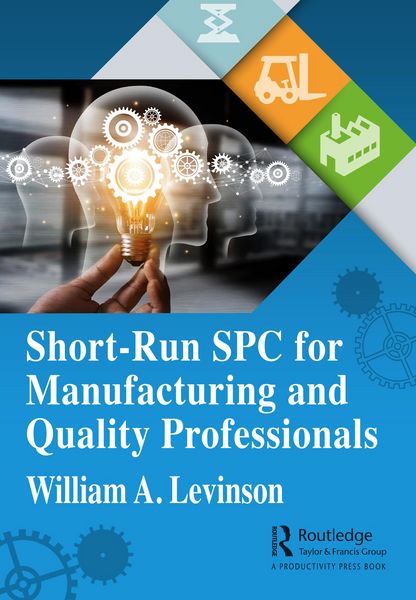
Short-Run SPC for Manufacturing and Quality Professionals
-
- Hardcover
- Taschenbuch
- eBook ausgewählt
-
Form:Einzelkauf Download
-
Sprache:Englisch
-
eBook Format:PDF
- ePUB 3 50,49 €
- PDF 50,49 € ausgewählt
50,49 €
inkl. gesetzl. MwSt.Beschreibung
Produktdetails
Format
Kopierschutz
Ja
Family Sharing
Nein
Text-to-Speech
Nein
Erscheinungsdatum
07.09.2022
Verlag
Taylor & Francis eBooksSeitenzahl
98 (Printausgabe)
Auflage
1. Auflage
Sprache
Englisch
EAN
9781000656244
On the manufacturing shop floor, the principle of "value comes from the production of parts rather than charts" crucially applies when using practical statistical process control (SPC). The production worker should need to enter only a sample's measurements to get immediately actionable information as to whether corrective action (e.g., as defined by a control plan's reaction plan) is necessary for an out-of-control situation, and should not have to perform any calculations, draw control charts, or use sophisticated statistical software. This book's key benefit for readers consists of spreadsheet-deployable solutions with all the mathematical precision of a vernier along with the simplicity of a stone ax.
Traditional SPC relies on the assumption that sufficient data are available with which to estimate the process parameters and set suitable control limits. Many practical applications involve, however, short production runs for which no process history is available. There are nonetheless tested and practical control methods such as PRE-Control and short-run SPC that use the product specifications to set appropriate limits. PRE-Control relies solely on the specification limits while short-run SPC starts with the assumption that the process is capable-that is, at least a 4-sigma process, and works from there to set control limits. Cumulative Sum (CUSUM) and exponentially weighted moving average (EWMA) charts also can be used for this purpose. Specialized charts can also track multiple part characteristics, and parts with different specifications, simultaneously. This is often useful, for example, where the same tool is engaged in mixed-model production.
Readers will be able to deploy practical and simple control charts for production runs for which no prior history is available and control the processes until enough data accumulate to enable the traditional methods (assuming it ever does). They will be able to track multiple product features with different specifications and also control mixed-model applications in which a tool generates very short runs of parts with different specifications. The methods will not require software beyond readily available spreadsheets, nor will they require specialized tables that are not widely available. Process owners and quality engineers will be able to perform all supporting calculations in Microsoft Excel, and without the need for advanced software.
Noch keine Bewertungen vorhanden
Verfassen Sie die erste Bewertung zu diesem Artikel
Helfen Sie anderen Kundinnen und Kunden durch Ihre Meinung.
Kurze Frage zu unserer Seite
Vielen Dank für Ihr Feedback
Wir nutzen Ihr Feedback, um unsere Produktseiten zu verbessern. Bitte haben Sie Verständnis, dass wir Ihnen keine Rückmeldung geben können. Falls Sie Kontakt mit uns aufnehmen möchten, können Sie sich aber gerne an unseren Kund*innenservice wenden.
zum Kundenservice