
Methods of Mathematical Oncology Fusion of Mathematics and Biology, Osaka, Japan, October 26–28, 2020
-
- Hardcover
- Taschenbuch ausgewählt
- eBook
-
Sprache:Englisch
168,99 €
UVP
192,59 €
inkl. gesetzl. MwSt.,
Beschreibung
Produktdetails
Einband
Taschenbuch
Erscheinungsdatum
23.08.2022
Abbildungen
XII, 308 p. 109 illus., 92 illus. in color.
Herausgeber
Takashi Suzuki + weitereVerlag
Springer SingaporeSeitenzahl
308
Maße (L/B/H)
23,5/15,5/1,8 cm
Gewicht
493 g
Auflage
22001 Auflage 1st ed. 2021
Sprache
Englisch
ISBN
978-981-16-4868-7
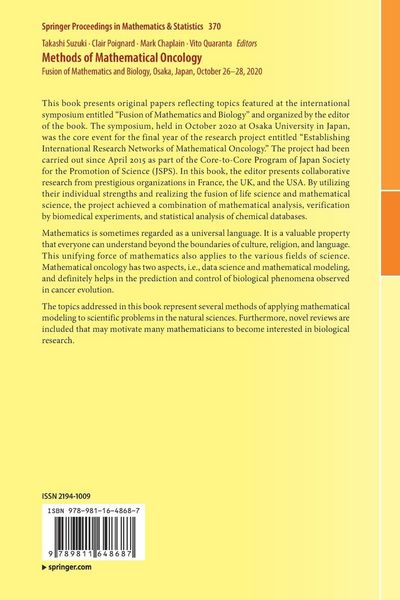
This book presents original papers reflecting topics featured at the international symposium entitled “Fusion of Mathematics and Biology” and organized by the editor of the book. The symposium, held in October 2020 at Osaka University in Japan, was the core event for the final year of the research project entitled “Establishing International Research Networks of Mathematical Oncology.” The project had been carried out since April 2015 as part of the Core-to-Core Program of Japan Society for the Promotion of Science (JSPS). In this book, the editor presents collaborative research from prestigious organizations in France, the UK, and the USA. By utilizing their individual strengths and realizing the fusion of life science and mathematical science, the project achieved a combination of mathematical analysis, verification by biomedical experiments, and statistical analysis of chemical databases.
Mathematics is sometimes regarded as a universal language. It is a valuable property that everyone can understand beyond the boundaries of culture, religion, and language. This unifying force of mathematics also applies to the various fields of science. Mathematical oncology has two aspects, i.e., data science and mathematical modeling, and definitely helps in the prediction and control of biological phenomena observed in cancer evolution.
The topics addressed in this book represent several methods of applying mathematical modeling to scientific problems in the natural sciences. Furthermore, novel reviews are included that may motivate many mathematicians to become interested in biological research.
Noch keine Bewertungen vorhanden
Verfassen Sie die erste Bewertung zu diesem Artikel
Helfen Sie anderen Kundinnen und Kunden durch Ihre Meinung.
Kurze Frage zu unserer Seite
Vielen Dank für Ihr Feedback
Wir nutzen Ihr Feedback, um unsere Produktseiten zu verbessern. Bitte haben Sie Verständnis, dass wir Ihnen keine Rückmeldung geben können. Falls Sie Kontakt mit uns aufnehmen möchten, können Sie sich aber gerne an unseren Kund*innenservice wenden.
zum Kundenservice