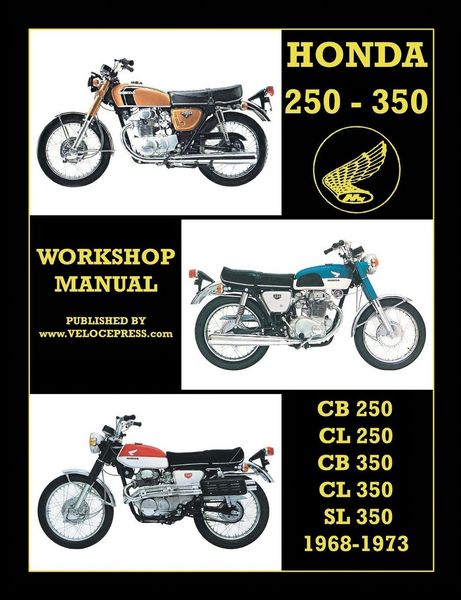
Honda Cb250, Cl250, Cb350, Cl350 & SL 350 1968 to 1973 Workshop Manual
-
- Englisch ausgewählt
49,99 €
inkl. gesetzl. MwSt.,
Beschreibung
Produktdetails
Einband
Taschenbuch
Erscheinungsdatum
16.03.2022
Verlag
Veloce Enterprises, Inc.Seitenzahl
176
Maße (L/B/H)
27,1/20,6/1,1 cm
Gewicht
400 g
Sprache
Englisch
ISBN
978-1-58850-261-2
The models covered in this manual are the twin cylinder 1968 to 1973 five speed CB250 (K0 K5) CL250 (K0 K2) and the CB350 (K0 K4), CL350 (K0 K5) and SL350 (K0 K2). Also included are the front disc brake CB250G and CB350G models.
Beginning in 1968 and extending through the 1975 model year, the 'K' suffix often, but not always, changed on an annual basis. 'K0' was used to indicate the first model in the series with updated versions identified as K1, K2, K3 etc. While the 'K' number designations continued in use outside the USA through 1978, in September 1973, American Honda adopted a year identifier within the model number - for example a CT70'76 would be a 1976 model.
Therefore, while the use of the letter 'K' suffix has become accepted practice to identify the progression of a particular model by year of production it can, at times, be misleading. For example, Honda occasionally identifies the 1968 models in the CB250/350 series as the CB250 & CB350 without the use of the 'K0' suffix and sometimes 'bypasses' the use of K1 for the 1969 models and jumps to K2 for the 1970 models. Setting this potential for confusion aside and reverting to what has become generally accepted usage of the 'K' suffix, we can state that this manual covers the five speed K0, K1, K2, K3, K4, K5 and disc brake models of the CB250 & CB350 and their variants from 1968 through 1973.
Finally, please note that the text in the original Honda Factory Workshop Manual was translated from Japanese into English. Consequently, some of the phrasing, grammar, punctuation and word usage may be subtly different from that commonly used in the English language. However, the information, as presented, is readily understandable. In addition, while we have done our best to identify any anomalies and errors that may have occurred during the original translation process, we are certain that we will have missed one or two and we request your indulgence in ignoring them.
Noch keine Bewertungen vorhanden
Verfassen Sie die erste Bewertung zu diesem Artikel
Helfen Sie anderen Kundinnen und Kunden durch Ihre Meinung.
Kurze Frage zu unserer Seite
Vielen Dank für Ihr Feedback
Wir nutzen Ihr Feedback, um unsere Produktseiten zu verbessern. Bitte haben Sie Verständnis, dass wir Ihnen keine Rückmeldung geben können. Falls Sie Kontakt mit uns aufnehmen möchten, können Sie sich aber gerne an unseren Kund*innenservice wenden.
zum Kundenservice