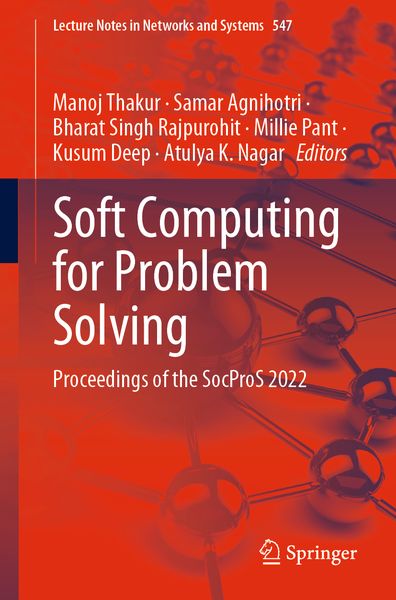
Produktbild: Soft Computing for Problem Solving
Band 547 - 12%

Soft Computing for Problem Solving Proceedings of the SocProS 2022

12% sparen

281,99 € UVP 320,99 €

inkl. gesetzl. MwSt., Versandkostenfrei


Beschreibung

Produktdetails

Einband

Taschenbuch

Erscheinungsdatum

02.03.2023

Herausgeber

Manoj Thakur + weitere

Verlag

Springer Singapore

Seitenzahl

733

Maße (L/B/H)

23,5/15,5/3,8 cm

Auflage

1st ed. 2023

Sprache

Englisch

ISBN

978-981-19-6524-1

Beschreibung

Portrait

Dr. Manoj Thakur is Associate Professor at the School of Basic Sciences, Indian Institute of Technology Mandi, Mandi, India. His research interests include optimization, machine learning, and computational finance.


Dr. Samar Agnihotri received the M.Sc. (Engg.) and Ph.D. degrees in electrical sciences from IISc Bangalore. From 2010 to 2012, he was Postdoctoral Fellow with the Department of Information Engineering, the Chinese University of Hong Kong. He is currently Associate Professor with the School of Computing and Electrical Engineering, IIT Mandi. His research interests include communication and information theory.


Dr. Bharat Singh Rajpurohit received the M.Tech. degree in power apparatus and electric drives from the Indian Institute of Technology Roorkee, Roorkee, India, in 2005 and the Ph.D. degree in electrical engineering from the Indian Institute of Technology Kanpur, Kanpur, India, in 2010. He is currently Professor with the School of Computing and Electrical Engineering, Indian Institute of Technology Mandi, Mandi, India. His major research interests include electric drives, renewable energy integration, and intelligent and energy-efficient buildings. He is Member of the International Society for Technology in Education, the Institution of Engineers, India, and the Institution of Electronics and Telecommunication Engineers.


Dr. Millie Pant is Professor at the Department of Applied Mathematics and Scientific Computing, Indian Institute of Technology Roorkee (IIT Roorkee) in India. Her areas of interests include numerical optimization, operations research, decision-making techniques, and artificial intelligence.


Dr. Kusum Deep is Professor at the Department of Mathematics, Indian Institute of Technology Roorkee. Her research interests include numerical optimization, nature-inspired optimization, computational intelligence, genetic algorithms, parallel genetic algorithms, and parallel particle swarm optimization. 


Prof. Atulya K. Nagar holds Foundation Chair as Professor of Mathematical Sciences and is Pro-Vice-Chancellor (Research) at Liverpool Hope University, UK. He is responsible for developing Sciences and Engineering and has been the Head of the School of Mathematics, Computer Science, and Engineering which he established at the university. He received a prestigious Commonwealth Fellowship for pursuing his doctorate (D.Phil.) in Applied Nonlinear Mathematics, which he earned from the University of York (UK) in 1996. He holds B.Sc. (Hons), M.Sc., and M.Phil. (with distinction) in Mathematical Physics from the MDS University of Ajmer, India. Prior to joining Liverpool Hope, he was with the Brunel University, London. He is an internationally respected scholar working at the cutting edge of nonlinear mathematics, theoretical computer science, and systems engineering. He has edited volumes on intelligent systems andapplied mathematics. He is well published with over 450 publications in prestigious publishing outlets. He has an extensive background and experience of working in universities in the UK and India. He has been an expert reviewer for the Biotechnology and Biological Sciences Research Council (BBSRC) grants peer-review committees for Bioinformatics Panel; Engineering and Physical Sciences Research Council (EPSRC) for High Performance Computing Panel; and served on the Peer-Review College of the Arts and Humanities Research Council (AHRC) as Scientific Expert member. Prof. Nagar sits on the JISC Research Strategy group, and he is Fellow of the Institute of Mathematics and its applications (FIMA) and Fellow of the Higher Education Academy (FHEA).

Produktdetails

Einband

Taschenbuch

Erscheinungsdatum

02.03.2023

Herausgeber

Verlag

Springer Singapore

Seitenzahl

733

Maße (L/B/H)

23,5/15,5/3,8 cm

Auflage

1st ed. 2023

Sprache

Englisch

ISBN

978-981-19-6524-1

Herstelleradresse

Springer-Verlag KG
Sachsenplatz 4-6
1201 Wien
AT

Email: ProductSafety@springernature.com

Kundinnen und Kunden meinen

0 Bewertungen

Informationen zu Bewertungen

Zur Abgabe einer Bewertung ist eine Anmeldung im Konto notwendig. Die Authentizität der Bewertungen wird von uns nicht überprüft. Wir behalten uns vor, Bewertungstexte, die unseren Richtlinien widersprechen, entsprechend zu kürzen oder zu löschen.

Die Bewertungen sind nach Format, Anzahl Sterne und Datum sortiert.

Verfassen Sie die erste Bewertung zu diesem Artikel

Helfen Sie anderen Kund*innen durch Ihre Meinung

Kundinnen und Kunden meinen

0 Bewertungen filtern

  • Produktbild: Soft Computing for Problem Solving
  • Chapter 1. Benchmarking state-of-the-art methodologies for optic disc segmentation.- Chapter 2. Automated Student Emotion Analysis During Online Classes using Convolutional Neural Network.- Chapter 3. Transfer Learning based Malware Classification.- Chapter 4. A Study on Metric-Based and Initialization-Based Methods for Few-Shot Image Classification.- Chapter 5. A Fast and Efficient Methods for Eye pre-processing and DR Level Detection.- Chapter 6. A deep neural model CNN-LSTM network for automated sleep staging based on a single-channel EEG signal.- Chapter 7. An Ensemble Model for Gait Classification in Children and Adolescent with Cerebral Palsy: A Low-Cost Approach.- Chapter 8. Imbalanced Learning of Regular Grammar for DFA Extraction from LSTM Architecture.- Chapter 9. Medical Prescription Label Reading using Computer Vision and Deep Learning.- Chapter 10. Autoencoder-based Deep Neural Architecture for Epileptic Seizures Classification.- Chapter 11. Stock Market Prediction using Deep Learning Techniques for Short and Long Horizon.- Chapter 12. Improved CNN Model for Breast Cancer Classification.- Chapter 13. Performance Assessment of Normalization in CNN with Retinal Image Segmentation.- Chapter 14. A novel multi-day ahead index price forecast using multi-output based deep learning system.- Chapter 15. Automatic Retinal Vessel Segmentation using BTLBO. etc.