• Produktbild: Social Reproduction, Solidarity Economy, Feminisms and Democracy
  • Produktbild: Social Reproduction, Solidarity Economy, Feminisms and Democracy
- 12%

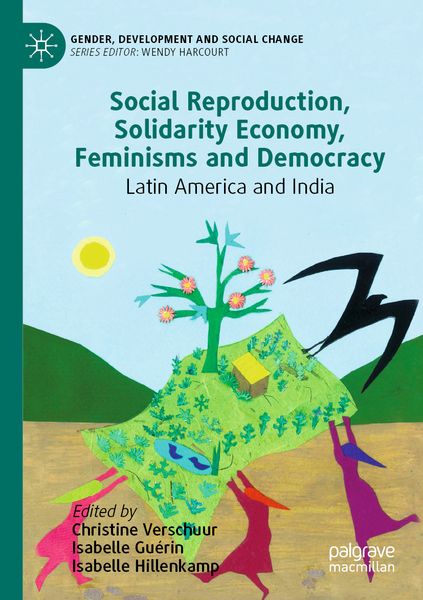
Social Reproduction, Solidarity Economy, Feminisms and Democracy Latin America and India

12% sparen

139,99 € UVP 160,49 €

inkl. gesetzl. MwSt., Versandkostenfrei


Beschreibung

Produktdetails

Einband

Taschenbuch

Erscheinungsdatum

08.09.2022

Abbildungen

XV, 280 p. 4 illus.

Herausgeber

Christine Verschuur + weitere

Verlag

Springer

Seitenzahl

280

Maße (L/B/H)

21/14,8/1,7 cm

Gewicht

386 g

Auflage

22001 Auflage 1st ed. 2021

Sprache

Englisch

ISBN

978-3-030-71533-5

Beschreibung

Portrait


Christine Verschuur
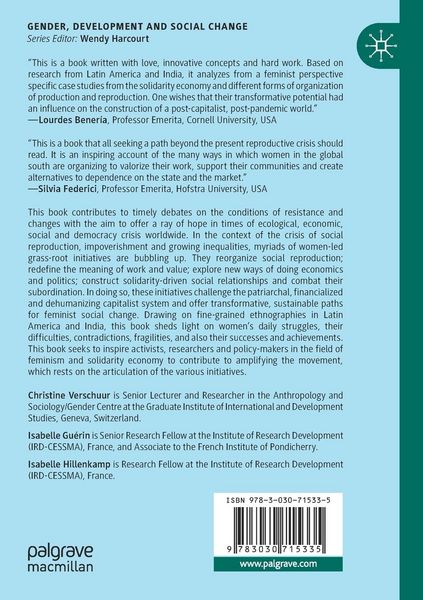
is Senior Lecturer and Researcher in the Anthropology and Sociology/Gender Centre at the Graduate Institute of International and Development Studies, Geneva, Switzerland. Her research interests include social reproduction, agroecology and peasant studies, solidarity economy, urban social movements and gender experts. She has published a number of books including
Under Development: Gender
(with I. Guérin and H. Guétat-Bernard, 2014),
Genre et économie solidaire, des croisements nécessaires
(with I. Guérin and I. Hillenkamp, 2017), and
Savoirs féministes au Sud: Expertes en genre et tournant décolonial
(2019).


Isabelle Guérin
is Senior Research Fellow at the Institute of Research Development (IRD-CESSMA), France, and Associate to the French Institute of Pondicherry. Her current work focuses on the financialization of domestic economies, how it engenders new forms of inequalities and domination, but also alternative and solidarity-based initiatives. She has edited a number of books including
Randomized Control Trials in the Field of Development
(with F. Bédécarrats and F. Roubaud, 2020).


Isabelle Hillenkamp
is Research Fellow at the Institute of Research Development (IRD-CESSMA), France. Her research focuses on the popular and solidarity economy from a socio-economic perspective, attentive to the links between economic practices and social relations. She has conducted research in Mexico, Bolivia and Brazil. She has edited a number of books and journal special issues, including “As Outras Economias à Luz do Gênero” (
Otra Economia
22(12), 2019, with L. Jalil).

Produktdetails

Einband

Taschenbuch

Erscheinungsdatum

08.09.2022

Abbildungen

XV, 280 p. 4 illus.

Herausgeber

Verlag

Springer

Seitenzahl

280

Maße (L/B/H)

21/14,8/1,7 cm

Gewicht

386 g

Auflage

22001 Auflage 1st ed. 2021

Sprache

Englisch

ISBN

978-3-030-71533-5

Herstelleradresse

Springer-Verlag GmbH
Tiergartenstr. 17
69121 Heidelberg
DE

Email: GPSR Kontakt

Noch keine Bewertungen vorhanden

Verfassen Sie die erste Bewertung zu diesem Artikel

Helfen Sie anderen Kundinnen und Kunden durch Ihre Meinung.

Kundinnen und Kunden meinen

Bewertungen (0)

  • Produktbild: Social Reproduction, Solidarity Economy, Feminisms and Democracy
  • Produktbild: Social Reproduction, Solidarity Economy, Feminisms and Democracy

  • Introduction: a collaborative feminist and interdisciplinary research project in Latin America and India.- Theoretical approaches to social and solidarity economy and social reproduction in feminist perspectives.- Forging Solidarities: Women construction workers in the informal sector and women's rights movements in Tamil Nadu, India.- Combating the destruction of social reproduction. History of a Dalit women's struggle in South India.- Platforms and the work of solidarity: Giving, sharing, distributing.- Local transformations in Batallas (Bolivia) and the "inexhaustible" capacity of women to sustain life.- Solidarity at the crossroads: struggles and transformations of domestic workers in Kerala.- Argentina: collectivizing care, reinventing work and solidarity.- Slippery Fish: Women’s Struggles Over Retail Fish Markets in Udupi, South India.- Agroecology and Feminism in Vale do Ribeira (Brazil): Towards more sustainable forms of reproducing life.- Concluding thoughts : reorganising social reproduction, reframing the meaning of work and democracy.- Conclusion: Demonstrating the heuristic potential of cross fertilization between feminisms and solidarity economy.