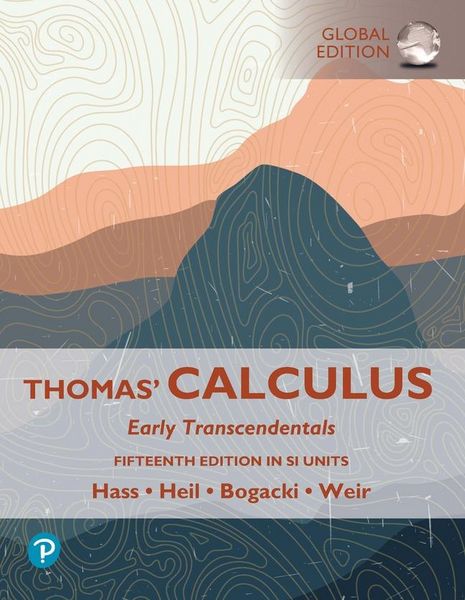
Produktbild: Thomas' Calculus

Thomas' Calculus Early Transcendentals, SI Units

114,99 €

inkl. gesetzl. MwSt., Versandkostenfrei


Beschreibung

Produktdetails

Einband

Taschenbuch

Erscheinungsdatum

01.06.2023

Verlag

Pearson Academic

Seitenzahl

1224

Maße (L/B/H)

27,6/22,7/6,5 cm

Gewicht

2477 g

Sprache

Englisch

ISBN

978-1-292-72590-1

Beschreibung

Produktdetails

Einband

Taschenbuch

Erscheinungsdatum

01.06.2023

Verlag

Pearson Academic

Seitenzahl

1224

Maße (L/B/H)

27,6/22,7/6,5 cm

Gewicht

2477 g

Sprache

Englisch

ISBN

978-1-292-72590-1

Herstelleradresse

Libri GmbH
Europaallee 1
36244 Bad Hersfeld
DE

Email: gpsr@libri.de

Kundinnen und Kunden meinen

0 Bewertungen

Informationen zu Bewertungen

Zur Abgabe einer Bewertung ist eine Anmeldung im Konto notwendig. Die Authentizität der Bewertungen wird von uns nicht überprüft. Wir behalten uns vor, Bewertungstexte, die unseren Richtlinien widersprechen, entsprechend zu kürzen oder zu löschen.

Die Bewertungen sind nach Format, Anzahl Sterne und Datum sortiert.

Verfassen Sie die erste Bewertung zu diesem Artikel

Helfen Sie anderen Kund*innen durch Ihre Meinung

Kundinnen und Kunden meinen

0 Bewertungen filtern

  • Produktbild: Thomas' Calculus
  • 1. Functions
    • 1.1 Functions and Their Graphs
    • 1.2 Combining Functions; Shifting and Scaling Graphs
    • 1.3 Trigonometric Functions
    • 1.4 Exponential Functions
    • 1.7 Inverse Functions and Logarithms
    • Questions to Guide Your Review
    • Practice Exercises
    • Additional and Advanced Exercises
    • Technology Application Projects
    2. Limits and Continuity
    • 2.1 Rates of Change and Tangent Lines to Curves
    • 2.2 Limit of a Function and Limit Laws
    • 2.3 The Precise Definition of a Limit
    • 2.4 One-Sided Limits
    • 2.5 Limits Involving Infinity; Asymptotes of Graphs
    • 2.6 Continuity
    • Questions to Guide Your Review
    • Practice Exercises
    • Additional and Advanced Exercises
    • Technology Application Projects
    3. Derivatives
    • 3.1 Tangent Lines and the Derivative at a Point
    • 3.2 The Derivative as a Function
    • 3.3 Differentiation Rules
    • 3.4 The Derivative as a Rate of Change
    • 3.5 Derivatives of Trigonometric Functions
    • 3.6 The Chain Rule
    • 3.7 Implicit Differentiation
    • 3.8 Derivatives of Inverse Functions and Logarithms
    • 3.9 Inverse Trigonometric Functions
    • 3.10 Related Rates
    • 3.11 Linearization and Differentials
    • Questions to Guide Your Review
    • Practice Exercises
    • Additional and Advanced Exercises
    • Technology Application Projects
    4. Applications of Derivatives
    • 4.1 Extreme Values of Functions on Closed Intervals
    • 4.2 The Mean Value Theorem
    • 4.3 Monotonic Functions and the First Derivative Test
    • 4.4 Concavity and Curve Sketching
    • 4.5 Indeterminate Forms and L'Hôpital's Rule
    • 4.6 Applied Optimization
    • 4.7 Newton's Method
    • 4.8 Antiderivatives
    • Questions to Guide Your Review
    • Practice Exercises
    • Additional and Advanced Exercises
    • Technology Application Projects
    5. Integrals
    • 5.1 Area and Estimating with Finite Sums
    • 5.2 Sigma Notation and Limits of Finite Sums
    • 5.3 The Definite Integral
    • 5.4 The Fundamental Theorem of Calculus
    • 5.5 Indefinite Integrals and the Substitution Method
    • 5.6 Definite Integral Substitutions and the Area Between Curves
    • Questions to Guide Your Review
    • Practice Exercises
    • Additional and Advanced Exercises
    • Technology Application Projects
    6. Applications of Definite Integrals
    • 6.1 Volumes Using Cross-Sections
    • 6.2 Volumes Using Cylindrical Shells
    • 6.3 Arc Length
    • 6.4 Areas of Surfaces of Revolution
    • 6.5 Work and Fluid Forces
    • 6.6 Moments and Centers of Mass
    • Questions to Guide Your Review
    • Practice Exercises
    • Additional and Advanced Exercises
    • Technology Application Projects
    7. Integrals and Transcendental Functions
    • 7.1 The Logarithm Defined as an Integral
    • 7.2 Exponential Change and Separable Differential Equations
    • 7.3 Hyperbolic Functions
    • 7.4 Relative Rates of Growth
    • Questions to Guide Your Review
    • Practice Exercises
    • Additional and Advanced Exercises
    8. Techniques of Integration
    • 8.1 Using Basic Integration Formulas
    • 8.2 Integration by Parts
    • 8.3 Trigonometric Integrals
    • 8.4 Trigonometric Substitutions
    • 8.5 Integration of Rational Functions by Partial Fractions
    • 8.6 Integral Tables and Computer Algebra Systems
    • 8.7 Numerical Integration
    • 8.8 Improper Integrals
    • Questions to Guide Your Review
    • Practice Exercises
    • Additional and Advanced Exercises
    • Technology Application Projects
    9. Infinite Sequences and Series
    • 9.1 Sequences
    • 9.2 Infinite Series
    • 9.3 The Integral Test
    • 9.4 Comparison Tests
    • 9.5 Absolute Convergence; The Ratio and Root Tests
    • 9.6 Alternating Series and Conditional Convergence
    • 9.7 Power Series
    • 9.8 Taylor and Maclaurin Series
    • 9.9 Convergence of Taylor Series
    • 9.10 Applications of Taylor Series
    • Questions to Guide Your Review
    • Practice Exercises
    • Additional and Advanced Exercises
    • Technology Application Projects
    10. Parametric Equations and Polar Coordinates
    • 10.1 Parametrizations of Plane Curves
    • 10.2 Calculus with Parametric Curves
    • 10.3 Polar Coordinates
    • 10.4 Graphing Polar Coordinate Equations
    • 10.5 Areas and Lengths in Polar Coordinates
    • 10.6 Conic Sections
    • 10.7 Conics in Polar Coordinates
    • Questions to Guide Your Review
    • Practice Exercises
    • Additional and Advanced Exercises
    • Technology Application Projects
    11. Vectors and the Geometry of Space
    • 11.1 Three-Dimensional Coordinate Systems
    • 11.2 Vectors
    • 11.3 The Dot Product
    • 11.4 The Cross Product
    • 11.5 Lines and Planes in Space
    • 11.6 Cylinders and Quadric Surfaces
    • Questions to Guide Your Review
    • Practice Exercises
    • Additional and Advanced Exercises
    • Technology Application Projects
    12. Vector-Valued Functions and Motion in Space
    • 12.1 Curves in Space and Their Tangents
    • 12.2 Integrals of Vector Functions; Projectile Motion
    • 12.3 Arc Length in Space
    • 12.4 Curvature and Normal Vectors of a Curve
    • 12.5 Tangential and Normal Components of Acceleration
    • 13.6 Velocity and Acceleration in Polar Coordinates
    • Questions to Guide Your Review
    • Practice Exercises
    • Additional and Advanced Exercises
    • Technology Application Projects
    13. Partial Derivatives
    • 13.1 Functions of Several Variables
    • 13.2 Limits and Continuity in Higher Dimensions
    • 13.3 Partial Derivatives
    • 13.4 The Chain Rule
    • 13.5 Directional Derivatives and Gradient Vectors
    • 13.6 Tangent Planes and Differentials
    • 13.7 Extreme Values and Saddle Points
    • 13.8 Lagrange Multipliers
    • 13.9 Taylor's Formula for Two Variables
    • 13.10 Partial Derivatives with Constrained Variables
    • Questions to Guide Your Review
    • Practice Exercises
    • Additional and Advanced Exercises
    • Technology Application Projects
    14. Multiple Integrals
    • 14.1 Double and Iterated Integrals over Rectangles
    • 14.2 Double Integrals over General Regions
    • 14.3 Area by Double Integration
    • 14.4 Double Integrals in Polar Form
    • 14.5 Triple Integrals in Rectangular Coordinates
    • 14.6 Applications
    • 14.7 Triple Integrals in Cylindrical and Spherical Coordinates
    • 14.8 Substitutions in Multiple Integrals
    • Questions to Guide Your Review
    • Practice Exercises
    • Additional and Advanced Exercises
    • Technology Application Projects
    15. Integrals and Vector Fields
    • 15.1 Line Integrals of Scalar Functions
    • 15.2 Vector Fields and Line Integrals: Work, Circulation, and Flux
    • 15.3 Path Independence, Conservative Fields, and Potential Functions
    • 15.4 Green's Theorem in the Plane
    • 15.5 Surfaces and Area
    • 15.6 Surface Integrals
    • 15.7 Stokes' Theorem
    • 15.8 The Divergence Theorem and a Unified Theory
    • Questions to Guide Your Review
    • Practice Exercises
    • Additional and Advanced Exercises
    • Technology Application Projects
    16. First-Order Differential Equations
    • 16.1 Solutions, Slope Fields, and Euler's Method
    • 16.2 First-Order Linear Equations
    • 16.3 Applications
    • 16.4 Graphical Solutions of Autonomous Equations
    • 16.5 Systems of Equations and Phase Planes
    • Questions to Guide Your Review
    • Practice Exercises
    • Technology Application Projects
    17. Second-Order Differential Equations
    • 17.1 Second-Order Linear Equations
    • 17.2 Nonhomogeneous Linear Equations
    • 17.3 Applications
    • 17.4 Euler Equations
    • 17.5 Power-Series Solutions
    • Questions to Guide Your Review
    • Practice Exercises
    • Additional and Advanced Exercises
    • Technology Application Projects
    18. Complex Functions (online)
    • 18.1 Complex Numbers
    • 18.2 Limits and Continuity
    • 18.3 Complex Derivatives
    • 18.4 The Cauchy-Riemann Equations
    • 18.5 Complex Series
    • 18.6 Conformal Maps
    19. Fourier Series and Wavelets (online)
    • 19.1 Periodic Functions
    • 19.2 Summing Sines and Cosines
    • 19.3 Vectors and Approximation in Three and More Dimensions
    • 19.4 Approximation of Functions
    • 19.5 Advanced Topic: The Haar System and Wavelets
    Appendix A
    • A.1 Real Numbers and the Real Line
    • A.2 Graphing with Software
    • A.3 Mathematical Induction
    • A.4 Lines, Circles, and Parabolas
    • A.5 Proofs of Limit Theorems
    • A.6 Commonly Occurring Limits
    • A.7 Theory of the Real Numbers
    • A.8 The Distributive Law for Vector Cross Products
    • A.9 Probability
    • A.10 The Mixed Derivative Theorem and the Increment Theorem
    Appendix B
    • B.1 Determinants
    • B.2 Extreme Values and Saddle Points for Functions of More than Two Variables
    • B.3 The Method of Gradient Descent
    Answers to Odd-Numbered Exercises Applications Index Subject Index A Brief Table of Integrals Credits