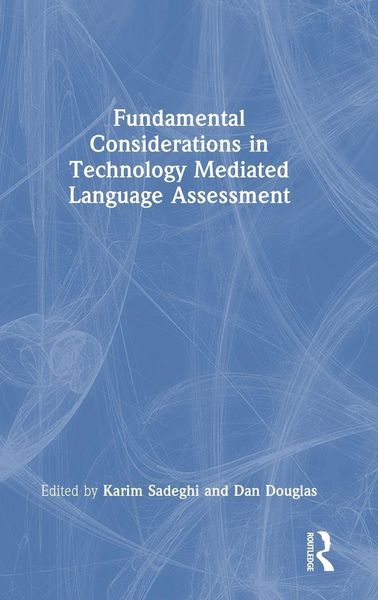

• Produktbild: Fundamental Considerations in Technology Mediated Language Assessment
  • Produktbild: Fundamental Considerations in Technology Mediated Language Assessment

Fundamental Considerations in Technology Mediated Language Assessment

221,99 €

inkl. gesetzl. MwSt., Versandkostenfrei


Beschreibung

Produktdetails

Einband

Gebundene Ausgabe

Erscheinungsdatum

27.04.2023

Herausgeber

Karim Sadeghi + weitere

Verlag

Routledge

Seitenzahl

304

Maße (L/B/H)

24/16,1/2,1 cm

Gewicht

622 g

Sprache

Englisch

ISBN

978-1-03-227364-8

Beschreibung

Produktdetails

Einband

Gebundene Ausgabe

Erscheinungsdatum

27.04.2023

Herausgeber

Verlag

Routledge

Seitenzahl

304

Maße (L/B/H)

24/16,1/2,1 cm

Gewicht

622 g

Sprache

Englisch

ISBN

978-1-03-227364-8

Herstelleradresse

Libri GmbH
Europaallee 1
36244 Bad Hersfeld
DE

Email: gpsr@libri.de

Noch keine Bewertungen vorhanden

Verfassen Sie die erste Bewertung zu diesem Artikel

Helfen Sie anderen Kundinnen und Kunden durch Ihre Meinung.

Kundinnen und Kunden meinen

Bewertungen (0)

Weitere Artikel finden Sie in

Die Leseprobe wird geladen.
  • Produktbild: Fundamental Considerations in Technology Mediated Language Assessment
  • Produktbild: Fundamental Considerations in Technology Mediated Language Assessment
  • Acknowledgements

    List of contributors

    Foreword: Lyle F. Bachman

    Chapter 1: Technology mediated language assessment: Key considerations

    Karim Sadeghi, Dan Douglas

    Section I: Validity Concerns in Technology Mediated Language Assessment

    Chapter 2: Validation in remote L2 assessment: Appraising models and frameworks

    Scott Walters

    Chapter 3: Exploring the Role of Self-Regulation in Young Learners’ Writing Assessment and Intervention using BalanceAI Automated Diagnostic Feedback

    Eunice Eunhee Jang, Melissa Hunte, Christie Barron,

    Liam Hannah

    Chapter 4: Balancing construct coverage and efficiency: Test design and validation considerations for a remote-proctored online language test

    Larry Davis, John M. Norris, Spiros Papageorgiou, Shoko Sasayama

    Chapter 5: From pen-and-paper trials to computer-based test: Impact on validity

    Ivy Chen, Ute Knoch

    Chapter 6: Evaluating Finnish 9th graders’ learning outcomes in English during the pandemic: How valid are the conclusions drawn?

    Marita Härmälä, Jukka Marjanen

    Section II: Reliability Issues and Machine Scoring

    Chapter 7: Exploring rater behaviors on handwritten and typed reading-to-write essays using FACETS

    Sun-Young Shin, Senyung Lee, Yena Park

    Chapter 8: Validating an AI-driven Scoring System: the Model Card approach

    Barry O’Sullivan, Trevor Breakspear, William Bayliss

    Chapter 9: Web-based testing and automated scoring: construct conceptualization and improving reliability

    Nathan Carr

    Section III: Impact, Security and Ethical Considerations

    Chapter 10: Testing young multilingual learners remotely: prioritizing equity, fairness, and social justice

    Mark Chapman

    , Jason A. Kemp, Ahyoung Alicia Kim, David MacGregor, Fabiana MacMillan,

    Chapter 11: Improving the impact of technology on diagnostic language assessment

    Ari Huhta

    Chapter 12: Proctoring remote language assessments

    Erik Voss

    Section IV: Options and Issues in Technology Mediated Classroom Assessment

    Chapter 13: Interdisciplinary collaboration in building the future of Learning Oriented Language Assessment

    Nick Saville, Paula Buttery

    Chapter 14: Interactional competence in video-mediated speaking assessment in Vietnam

    Noriko Iwashita

    , Van Trao Nguyen, Hong Giang Nguyen

    Chapter 15: Test-taking strategies in technology-assisted language assessment

    Andrew Cohen, Teymour Rahmati, Karim Sadeghi

    Chapter 16: Researching technology-mediated classroom language assessment practices: Methodological challenges and opportunities

    Keith Menary, Luke Harding

    Chapter 17: Conclusion

    Dan Douglas, Karim Sadeghi