• Produktbild: Advances in Nanotechnology for Marine Antifouling
  • Produktbild: Advances in Nanotechnology for Marine Antifouling

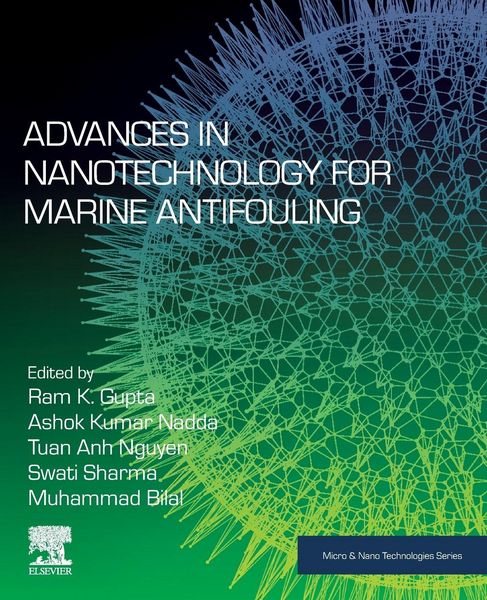
Advances in Nanotechnology for Marine Antifouling

251,99 €

inkl. gesetzl. MwSt., Versandkostenfrei


Beschreibung

Produktdetails

Einband

Taschenbuch

Erscheinungsdatum

01.05.2023

Herausgeber

Ram K. Gupta + weitere

Verlag

Elsevier

Seitenzahl

404

Maße (L/B/H)

23,5/19,1/2,1 cm

Gewicht

860 g

Sprache

Englisch

ISBN

978-0-323-91762-9

Beschreibung

Portrait

Ram Gupta is a Professor in the Department of Chemistry at Pittsburg State University, Kansas, United States. His research focus is in green energy production and storage using nanomaterials, optoelectronics and photovoltaics devices, organic-inorganic heterojunctions for sensors, nanomagnetism, conducting polymers and composites as well as bio-based polymers, bio-compatible nanofibers for tissue regeneration, scaffold and antibacterial applications, and bio-degradable metallic implants.

Dr. Ashok Kumar Nadda is Assistant Professor in the Department of Biotechnology and Bioinformatics, at Jaypee University of Information Technology, India. His research interests are microbial biotechnology, biocatalysis, biopolymers, enzyme immobilization, bioenergy, and CO2 conversion.

Dr. Swati Sharma (MSc, Dr. Yashwant Singh Parmar University of Horticulture and Forestry, Nauni Solan H.P. India; PhD. University Malaysia, Pahang, Malaysia) is Assistant Professor at University Institute of Biotechnology, the Chandigarh University Mohali, India. She worked as a visiting researcher in the College of Life and Environmental Sciences at Konkuk University, Seoul, South Korea. She has also worked as a program co-coordinator at the Himalayan Action Research Center (HARC), Dehradun, and Senior Research Fellow at the India Agricultural Research Institute in 2013-2014. Presently, Dr. Sharma's research is in the field of bioplastics, hydrogels, keratin nano-fibers and nano-particles, biodegradable polymers and polymers with antioxidant and anticancer activities and sponges. Dr. Swati has published numerous books and papers in various internationally reputed journals.

Muhammad Bilal is working as an Associate Professor at the Faculty of Civil and Environmental Engineering, Gdansk University of Technology, Poland. Previously, he served as an assistant/associate Professor at Poznan University of Technology, Poland, and the School of Life Science and Food Engineering, Huaiyin Institute of Technology, Huaian, China. He earned his Ph.D. from Shanghai Jiao Tong University, specializing in bioengineering and applied biotechnology. His main research activities are oriented to Environmental biotechnology, nanotechnology, enzyme engineering, immobilization, chemical modifications, and industrial applications of microbial enzymes, liquid, and solid waste management. He has authored over 700 peer-reviewed articles, 150 book chapters, 25 edited books. Dr. Bilal is the associate editor of Frontiers in Chemical Engineering and Frontiers in Environmental Science (Frontiers), and an editorial board member for several journals. He was listed as a highly cited researcher (Clarivate) in 2021 and holds several "highly cited papers" in WOS.

Tuan Anh Nguyen is a Senior Principal Research Scientist at the Institute for Tropical Technology, Vietnam Academy of Science and Technology, Hanoi, Vietnam. He received a BS in physics from Hanoi University in 1992, a BS in economics from Hanoi National Economics University in 1997, and a PhD in chemistry from the Paris Diderot University, France, in 2003. He was a Visiting Scientist at Seoul National University, South Korea, in 2004, and the University of Wollongong, Australia, in 2005. He then worked as a Postdoctoral Research Associate and Research Scientist at Montana State University, United States in 2006-09. In 2012 he was appointed as the Head of the Microanalysis Department at the Institute for Tropical Technology. His research areas of interest include smart sensors, smart networks, smart hospitals, smart cities, complexiverse, and digital twins. He has edited more than 74 books for Elsevier, 12 books for CRC Press, 1 book for Springer, 1 book for RSC, and 2 books for IGI Global. He is the Editor-in-Chief of Kenkyu Journal of Nanotechnology & Nanoscience.

Produktdetails

Einband

Taschenbuch

Erscheinungsdatum

01.05.2023

Herausgeber

Verlag

Elsevier

Seitenzahl

404

Maße (L/B/H)

23,5/19,1/2,1 cm

Gewicht

860 g

Sprache

Englisch

ISBN

978-0-323-91762-9

Herstelleradresse

Libri GmbH
Europaallee 1
36244 Bad Hersfeld
DE

Email: gpsr@libri.de

Kundinnen und Kunden meinen

0 Bewertungen

Informationen zu Bewertungen

Zur Abgabe einer Bewertung ist eine Anmeldung im Konto notwendig. Die Authentizität der Bewertungen wird von uns nicht überprüft. Wir behalten uns vor, Bewertungstexte, die unseren Richtlinien widersprechen, entsprechend zu kürzen oder zu löschen.

Die Bewertungen sind nach Format, Anzahl Sterne und Datum sortiert.

Verfassen Sie die erste Bewertung zu diesem Artikel

Helfen Sie anderen Kund*innen durch Ihre Meinung

Kundinnen und Kunden meinen

0 Bewertungen filtern

Die Leseprobe wird geladen.
  • Produktbild: Advances in Nanotechnology for Marine Antifouling
  • Produktbild: Advances in Nanotechnology for Marine Antifouling
  • PART 1: BIOFOULING: FUNDAMENTALS
    1. Biofouling: Current status and challenges
    2. Traditional antifouling technologies: Effects on aquatic life
    3. Biofouling in the petroleum industry
    4. Biofouling in maritime technology
    5. Strategies for developing new biofouling based on natural products
    6. Mathematical modeling/simulation of biofouling growth

    PART 2: ANTIFOULING TECHNIQUES AND NANOMATERIALS
    7. Nanoscale techniques for the modification of the marine vessel
    8. Methods for design and formulations of underwater materials
    9. Marine organism and metabolites as antifouling agents
    10. Antifouling nanomaterials and composites
    11. Photochemical nanomaterials in antifouling
    12. Interfacial phenomena for improved anti-biofouling
    13. Bioinspired antifouling techniques and coatings
    14. Antifouling ceramic coating
    15. Zwitterionic antifouling coating
    16. Electrochemical sensors in antifouling

    PART 3: ENVIRONMENTAL CHALLENGES AND IMPLICATIONS
    17. Hazard of novel antifouling nanomaterials
    18. Biocide-based coatings and marine life
    19. Self-healing and eco-friendly nano-coating for antifouling
    20. Marine vessels and underwater structure management
    21. Safety, regulations and economic impact of nanotechnology in maritime industries
    22. Future scope and perspectives for nanotechnology in marine antifouling