Beschreibung
Produktdetails
Einband
Loseblattausgabe
Erscheinungsdatum
03.03.2023
Verlag
Human Kinetics PublishersSeitenzahl
736
Maße (L/B/H)
28,1/22,3/3,5 cm
Gewicht
2010 g
Sprache
Englisch
ISBN
978-1-71821-656-3
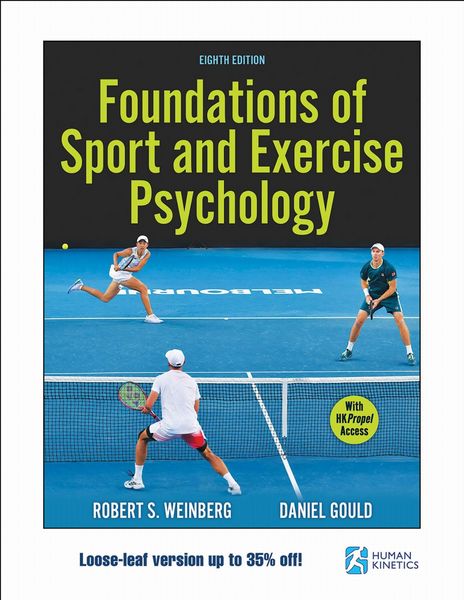
Foundations of Sport and Exercise Psychology, Eighth Edition With HKPropel Access, is a leading textbook that offers a comprehensive view of sport and exercise psychology. It draws connections between research and practice, and it captures the excitement of the world of sport and exercise.
Internationally respected authors Robert Weinberg and Daniel Gould have built a text that addresses emerging trends and remains relevant with each new edition. Every chapter has been updated with the latest research and practice in sport and exercise psychology while maintaining and highlighting classic studies that have shaped the field. In-depth learning aids have been refreshed to help students think critically. Specific content changes were made throughout the text to highlight significant advances in research and practices. These include areas such as mental health of athletes, effects of COVID-19 on athletes, mindfulness, legalized gambling, psychological issues surrounding the 2020 Olympic Games (held in 2021), and drug controversies.
Foundations of Sport and Exercise Psychology provides students with a unique learning experience-starting with an exploration of the field’s origins, key concepts, research development, and career options available in the field. After this introduction to the field, the text shifts to personal factors that affect performance and behavior in sport, physical education, and exercise settings. It augments those concepts by factoring in situational circumstances that influence behavior, group interaction and processes, and the use of psychological techniques to help people perform more effectively. Students will gain critical insights into the role psychological factors play in health and exercise and the psychological consequences of participation in sport and physical activity, including children’s psychological development through sport participation, aggression in sport, and moral development and good sporting behavior in sport and physical activity contexts.
More than 100 related online activities offer interactive opportunities to engage with the content-many of which can be assigned, and progress tracked, by instructors directly through HKPropel. In addition, chapter quizzes may also be assigned; these are automatically graded to test comprehension of critical concepts. Some activities may be downloaded and printed as assignments to be completed by students. Many of the activities offer compelling audio and video clips that reveal how sport psychology consultants communicate with athletes and coaches to improve athletic experiences. These clips feature esteemed experts from the field discussing concepts that they have studied and refined during their professional careers.
The updated eighth edition of Foundations of Sport and Exercise Psychology continues to ensure that students are well equipped-and excited-to enter the field of sport and exercise psychology, fully prepared for the challenges they may encounter as well as the possibilities.
Note: A code for accessing HKPropel is included with this ebook.
Internationally respected authors Robert Weinberg and Daniel Gould have built a text that addresses emerging trends and remains relevant with each new edition. Every chapter has been updated with the latest research and practice in sport and exercise psychology while maintaining and highlighting classic studies that have shaped the field. In-depth learning aids have been refreshed to help students think critically. Specific content changes were made throughout the text to highlight significant advances in research and practices. These include areas such as mental health of athletes, effects of COVID-19 on athletes, mindfulness, legalized gambling, psychological issues surrounding the 2020 Olympic Games (held in 2021), and drug controversies.
Foundations of Sport and Exercise Psychology provides students with a unique learning experience-starting with an exploration of the field’s origins, key concepts, research development, and career options available in the field. After this introduction to the field, the text shifts to personal factors that affect performance and behavior in sport, physical education, and exercise settings. It augments those concepts by factoring in situational circumstances that influence behavior, group interaction and processes, and the use of psychological techniques to help people perform more effectively. Students will gain critical insights into the role psychological factors play in health and exercise and the psychological consequences of participation in sport and physical activity, including children’s psychological development through sport participation, aggression in sport, and moral development and good sporting behavior in sport and physical activity contexts.
More than 100 related online activities offer interactive opportunities to engage with the content-many of which can be assigned, and progress tracked, by instructors directly through HKPropel. In addition, chapter quizzes may also be assigned; these are automatically graded to test comprehension of critical concepts. Some activities may be downloaded and printed as assignments to be completed by students. Many of the activities offer compelling audio and video clips that reveal how sport psychology consultants communicate with athletes and coaches to improve athletic experiences. These clips feature esteemed experts from the field discussing concepts that they have studied and refined during their professional careers.
The updated eighth edition of Foundations of Sport and Exercise Psychology continues to ensure that students are well equipped-and excited-to enter the field of sport and exercise psychology, fully prepared for the challenges they may encounter as well as the possibilities.
Note: A code for accessing HKPropel is included with this ebook.
Noch keine Bewertungen vorhanden
Verfassen Sie die erste Bewertung zu diesem Artikel
Helfen Sie anderen Kundinnen und Kunden durch Ihre Meinung.
Kurze Frage zu unserer Seite
Vielen Dank für Ihr Feedback
Wir nutzen Ihr Feedback, um unsere Produktseiten zu verbessern. Bitte haben Sie Verständnis, dass wir Ihnen keine Rückmeldung geben können. Falls Sie Kontakt mit uns aufnehmen möchten, können Sie sich aber gerne an unseren Kund*innenservice wenden.
zum Kundenservice