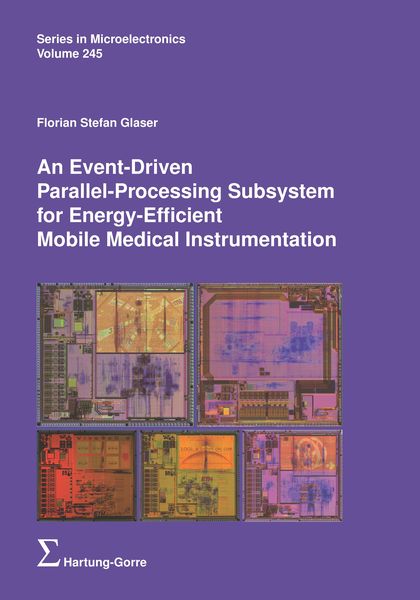
An Event-Driven Parallel-Processing Subsystem for Energy-Efficient Mobile Medical Instrumentation
-
- Englisch ausgewählt
64,00 €
inkl. gesetzl. MwSt.,
Beschreibung
Produktdetails
Einband
Paperback
Erscheinungsdatum
08.11.2022
Herausgeber
Luca Benini + weitereVerlag
Hartung-GorreSeitenzahl
200
Maße (L/B/H)
21/14,8/1,4 cm
Gewicht
317 g
Auflage
1. Auflage
Sprache
Englisch
ISBN
978-3-86628-777-8
In this thesis, we present two major contributions to achieve the discussed goals in the context of miniaturized medical instrumentation: First, we present a synchronization solution for embedded, parallel near-threshold computing (NTC), a promising concept for enabling the required processing capabilities with an energy efficiency that is suitable for highly mobile devices with very limited battery capacity. Our proposed solution aims at increasing energy efficiency and performance for parallel NTC clusters by maximizing the effective utilization of the available cores under parallel workloads. We describe a hardware unit that enables fine-grain parallelization by greatly optimizing and accelerating core-to-core synchronization and communication and analyze the impact of those mechanisms on the overall performance and energy efficiency of an eight-core cluster. With a range of digital signal processing (DSP) applications typical for the targeted systems, the proposed hardware unit improves performance by up to 92% and 23% on average and energy efficiency by up to 98% and 39% on average.
In the second part, we present a MCU processing and control subsystem (MPCS) for the integration into VivoSoC, a highly versatile single-chip solution for mobile medical instrumentation. In addition to the MPCS, it includes a multitude of analog front-ends (AFEs) and a multi-channel power management IC (PMIC) for voltage conversion. The MPCS is comprised of a highly capable single-core control and peripheral MCU subsystem and a quad-core cluster which achieves a peak energy efficiency of 31GOPS/W at 0.48V and also features our synchronization solution. We extend the single-core MCU subsystem with a range of application-specific hardware units that – together with a sophisticated event-based power management scheme – allows the subsystem to operate in a wide range of low power modes. We achieve autonomous AFE readout, buffering, and light processing operation without the interaction of any core at 25.3 μW and a standby power consumption of less than 10 μW with 16 kB of retentive memory. On the other end of the spectrum of power modes, all cores of the MPCS combined achieve a peak performance of 581 MOPS.
Noch keine Bewertungen vorhanden
Verfassen Sie die erste Bewertung zu diesem Artikel
Helfen Sie anderen Kundinnen und Kunden durch Ihre Meinung.
Kurze Frage zu unserer Seite
Vielen Dank für Ihr Feedback
Wir nutzen Ihr Feedback, um unsere Produktseiten zu verbessern. Bitte haben Sie Verständnis, dass wir Ihnen keine Rückmeldung geben können. Falls Sie Kontakt mit uns aufnehmen möchten, können Sie sich aber gerne an unseren Kund*innenservice wenden.
zum Kundenservice