• Produktbild: Masterpieces on Japan by Foreign Authors
  • Produktbild: Masterpieces on Japan by Foreign Authors

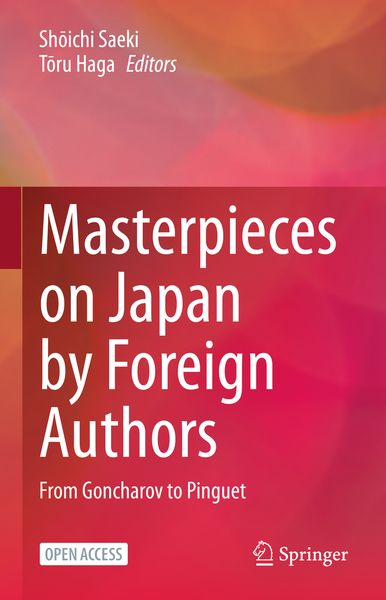
Masterpieces on Japan by Foreign Authors From Goncharov to Pinguet

48,99 €

inkl. gesetzl. MwSt., Versandkostenfrei


Beschreibung

Produktdetails

Einband

Gebundene Ausgabe

Erscheinungsdatum

24.03.2023

Herausgeber

Shōichi Saeki + weitere

Verlag

Springer Singapore

Seitenzahl

246

Maße (L/B/H)

24,1/16/2 cm

Auflage

1st ed. 2023

Originaltitel

Gaikokujin ni yoru Nihonron no Meicho - Goncharov kara Pinguet made

Übersetzt von

Takiro Terasihta

Sprache

Englisch

ISBN

978-981-19-9852-2

Beschreibung

Portrait

Shōichi Saeki

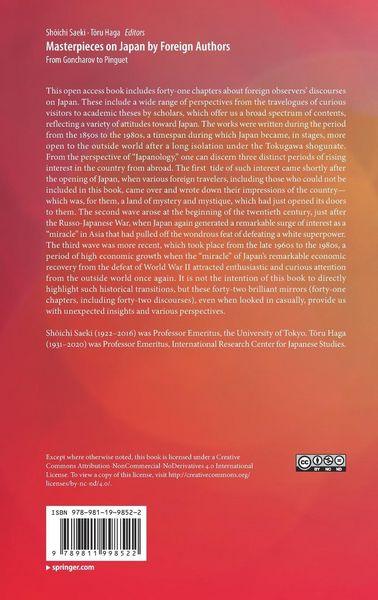
Shōichi Saeki was born on April 26, 1922 (Taishō 11) and graduated from the Department of English Literature at the University of Tokyo in 1943. He was a professor of Liberal Arts at the University of Tokyo, a professor at Chūō University, and professor emeritus at the University of Tokyo (specializing in American and Japanese literature). He died on January 1, 2016 (Heisei 28). His major works include Nihonjin no jiden (Autobiography of the Japanese) (Tokyo: Kōdansha, 1974), Monogatari geijutsu ron (Narrative Art Theory) (Tokyo: Kōdansha, 1979), winner of the Yomiuri Literature Award, and Jiden no seiki (Century of Autobiography) Tokyo: Kōdansha, 1985), awarded the Art Encouragement Prize.


Tōru Haga 

Tōru Haga was born in 1931(Showa 6), and graduated from the University of Tokyo with a B.A. in Liberal Arts and a Ph.D. in Comparative Literature and Culture.  He specialized in comparative literature and modern Japanese comparative cultural history and was president emeritus of Kyoto University of Art and Design, director of the Okazaki City Museum of Art, and director of the Shizuoka Prefectural Museum of Art. He died in 2020 (Reiwa 2).His writings include Taikun no shisetsu (Mission of the Tycoon) (Tokyo: Chūkō Shinsho, 1968); Watanabe Kazan (Tokyo: Asahi Sensho, 1974); Hiraga Gen’nai (Tokyo: Asahi Hyōdensen, 1981), awarded the Suntory Prize for Arts and Letters; Kaiga no ryōbun (The Domain of Art) (Tokyo: Asahi Shimbun, 1984), winner of the Osaragi Jirō Prize; Yosa Buson no chiisana sekai (The Little World of Yosa Buson); (Tokyo: Chūokōron Shinsha, 1984); Shiika no mori e (To Forest of Poetry) (Tokyo: Chūkō Shinsho, 2002); and Geijutsu no kuni Nippon: Gabun kōkyō (Japan—The Land of the Arts: A symphony of painting and literature) (Tokyo: Kadokawa Gakugei Shuppan, 2010).

Produktdetails

Einband

Gebundene Ausgabe

Erscheinungsdatum

24.03.2023

Herausgeber

Verlag

Springer Singapore

Seitenzahl

246

Maße (L/B/H)

24,1/16/2 cm

Auflage

1st ed. 2023

Originaltitel

Gaikokujin ni yoru Nihonron no Meicho - Goncharov kara Pinguet made

Übersetzt von

Takiro Terasihta

Sprache

Englisch

ISBN

978-981-19-9852-2

Herstelleradresse

Springer-Verlag GmbH
Tiergartenstr. 17
69121 Heidelberg
DE

Email: ProductSafety@springernature.com

Kundinnen und Kunden meinen

0 Bewertungen

Informationen zu Bewertungen

Zur Abgabe einer Bewertung ist eine Anmeldung im Konto notwendig. Die Authentizität der Bewertungen wird von uns nicht überprüft. Wir behalten uns vor, Bewertungstexte, die unseren Richtlinien widersprechen, entsprechend zu kürzen oder zu löschen.

Die Bewertungen sind nach Format, Anzahl Sterne und Datum sortiert.

Verfassen Sie die erste Bewertung zu diesem Artikel

Helfen Sie anderen Kund*innen durch Ihre Meinung

Kundinnen und Kunden meinen

0 Bewertungen filtern

  • Produktbild: Masterpieces on Japan by Foreign Authors
  • Produktbild: Masterpieces on Japan by Foreign Authors
  • Chapter 1. Ivan Aleksandrovich Goncharov, The Frigate Pallada.- Chapter 2. Sir Rutherford Alcock, The Capital of the Tycoon: A Narrative of a Three Years’ Residence in Japan.- Chapter 3. Ernest Mason Satow, A Diplomat in Japan.- Chapter 4. William Elliot Griffis, The Mikado’s Empire.- Chapter 5. Emile Etienne Guimet, Promenades Japonaises Tokio-Nikko, Félix Régamey, Japon.- Chapter 6. Huang Zunxian, Poems on Miscellaneous Subjects from Japan.- Chapter 7. Isabella Lucy Bird Bishop, Unbeaten Tracks in Japan.- Chapter 8. Percival Lowell, The Soul of the Far East.- Chapter 9. Pierre Loti, Japoneries d’automne.- Chapter 10. Basil Hall Chamberlain, Things Japanese.- Chapter 10. Lafcadio Hearn, Glimpses of Unfamiliar Japan.- Chapter 11. Lady Fraser, A Diplomatist’s Wife in Japan – Letters from Home to Home.- Chapter 12. Ludwig Riess, Allerlei aus Japan.- Chapter 13. Erwin von Bälz (Baelz), Erwin von Bälz. Das Leben eines deutschen Arztes im erwachenden Japan.- Chapter 14. Muṣṭafā Kāmil Pasha, Al-Shams al-Mushriqa (Rising Sun).- Chapter 15. Ernest Francisco Fenollosa, Epochs of Chinese and Japanese Art: An Outline History of East Asiatic Design.- Chapter 16. Edward Sylvester Morse, Japan Day by Day 1877, 1878-79, 1882-83.- Chapter 17. Rabindranath Tagore, Nationalism.- Chapter 18. Wenceslau de Moraes, Ó-Yoné e Ko-Haru.- Chapter 19. Paul Claudel, L’Oiseau noir dans le Soleil levant.- Chapter 20. Dai Jitao, Theory of Japan.- Chapter 21. Zhou Zuoren, A Personal View of Japan.- Chapter 22. Lady Sansom, Living in Tokyo.- Chapter 23. Bruno Taut, Das japanische Haus und sein Leben.- Chapter 24. Joseph Clark Grew, Ten Years in Japan: A Contemporary Record Drawn from the Diaries and Private and Official Papers of Joseph C. Grew, United States Ambassador to Japan, 1932–1942.- Chapter 25. Ruth Benedict, The Chrysanthemum and the Sword: Patterns of Japanese Culture.- Chapter 26. Leocadio de Asis, From Bataan to Tokyo, Diary of a Filipino Student in Wartime Japan 1943–1944.- Chapter 27. Reginald Horace Blyth, Haiku.- Chapter 28. Sir George Bailey Sansom, The Western World and Japan – A Study in the Interaction of European and Asiatic Culture.- Chapter 29. Ronald Philip Dore, City Life in Japan – A Study of Tokyo Ward.- Chapter 30. Donald Keene, The Japanese Discovery of Europe – Honda Toshiaki and Other Discoverers 1720 –1830.- Chapter 31. Earl Miner, The Japanese Tradition in British and American Literature.- Chapter 32. Marius B. Jansen, Sakamoto Ryoma and the Meiji Restoration.- Chapter 33. Roland Barthes, L’empire des signes.- Chapter 34. Edwin Oldfather Reischauer, The Japanese.- Chapter 35. Kim So-un, Ten no hate ni ikuru to mo (Even though I Live at the End of the Skies).- Chapter 36. Lee O-young, The Compact Culture: The Japanese tradition of “smaller is better”.- Chapter 37. Edward Seidensticker, Low City, High City – Tokyo from Edo to the Earthquake.- Chapter 38. Maurice Pinguet, La mort volontaire au Japon.