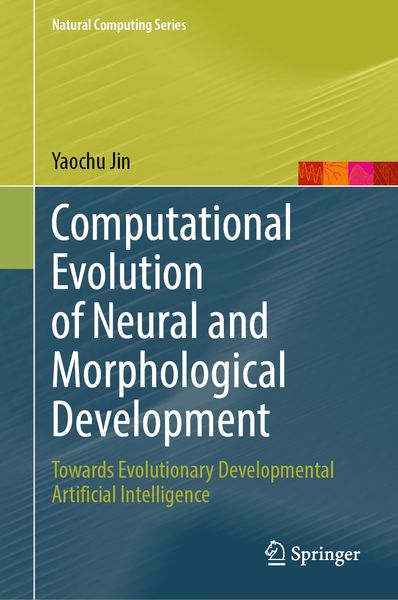
Computational Evolution of Neural and Morphological Development Towards Evolutionary Developmental Artificial Intelligence
-
- Hardcover ausgewählt
- Taschenbuch
- eBook
-
Sprache:Englisch
159,99 €
UVP
181,89 €
inkl. gesetzl. MwSt.,
Beschreibung
Produktdetails
Einband
Gebundene Ausgabe
Erscheinungsdatum
15.07.2023
Abbildungen
XI, 295 p. 164 illus., 131 illus. in color.
Verlag
Springer SingaporeSeitenzahl
295
Maße (L/B/H)
24,1/16/2,2 cm
Gewicht
685 g
Auflage
2023
Sprache
Englisch
ISBN
978-981-9918-53-9
This book provides a basic yet unified overview of theory and methodologies for evolutionary developmental systems. Based on the author’s extensive research into the synergies between various approaches to artificial intelligence including evolutionary computation, artificial neural networks, and systems biology, it also examines the inherent links between biological intelligence and artificial intelligence.
The book begins with an introduction to computational algorithms used to understand and simulate biological evolution and development, including evolutionary algorithms, gene regulatory network models, multi-cellular models for neural and morphological development, and computational models of neural plasticity. Chap. 2 discusses important properties of biological gene regulatory systems, including network motifs, network connectivity, robustness and evolvability. Going a step further, Chap. 3 presents methods for synthesizing regulatory motifs from scratch and creating more complex regulatory dynamics by combining basic regulatory motifs using evolutionary algorithms. Multi-cellular growth models, which can be used to simulate either neural or morphological development, are presented in Chapters 4 and 5. Chap. 6 examines the synergies and coupling between neural and morphological evolution and development. In turn, Chap. 7 provides preliminary yet promising examples of how evolutionary developmental systems can help in self-organized pattern generation, referred to as morphogenetic self-organization, highlighting the great potentials of evolutionary developmental systems. Finally, Chap. 8 rounds out the book, stressing the importance and promise of the evolutionary developmental approach to artificial intelligence.
Featuring a wealth of diagrams, graphs and charts to aid in comprehension, this book offers a valuable asset for graduate students, researchers and practitioners who are interested in pursuing a different approach to artificial intelligence.
Noch keine Bewertungen vorhanden
Verfassen Sie die erste Bewertung zu diesem Artikel
Helfen Sie anderen Kundinnen und Kunden durch Ihre Meinung.
Kurze Frage zu unserer Seite
Vielen Dank für Ihr Feedback
Wir nutzen Ihr Feedback, um unsere Produktseiten zu verbessern. Bitte haben Sie Verständnis, dass wir Ihnen keine Rückmeldung geben können. Falls Sie Kontakt mit uns aufnehmen möchten, können Sie sich aber gerne an unseren Kund*innenservice wenden.
zum Kundenservice