Produktbild: Satoumi Science
- 12%

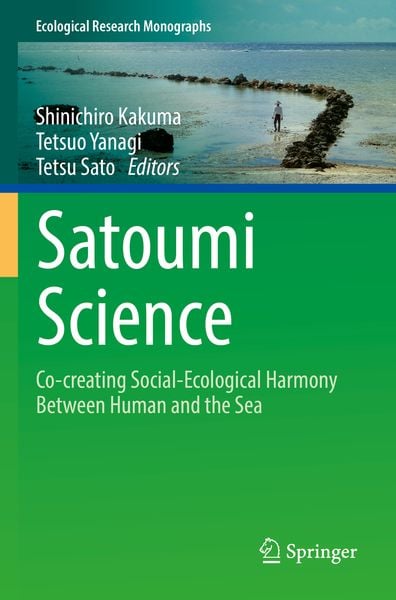
Satoumi Science Co-creating Social-Ecological Harmony Between Human and the Sea

12% sparen

159,99 € UVP 181,89 €

inkl. gesetzl. MwSt., Versandkostenfrei


Beschreibung

Produktdetails

Einband

Taschenbuch

Erscheinungsdatum

09.04.2023

Herausgeber

Shinichiro Kakuma + weitere

Verlag

Springer Singapore

Seitenzahl

272

Maße (L/B/H)

23,5/15,5/1,5 cm

Gewicht

480 g

Auflage

1st ed. 2022

Originaltitel

Satoumigaku no susume

Sprache

Englisch

ISBN

978-981-16-7493-8

Beschreibung

Portrait

Shinichiro Kakuma 

Shinichiro Kakuma had worked with Okinawa prefectural government for long as a fisheries researcher or extension officer with transdisciplinary approaches. He also studied fisheries co-management and coral reef conservation in 15 Asia-Pacific and Caribbean countries. His interest is Satoumi and marine protected areas. He started the research of Satoumi Science in the early1990s. He moved to Saga University in 2019 and continues his study on Satoumi Science. 


Tetsuo Yanagi 

Tetsuo Yanagi is a coastal oceanographer with about 500 scientific publications. He was awarded the Japan-France Oceanographic Society Award in 1986 and the Uda-Prize of Oceanographic Society of Japan in 2012. He was a member of the Scientific Steering Committee of Land-Ocean Interactions in the Coastal Zone (LOICZ) and is a member of the Scientific Planning Committee of Japan’s Environmental Management of Enclosed Coastal Seas (EMECS). He discovered the tide-induced residual current and proposed a new concept of Satoumi for integrated coastal sea management. 


Tetsu Sato  

Project leader of “Establishment of a Sustainable Community Development Model Based on Integrated Natural Resource Management Systems in Lake Malawi National Park” in JICA-JST SATREPS Program. 

Tetsu Sato studied the ecology of cichlid fishes of African lakes for 20 years, and he expanded his research into adaptive governance of complex social-ecological systems. Throughout his career, including as Conservation Director of WWF Japan and professor of Research Institute for Humanity and Nature, Kyoto, Japan, he focused on mobilizing creative and transformative processes of innovations based on knowledge co-production. He has been exploring transdisciplinary approach to co-create Integrated Local Environmental Knowledge (ILEK) as the knowledge bases for decision making and collective actions among diverse actors for societal transformations toward sustainable futures.

Produktdetails

Einband

Taschenbuch

Erscheinungsdatum

09.04.2023

Herausgeber

Verlag

Springer Singapore

Seitenzahl

272

Maße (L/B/H)

23,5/15,5/1,5 cm

Gewicht

480 g

Auflage

1st ed. 2022

Originaltitel

Satoumigaku no susume

Sprache

Englisch

ISBN

978-981-16-7493-8

Herstelleradresse

Springer-Verlag KG
Sachsenplatz 4-6
1201 Wien
AT

Email: ProductSafety@springernature.com

Kundinnen und Kunden meinen

0 Bewertungen

Informationen zu Bewertungen

Zur Abgabe einer Bewertung ist eine Anmeldung im Konto notwendig. Die Authentizität der Bewertungen wird von uns nicht überprüft. Wir behalten uns vor, Bewertungstexte, die unseren Richtlinien widersprechen, entsprechend zu kürzen oder zu löschen.

Die Bewertungen sind nach Format, Anzahl Sterne und Datum sortiert.

Verfassen Sie die erste Bewertung zu diesem Artikel

Helfen Sie anderen Kund*innen durch Ihre Meinung

Kundinnen und Kunden meinen

0 Bewertungen filtern

  • Produktbild: Satoumi Science
  • Chapter 1. Prologue: What is Satoumi?.- Chapter 2. The History and Future of Satoumi Concept.- Chapter 3.Global Effect of the Satoumi Concept – Harmony of Human Society with the Ocean Biome.- Chapter 4. Roles of Women in Satoumi .- Chapter 5. Enlivening Ecosystems with Human Hands: Building Satoumi through Coral Reef Culture.- Chapter 6. Restoring Eelgrass Beds and Culturing Oysters.- Chapter 7. Reviving Abandoned Aquaculture Ponds and Coastal Areas by Integrated Multi Tropic Aquaculture.- Chapter 8. Conserving Multiple Coral Reef Resources.- Chapter 9. Villagers Managing Lake Fisheries Resources by Themselves: Mbenji Islands in Lake Malawi.- Chapter 10. Protecting Fisheries Resources through Marine Protected Area Networks – Fiji.- Chapter 11. Connecting Local Regions and Cities through Mozuku Seaweed Farming and Coral Reef Restoration: Onna Village, Okinawa.- Chapter 12. Divers and Fishermen Working Together to Create Satoumi.- Chapter 13. Models for Implementing the Satoumi Concept via Residential Research Institute Collaborations with Citizen Scientists in the United States.- Chapter 14. Epilogue: Opening the Way to Sustainable Futures with Satoumi.