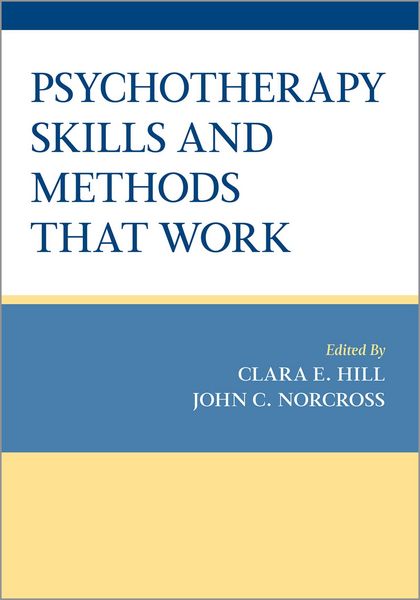
Produktbild: Psychotherapy Skills and Methods That Work

Psychotherapy Skills and Methods That Work

189,99 €

inkl. gesetzl. MwSt., Versandkostenfrei


Beschreibung

Produktdetails

Einband

Gebundene Ausgabe

Erscheinungsdatum

28.07.2023

Herausgeber

Hill Clara E. + weitere

Verlag

Oxford University Press

Seitenzahl

744

Maße (L/B/H)

26,2/19/5,5 cm

Gewicht

1383 g

Sprache

Englisch

ISBN

978-0-19-761101-2

Beschreibung

Produktdetails

Einband

Gebundene Ausgabe

Erscheinungsdatum

28.07.2023

Herausgeber

Verlag

Oxford University Press

Seitenzahl

744

Maße (L/B/H)

26,2/19/5,5 cm

Gewicht

1383 g

Sprache

Englisch

ISBN

978-0-19-761101-2

Herstelleradresse

Libri GmbH
Europaallee 1
36244 Bad Hersfeld
DE

Email: GPSR Kontakt

Noch keine Bewertungen vorhanden

Verfassen Sie die erste Bewertung zu diesem Artikel

Helfen Sie anderen Kundinnen und Kunden durch Ihre Meinung.

Kundinnen und Kunden meinen

Bewertungen (0)

Die Leseprobe wird geladen.
  • Produktbild: Psychotherapy Skills and Methods That Work
    • Preface

    • List of Contributors

    • About the Editors

    • Chapter 1: Introduction to Psychotherapy Skills and Methods that Work

    • Clara E. Hill, John C. Norcross, and the Steering Committee

    • Chapter 2: Affirmation/Validation, Self-Disclosure, Immediacy, and Rupture Repairs

    • Barry A. Farber, Clara E. Hill, Sarah Knox, Catherine F. Eubanks, J. Christopher Muran, and John C. Norcross

    • Chapter 3: Questions

    • Elizabeth Nutt Williams

    • Chapter 4: Socratic Questioning and Guided Discovery

    • James C. Overholser and Eleanor Beale

    • Chapter 5: Empathic Reflection

    • Robert Elliott, Art Bohart, Dale G. Larson, Peter Muntigl, and Olga Smoliak

    • Chapter 6: Metaphors

    • Linda M. McMullen and Dennis Tay

    • Chapter 7: Interpretations

    • Sigal Zilcha-Mano, Hadar Fisher, Tohar Dolev-Amit, John R. Keefe, and Jacques P. Barber

    • Chapter 8: Paradoxical Interventions

    • Paul R. Peluso and Robert Freund

    • Chapter 9: Advice, Suggestions, Recommendations

    • Clara E. Hill, Sarah Knox, and Changming Duan

    • Chapter 10: Integrating Between-Session Homework

    • Truls Ryum, Mia Bennion, and Nikolaos Kazantzis

    • Chapter 11: Silence

    • Heidi M. Levitt and Zenobia Morrill

    • Chapter 12: Facilitating Dyadic Synchrony

    • Dana Atzil Slonim, Christina S. Soma, Xinyao Zhang, Adar Paz, and Zac E. Imel

    • Chapter 13: Role Induction

    • Joshua K. Swift, Elizabeth A. Penix, and Ailun Li

    • Chapter 14: Collaborative Assessment Methods

    • Filippo Aschieri, Arnold A. P. van Emmerik, Carlijn Wibbelink, and Jan H. Kamphuis

    • Chapter 15: Routine Outcome Monitoring

    • Michael Barkham, Kim de Jong, Jaime Delgadillo, and Wolfgang Lutz

    • Chapter 16: Strength-Based Methods

    • Christoph Flückiger, Thomas Munder, A. C. Del Re, and Nili Solomonov

    • Chapter 17: Enhancing Emotion Regulation

    • Shigeru Iwakabe, Kaori Nakamura, and Nathan C. Thoma

    • Chapter 18: Chairwork

    • Antonio Pascual-Leone and Tabarak Baher

    • Chapter 19: Dream Work and Nightmare Treatments

    • Patricia T. Spangler and Wonjin Sim

    • Chapter 20: Mediation, Mindfulness, and Acceptance

    • Simon B. Goldberg, Christopher Anders, Shannon L. Stuart-Maver, and D. Martin Kivlighan III

    • Chapter 21: Facilitating Behavioral Activation

    • Pim Cuijpers, Eirini Karyotaki, Mathias Harrer, and Yvonne Stikkelbroek

    • Chapter 22: Cognitive Restructuring

    • Iony D. Ezawa and Steven D. Hollon

    • Chapter 23: Skills and Methods That Work in Psychotherapy: Research Results, Training Implications, Therapeutic Practices, and Task Force Conclusions

    • Clara E. Hill, John C. Norcross, and the Steering Committee

    • Index