• Produktbild: Emerging Technologies for Water Supply, Conservation and Management
  • Produktbild: Emerging Technologies for Water Supply, Conservation and Management
- 13%

Emerging Technologies for Water Supply, Conservation and Management

Aus der Reihe Springer Water
13% sparen

166,99 € UVP 192,59 €

inkl. gesetzl. MwSt., Versandkostenfrei


Beschreibung

Produktdetails

Einband

Gebundene Ausgabe

Erscheinungsdatum

26.07.2023

Abbildungen

XIV, 384 p. 99 illus., 85 illus. in color.

Herausgeber

Etikala Balaji + weitere

Verlag

Springer

Seitenzahl

384

Maße (L/B/H)

24,1/16/2,7 cm

Gewicht

764 g

Auflage

2023

Sprache

Englisch

ISBN

978-3-031-35278-2

Beschreibung

Portrait

Dr. Etikala Balaji obtained a 5-year integrated M.Sc. in Earth Sciences from the Department of Earth Sciences, Yogi Vemana University, Kadapa, Andhra Pradesh, India. He received his doctorate in Geology from the Department of Geology, Sri Venkateswara University, Tirupati, Andhra Pradesh, India. The area of his doctoral research was remote sensing, hydrogeochemistry and geochemical modeling. His current research focuses on trace metal pollution and associated health risks and artificial intelligence and machine learning algorithms for water resource management. Earlier, he worked as an academic consultant in the Department of Earth Sciences, Yogi Vemana University, Kadapa, A.P. He qualified Joint CSIR-JRF in 2014 and AP-SET in 2013 for an assistant professor/lectureship in earth, atmospheric, ocean and planetary sciences. He worked as a CSIR junior research fellow for two years and CSIR senior research fellow for another two years. He is a reviewer for various reputed journals and reviewed more than 90 articles. He has published 24 research articles, five book chapters and one book.


Dr. Golla Veeraswamy obtained his master's and doctoral degree in Geology from the Department of Geology, Sri Venkateswara University, Tirupati, Andhra Pradesh, India. The area of his doctoral research focused on remote sensing, hydrogeochemistry and geochemical modeling. His current research focuses on heavy metal analysis in water and soils and their associated health risks to humans. Earlier, he worked as an associate professor at the Annamacharya Institute of Technology and Sciences. He qualified AP-SET in 2016 for an assistant professor/lectureship in earth, atmospheric, ocean and planetary sciences. He is a reviewer for various reputed journals. He has published 32 research articles, five book chapters and one book.


Dr. Mannala Prasad is presently working as an assistant professor in the Department of Geology, Central Tribal University of Andhra Pradesh, Vizianagaram, Andhra Pradesh, India. Before joining CTUAP, he worked as an academic consultant in the Department of Earth Sciences, Yogi Vemana University, Kadapa, A.P. He is the recipient of INSPIRE JRF and SRF by the Dept. of Science and Technology (DST), New Delhi. He secured first rank with distinction (CGPA 8.29) in M.Sc. in Geology and Geo-informatics and received a doctoral degree in Earth Sciences from Yogi Vemana University Kadapa, Andhra Pradesh. He qualified Joint CSIR-UGC JRF cum NET in 2012 and AP-SET in 2021 for an assistant professor/ lectureship in earth, atmospheric, ocean and planetary sciences. He has published 20 research articles, five book chapters and one book. He is a reviewer for international and nationally reputed journals.


Dr. Sughosh Madhav is presently working as Dr. D.S. Kothari postdoctoral fellow at the Department of Civil Engineering, Jamia Millia Islamia, New Delhi, India. Earlier, he worked as a CSIR research associate. He obtainedhis master's degree from the Department of Environmental Sciences, Banaras Hindu University, Varanasi, India. He earned his doctorate from Jawaharlal Nehru University, New Delhi. The area of his doctoral research was the impact of textile effluents on soil and water quality and associated health hazards. He qualified UGC JRF in 2011 and ICAR NET in 2016. He has published more than fifteen research papers and five book chapters in environmental geochemistry, water pollution, soil contamination, wastewater treatment, and climate change. He is a reviewer for international and nationally reputed journals. He also edited five books in various reputed publications.
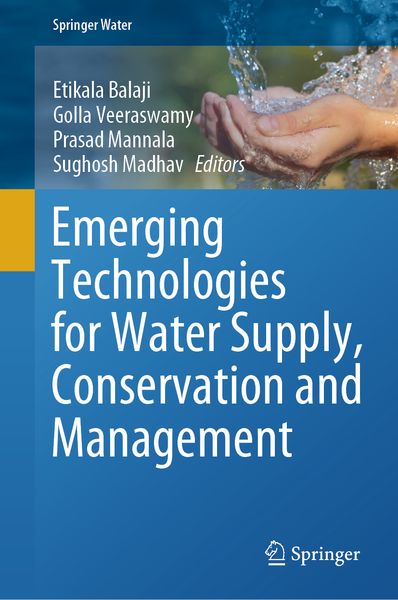
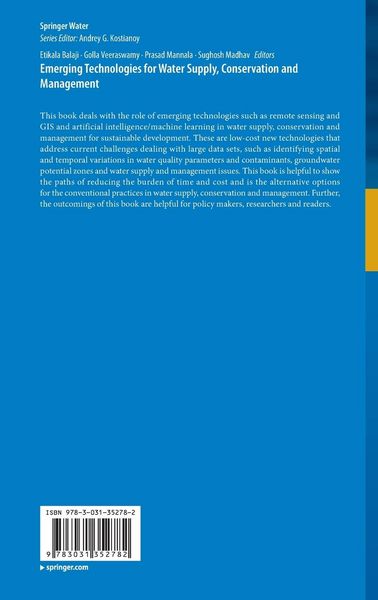
Produktdetails

Einband

Gebundene Ausgabe

Erscheinungsdatum

26.07.2023

Abbildungen

XIV, 384 p. 99 illus., 85 illus. in color.

Herausgeber

Verlag

Springer

Seitenzahl

384

Maße (L/B/H)

24,1/16/2,7 cm

Gewicht

764 g

Auflage

2023

Sprache

Englisch

ISBN

978-3-031-35278-2

Herstelleradresse

Springer-Verlag KG
Sachsenplatz 4-6
1201 Wien
AT

Email: ProductSafety@springernature.com

Noch keine Bewertungen vorhanden

Verfassen Sie die erste Bewertung zu diesem Artikel

Helfen Sie anderen Kundinnen und Kunden durch Ihre Meinung.

Kundinnen und Kunden meinen

Bewertungen (0)

  • Produktbild: Emerging Technologies for Water Supply, Conservation and Management
  • Produktbild: Emerging Technologies for Water Supply, Conservation and Management
  • Assessment of Water Consumers Literacy.- Machine learning applications in sustainable water resource management: A systematic review.- Remote Sensing and Machine Learning Applications for the Assessment of Urban Water Stress: A Review.- Role of Artificial Intelligence in Water Conservation with special reference to India.- Remote sensing and GIS based techniques for monitoring and conserving water on newly developed farmlands.- A Comprehensive Review on Mapping of Groundwater Potential Zones: Past, present and future recommendations.-  Geographic Information System and Remote Sensing in deciphering groundwater potential zones.- Remote Sensing & GIS based monitoring and management of coastal aquifers and ecosystem.- Hydrogeomorphological mapping of groundwater potential zones using multi-influence factor (MIF) and GIS techniques: A case study of Vishav watershed, western Himalayas.- GIS-based disaster risk analysis of floods using certainty factor (CF) and its ensemble with deep learning neural network (DLNN): A case study of Dima Hasao district of Assam.- Geospatial and Analytical Hierarchical Techniques to assess the groundwater potential areas in Kanyakumari district, Tamil Nadu.- Application of Remote Sensing and GIS in Mapping Groundwater Potential Zones through Fuzzy Integration in Kodavanar Watershed, A part of Amaravathi Basin, Tamil Nadu.- Morphometric analysis using geospatial techniques in the Pandameru River Basin, Anantapur District, Andhra Pradesh, India.- Ground Water Quality assessment using Water Quality Index and Geographical Information System of Mogamureru River Basin, Y.S.R. District, A.P., India.- Using Geo-spatial Technologies for Land and Water Resource Development Planning: A Case Study of Tirora Tehsil, India.- Delineation of Seawater Intrusion into freshwater aquifers by using VES & GIS in the Kakinada Region, East Godavari District, Andhra Pradesh,India.- . Systematic approach of groundwater resources assessment using remote sensing and multi-influence factor (MIF) techniques in Medchal Mandal, Telangana State, India.- Remote sensing snd GIS Application for Rainwater Harvesting and Groundwater Recharge to Secure Sustainable Groundwater Future of Adikavi Nannaya University, Rajamahendravaram, India.