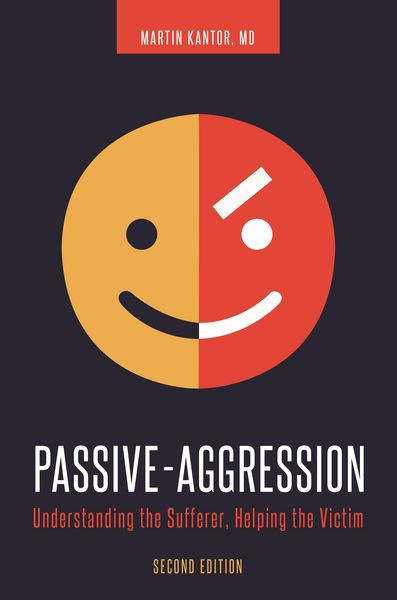
Passive-Aggression Understanding the Sufferer, Helping the Victim
-
Form:Einzelkauf Download
-
Sprache:Englisch
-
eBook Format:ePUB
- PDF 55,99 €
- ePUB 55,99 € ausgewählt
55,99 €
inkl. gesetzl. MwSt.Beschreibung
Produktdetails
Format
ePUB
Kopierschutz
Ja
Family Sharing
Nein
Text-to-Speech
Ja
Altersempfehlung
ab 7 Jahr(e)
Erscheinungsdatum
03.10.2017
Verlag
Bloomsbury eBooks USSeitenzahl
296 (Printausgabe)
Auflage
2. Auflage
Sprache
Englisch
EAN
9798216126997
Passive Aggressive Personality Disorder (PAPD) is now recognized as a distinct personality disorder. Those who suffer from PAPD are sorely in need not only of diagnostic recognition, but also of specific therapeutic intervention. This new book from Martin Kantor speaks to therapists; guides those who interact with passive-aggressive individuals to advance their own effective coping methods based on science, understanding, and compassion; and directly addresses passive-aggressive individuals themselves.
Contrary to what is implied in the American Psychiatric Association's Diagnostic and Statistical Manual of Mental Disorders, Fifth Edition (DSM-5), and what some practitioners have believed in recent years, new thinking points to passive-aggression being a full disorder. A counterrevolution is now occurring, with some of the most centrist of authors participating in a concerted drive to bring back the diagnosis as being one of the fundamental personality disorders-indeed, a disorder that describes individuals with a distinctly troublesome personality. In this new book, Martin Kantor-a Harvard-trained psychiatrist and noted author of numerous medical texts-takes a new look at passive-aggression and passive-aggressive personality disorder (PAPD) that precisely and scientifically defines it in terms of description, causality, and therapeutic intervention, all based on recent theoretical findings.
Kantor makes a powerful argument that passive-aggression can only be reliably identified by answering three fundamental questions, the answers to which define the disorder: why these patients get so angry; why these patients cannot express their anger directly; and what anger styles they employ to express their aggressions. His examination of passive-aggression, which involves two people enmeshed with each other, logically takes two distinct points of view: that of the passive-aggressive individual, and that of his or her "victim" or "target." Specific clinical observation is presented to clarify theory. The book explains how passive-aggression can develop into a complex dyadic interaction in which it is difficult to determine who is doing what to whom, who started it, and what path to take to deescalate; and how using mutual understanding and healthy empathy plus compassion can preclude getting involved in sadomasochistic mutual provocation. The author also suggests ways for those who suffer from passive-aggression to be less hypersensitive, and to express what hypersensitivity they can't help feeling more directly, rather than via the various unhealthy anger styles that constitute the passive-aggressive modus operandi.
Contrary to what is implied in the American Psychiatric Association's Diagnostic and Statistical Manual of Mental Disorders, Fifth Edition (DSM-5), and what some practitioners have believed in recent years, new thinking points to passive-aggression being a full disorder. A counterrevolution is now occurring, with some of the most centrist of authors participating in a concerted drive to bring back the diagnosis as being one of the fundamental personality disorders-indeed, a disorder that describes individuals with a distinctly troublesome personality. In this new book, Martin Kantor-a Harvard-trained psychiatrist and noted author of numerous medical texts-takes a new look at passive-aggression and passive-aggressive personality disorder (PAPD) that precisely and scientifically defines it in terms of description, causality, and therapeutic intervention, all based on recent theoretical findings.
Kantor makes a powerful argument that passive-aggression can only be reliably identified by answering three fundamental questions, the answers to which define the disorder: why these patients get so angry; why these patients cannot express their anger directly; and what anger styles they employ to express their aggressions. His examination of passive-aggression, which involves two people enmeshed with each other, logically takes two distinct points of view: that of the passive-aggressive individual, and that of his or her "victim" or "target." Specific clinical observation is presented to clarify theory. The book explains how passive-aggression can develop into a complex dyadic interaction in which it is difficult to determine who is doing what to whom, who started it, and what path to take to deescalate; and how using mutual understanding and healthy empathy plus compassion can preclude getting involved in sadomasochistic mutual provocation. The author also suggests ways for those who suffer from passive-aggression to be less hypersensitive, and to express what hypersensitivity they can't help feeling more directly, rather than via the various unhealthy anger styles that constitute the passive-aggressive modus operandi.
Noch keine Bewertungen vorhanden
Verfassen Sie die erste Bewertung zu diesem Artikel
Helfen Sie anderen Kundinnen und Kunden durch Ihre Meinung.
Kurze Frage zu unserer Seite
Vielen Dank für Ihr Feedback
Wir nutzen Ihr Feedback, um unsere Produktseiten zu verbessern. Bitte haben Sie Verständnis, dass wir Ihnen keine Rückmeldung geben können. Falls Sie Kontakt mit uns aufnehmen möchten, können Sie sich aber gerne an unseren Kund*innenservice wenden.
zum Kundenservice