
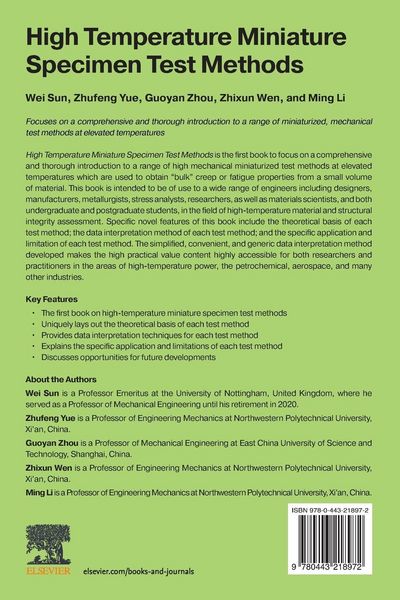
• Produktbild: High Temperature Miniature Specimen Test Methods
  • Produktbild: High Temperature Miniature Specimen Test Methods
- 18%

High Temperature Miniature Specimen Test Methods

18% sparen

147,99 € UVP 182,50 €

inkl. gesetzl. MwSt., Versandkostenfrei


Beschreibung

Produktdetails

Einband

Taschenbuch

Erscheinungsdatum

27.10.2023

Verlag

Elsevier Science & Technology

Seitenzahl

286

Maße (L/B/H)

15,3/23/1,9 cm

Gewicht

470 g

Sprache

Englisch

ISBN

978-0-443-21897-2

Beschreibung

Produktdetails

Einband

Taschenbuch

Erscheinungsdatum

27.10.2023

Verlag

Elsevier Science & Technology

Seitenzahl

286

Maße (L/B/H)

15,3/23/1,9 cm

Gewicht

470 g

Sprache

Englisch

ISBN

978-0-443-21897-2

Herstelleradresse

Libri GmbH
Europaallee 1
36244 Bad Hersfeld
DE

Email: gpsr@libri.de

Noch keine Bewertungen vorhanden

Verfassen Sie die erste Bewertung zu diesem Artikel

Helfen Sie anderen Kundinnen und Kunden durch Ihre Meinung.

Kundinnen und Kunden meinen

Bewertungen (0)

Die Leseprobe wird geladen.
  • Produktbild: High Temperature Miniature Specimen Test Methods
  • Produktbild: High Temperature Miniature Specimen Test Methods
  • 1. Outlines test types and data processing used to estimate the material constants
    2. The most popular small punch test method, i.e. the small punch test
    3. Introduces the impression creep test method using a rectangular indenter
    4. Theoretical methods for data interpretation and typical test data are described
    5. These include the miniature ring creep test methods
    6. The miniature bar-type creep test method
    7. Miniature bending creep tests
    8. The more recently developed miniature thin-plate test creep and low cycle fatigue test methods 
    9. A specific topic related to the data interpretation is addressed in this chapter, in which the concept of the Equivalent Gauge Length (EGL) is introduced
    10. The determination of material properties from the miniature specimen
    11. Focuses on a specific application field on structural assessment of aero-engine gas turbine blades, where the assessment of anisotropy and lifing of service-aged gas turbine blades made of single-crystal nickel-based superalloy is particularly discussed
    12. Briefly addresses several requirements for the future development of the miniaturized specimen test method, which is related to material property characterization, component assessment, size effect and multi-scale modelling, as well as standardization