• Produktbild: Cognitive Sciences and Education in Non-WEIRD Populations
  • Produktbild: Cognitive Sciences and Education in Non-WEIRD Populations
- 13%

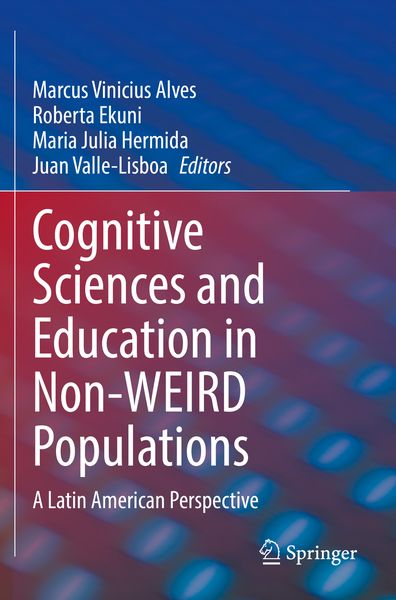
Cognitive Sciences and Education in Non-WEIRD Populations A Latin American Perspective

13% sparen

92,99 € UVP 106,99 €

inkl. gesetzl. MwSt., Versandkostenfrei


Beschreibung

Produktdetails

Einband

Taschenbuch

Erscheinungsdatum

29.08.2023

Abbildungen

XXV, 367 p. 38 illus., 31 illus. in color.

Herausgeber

Marcus Vinicius Alves + weitere

Verlag

Springer

Seitenzahl

367

Maße (L/B/H)

23,5/15,5/2,2 cm

Gewicht

598 g

Auflage

23001 Auflage 1st ed. 2022

Sprache

Englisch

ISBN

978-3-031-06910-9

Beschreibung

Portrait

Marcus Vinicius Alves
  holds a PhD in psychobiology from Universidade Federal de São Paulo (Brazil) and has experience as a visiting researcher at Memorial University of Newfoundland (Canada) and as a research and development specialist at Université du Luxembourg (Luxembourg). At present, he is a full professor at Faculty of Technology and Sciences in Salvador, Brazil, and also the lead researcher of the Sociocognitive Neuropsychology Laboratory (LINES), registered at the National Council for Scientific and Technological Development (CNPQ). Alves’ research interests include learning, memory, incidental and motivated forgetting, mental effort (processing systems, attention, and cognitive load theory), and social cognition, using mostly eye tracking and pupillometry.

Roberta Ekuni
is an Adjunct Professor at Universidade Estadual do Norte do Paraná - Graduate Program in Education. She has a PhD at Universidade Federal de São Paulo (Brazil), and she was a visitor student at Washington University in St. Louis. Also, she is one of the editors of “Neuromyth’s Busters” book collection. She has interest in research that applies cognitive psychology to education, especially involving retrieval practice to improve student’s memory.

Maria Julia Hermida
is an Adjunct Professor at the Universidad Nacional de Hurlingham and researcher at the National Council of Scientific and Technical Research, in Argentina. She has received a PhD in Psychology from the Universidad Nacional de San Luis, Argentina. For more than ten years she has been studying child cognitive development, how it is affected by poverty and which interventions can help to prevent the negative cognitive consequences of poverty. Specifically, she has conducted different interventions combining cognitive neuroscience and educational approaches in diverse scholar contexts.

Juan Valle Lisboa
is an Aggregate Professor of Biophysics and Neuroscience at Universidad de la República (UDELAR), sharing his time between the Schools of Science and Psychology. He has received a PhD in Biology and a Master in Biophysics from the PEDECIBA-UDELAR program. His main research interests are the study of learning and cognition, and the application of digital technologies to enhance Education. In particular in the last few years he has directed projects aimed at measuring math and reading abilities as well as neuropsychological predictors of reading with the use of digital devices like tablets and cell phones. He is also interested in basic aspects of language processing, lexical representation and linguistic composition, and the use of neural network models to describe these processes.

Produktdetails

Einband

Taschenbuch

Erscheinungsdatum

29.08.2023

Abbildungen

XXV, 367 p. 38 illus., 31 illus. in color.

Herausgeber

Verlag

Springer

Seitenzahl

367

Maße (L/B/H)

23,5/15,5/2,2 cm

Gewicht

598 g

Auflage

23001 Auflage 1st ed. 2022

Sprache

Englisch

ISBN

978-3-031-06910-9

Herstelleradresse

Springer-Verlag KG
Sachsenplatz 4-6
1201 Wien
AT

Email: GPSR Kontakt

Noch keine Bewertungen vorhanden

Verfassen Sie die erste Bewertung zu diesem Artikel

Helfen Sie anderen Kundinnen und Kunden durch Ihre Meinung.

Kundinnen und Kunden meinen

Bewertungen (0)

  • Produktbild: Cognitive Sciences and Education in Non-WEIRD Populations
  • Produktbild: Cognitive Sciences and Education in Non-WEIRD Populations
  • Part I – Cognitive Sciences and Education: Theories, Beliefs and Misconceptions.- 1. The importance of bringing the Latin American perspective to cognitive science and education.- 2. Neuroscience and Vygotsky: putting together contemporary evidence and Cultural-Historical Psychology.- 3. Dialogue with Latin American teachers - beliefs about neuroscience and education.- Part II – Factors influencing child and adolescent development.- 4. Attention and academic performance: from early childhood to adolescence.- 5. Child cognitive development in Latin American rural poverty: what do researchers should consider for conducting fieldwork.- 6. Concepts, language, and early socialization in indigenous Wichi perspective: towards a Relational-Ecological Paradigm.- 7. The role of local violence on children’s affective decision-making.- 8. The role of peer pressure in adolescents’ risky behaviors .- 9. The implications of exposure to neurotoxic metals for cognitive development of children and adolescents.- Part III – Academic performance.- 10. Bilingualism, foreign language learning, and cognition: Insights for education.- 11. Development of mathematical cognition: the role of technology in low SES populations.- 12. Number processing and low arithmetic achievement in Cuban and Chilean children: from neurocognitive theories to educational practice.- 13. The perfect hurricane in Latin America: school start time, chronotype, sleep, and academic performance during adolescence.- 14. Stereotype threat and professional motivation: Assessing career expectations of undergraduate and graduate female students.- Part IV – Educational practices and interventions.- 15. Retrieval practice as a learning strategy for diverse populations.- 16. Consideration of individual differences in cognitive interventions for children at risk for poverty.- 17. Technology on our side: using technology for transferring Cognitive Science to Education.- 18. Early language intervention in school settings: what works for whom?.- 19. Developing higher order thinking in elementary school science: A narrative around a research group quest.- Part V – Future perspectives.- 20. Latin American perspectives in the study of childhood and adolescence poverty through the lenses of neural sciences.