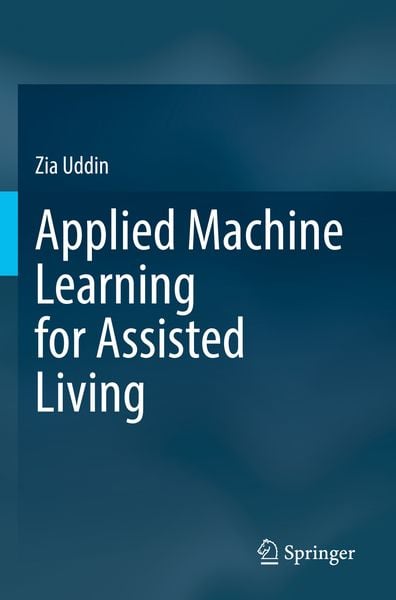
Applied Machine Learning for Assisted Living
-
- Hardcover
- Taschenbuch ausgewählt
- eBook
-
Sprache:Englisch
146,99 €
inkl. gesetzl. MwSt.,
Beschreibung
Produktdetails
Einband
Taschenbuch
Erscheinungsdatum
31.08.2023
Verlag
SpringerSeitenzahl
131
Maße (L/B/H)
23,5/15,5/0,9 cm
Gewicht
230 g
Auflage
1st ed. 2022
Sprache
Englisch
ISBN
978-3-031-11536-3
User care at home is a matter of great concern since unforeseen circumstances might occur that affect people's well-being. Technologies that assist people in independent living are essential for enhancing care in a cost-effective and reliable manner. Assisted care applications often demand real-time observation of the environment and the resident’s activities using an event-driven system. As an emerging area of research and development, it is necessary to explore the approaches of the user care system in the literature to identify current practices for future research directions.
Therefore, this book is aimed at a comprehensive review of data sources (e.g., sensors) with machine learning for various smart user care systems. To encourage the readers in the field, insights of practical essence of different machine learning algorithms with sensor data (e.g., publicly available datasets) are also discussed. Some code segments are also included to motivate the researchers ofthe related fields to practically implement the features and machine learning techniques. It is an effort to obtain knowledge of different types of sensor-based user monitoring technologies in-home environments. With the aim of adopting these technologies, research works, and their outcomes are reported. Besides, up to date references are included for the user monitoring technologies with the aim of facilitating independent living.
Research that is related to the use of user monitoring technologies in assisted living is very widespread, but it is still consists mostly of limited-scale studies. Hence, user monitoring technology is a very promising field, especially for long-term care. However, monitoring of the users for smart assisted technologies should be taken to the next level with more detailed studies that evaluate and demonstrate their potential to contribute to prolonging the independent living of people. The target of this book is to contribute towards that direction.
Noch keine Bewertungen vorhanden
Verfassen Sie die erste Bewertung zu diesem Artikel
Helfen Sie anderen Kundinnen und Kunden durch Ihre Meinung.
Kurze Frage zu unserer Seite
Vielen Dank für Ihr Feedback
Wir nutzen Ihr Feedback, um unsere Produktseiten zu verbessern. Bitte haben Sie Verständnis, dass wir Ihnen keine Rückmeldung geben können. Falls Sie Kontakt mit uns aufnehmen möchten, können Sie sich aber gerne an unseren Kund*innenservice wenden.
zum Kundenservice